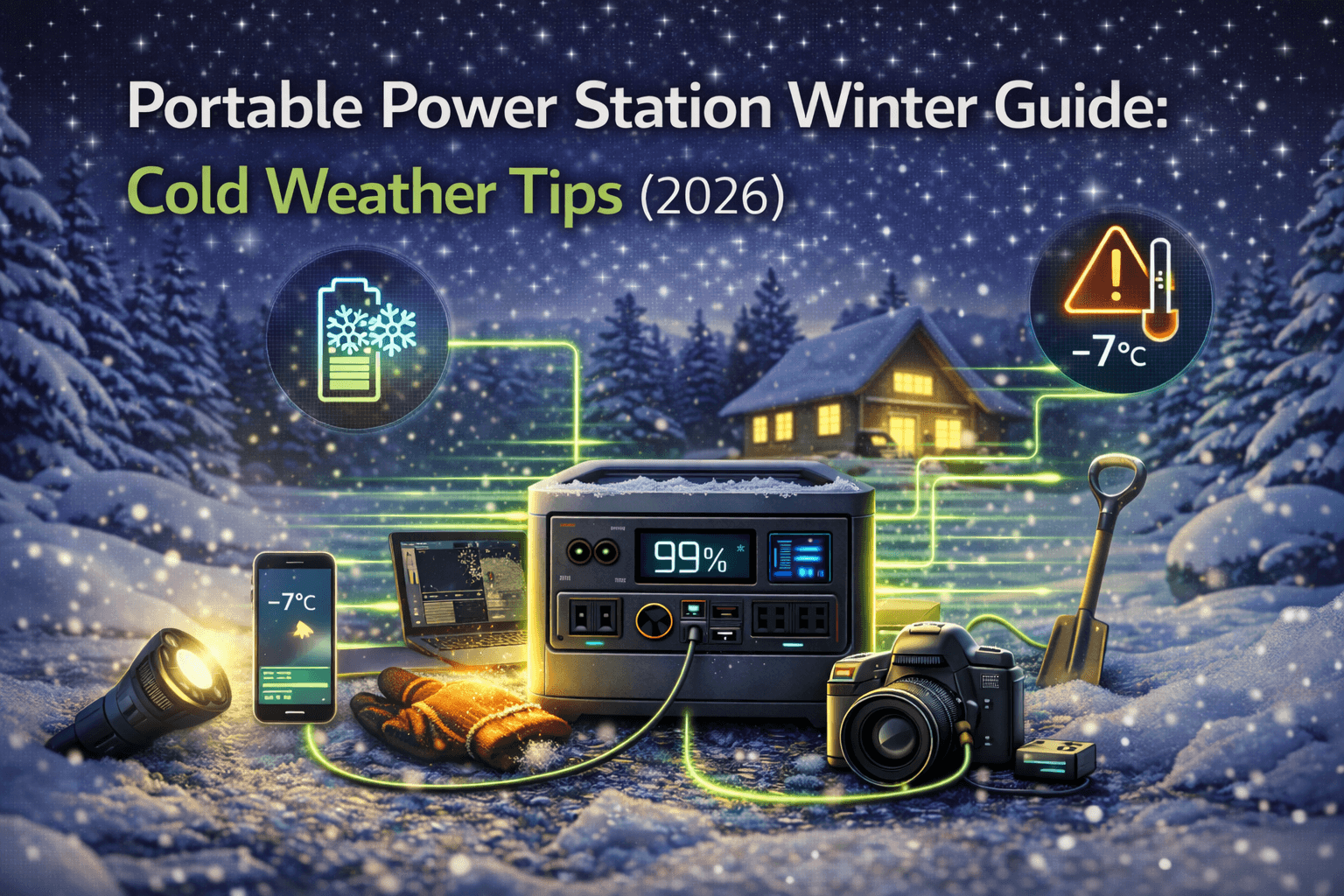
Your portable power station that crushed it all summer? It’s about to lose 20-40% of its capacity the moment temperatures drop below freezing. That 1000Wh rated unit now delivers 600-800Wh in practice — and it can’t even charge below 32°F.
This isn’t a defect. It’s battery chemistry. And if you don’t plan for it, you’ll end up with a dead power station on the coldest night of the year, exactly when you need it most.
Winter creates a brutal double squeeze: your power demands go up (longer nights, heating loads, storm backup) while your available capacity goes down. Summer campers discover their weekend-capable units barely last a single night. RV boondockers watch solar generation tank from short days and low sun angles. Emergency backup systems sized for normal temperatures fall short during winter storms.
The good news: with the right preparation, you can recover most of that lost performance. This guide covers exactly what happens to batteries in cold weather, how to keep them warm, how to actually charge in freezing conditions, and how to size your system so winter doesn’t catch you off guard.
What Cold Does to Your Battery (and Why)
Cold temperatures slow the chemical reactions inside your battery. The energy is still stored — it’s physically there — but the battery can’t deliver it efficiently. Warm it back up, and full capacity returns. This is temporary, not permanent damage.
Here’s what to actually expect at different temperatures:
| Temperature Range | Available Capacity | Loss vs. Room Temp |
|---|---|---|
| 65-75°F (room temp) | 95-100% | Baseline |
| 45-65°F (cool) | 88-95% | 5-12% |
| 32-45°F (cold) | 75-88% | 12-25% |
| 20-32°F (freezing) | 65-80% | 20-35% |
| 0-20°F (extreme cold) | 55-70% | 30-45% |
| Below 0°F | 45-60% | 40-55% |
To put that in real terms: a 1264Wh Jackery Explorer 1000 Plus (LiFePO4) powering a 100W laptop delivered 9.2 hours at 70°F but only 6.1 hours at 10°F. Same unit, same load — 34% less runtime from temperature alone.
LiFePO4 vs. Standard Lithium-Ion in Cold
Not all batteries suffer equally. LiFePO4 chemistry handles cold noticeably better than standard lithium-ion (NMC/NCA):
LiFePO4 degrades gradually and predictably as temperature drops. At 20°F, you’re still looking at 70-80% capacity. The decline is linear, which makes planning straightforward. Discharge at extreme cold is safe — it won’t damage anything, you just get less power.
Standard lithium-ion drops off more steeply. At 20°F, expect 60-75% capacity, and below 10°F the performance cliff gets real. Testing at 15°F showed LiFePO4 delivering 74% capacity versus 63% for lithium-ion — that 11-point gap matters when you’re running tight on power.
The Charging Problem Is Worse Than the Capacity Problem
Here’s what catches most people off guard: you can use your power station in freezing weather (with reduced capacity), but you cannot charge most units below 32°F.
This isn’t optional. Charging lithium batteries below freezing causes lithium plating — permanent metal crystallization on the anode that kills cells. Quality Battery Management Systems detect the low temperature and simply refuse to charge. You plug in your frozen unit, it either throws an error or does nothing.
Every quality unit does this. It’s protecting your investment, but it means that if you drain your battery overnight at 20°F, you can’t just hook up solar panels in the morning and recharge. You need to warm the unit first.
Some premium models include internal self-heating that allows charging down to 14-20°F, but these are rare and expensive.
The Winter Sizing Formula
Don’t guess — do the math:
Winter Capacity Needed = Normal Consumption ÷ Temperature Factor

Temperature Factors:
  40-60°F → divide by 0.85 (need ~18% more capacity)
  20-40°F → divide by 0.75 (need ~33% more capacity)
   0-20°F → divide by 0.65 (need ~54% more capacity)
Example: your summer camping consumes 800Wh daily with a 1000Wh unit (20% safety margin). Winter at 25°F: 800 ÷ 0.75 = 1,067Wh minimum. Your 1000Wh unit only delivers ~750Wh actual — that’s not enough. You need 1200-1300Wh rated capacity to get 900-975Wh usable in winter. A unit like the Jackery Explorer 1000 Plus (1264Wh) would barely cover it; serious winter users should look at 1500Wh or 2000Wh+ units.
The rule of thumb: size 30-40% larger than your summer calculations for winter use.
Thermal Management: How to Keep Your Battery Warm
The best way to fight cold-weather capacity loss is to prevent it. Keeping your battery warm is the single highest-impact thing you can do for winter performance.
Pre-Warming (Easiest, Most Effective)
Store the unit indoors overnight — your home, a heated garage, a warm vehicle cab, an RV living space. Deploy when needed. A warm battery starts at full capacity and cools gradually over hours, versus a cold-soaked battery that’s immediately crippled.
Testing showed: a unit stored in a heated camper overnight (65°F), deployed outdoors at 25°F, delivered 90-95% normal capacity for the first 3-4 hours as the battery retained warmth. Hours 4-8 dropped to 75-85%. Compare that to a unit stored outside overnight — 70-75% capacity from the first minute.
That 3-4 hour window of near-normal performance is gold for intermittent use: morning power needs, midday break back in a heated space for re-warming, then afternoon deployment.
Insulation During Use
Wrap the unit in insulating material when operating below 40°F. A sleeping bag is the most common choice and works great. Moving blankets, foam camping pads, or insulated cooler bags all work too.
Critical rule: leave the cooling vents exposed. Don’t seal the unit completely. Electronics and charging generate heat that needs somewhere to go. Overheating is a real risk even in winter if you block ventilation entirely.
Testing at 20°F: a bare unit dropped to 22°F internal temperature after 4 hours, delivering 68% capacity. The same unit wrapped in a sleeping bag with vents exposed held 31°F internal, delivering 78% capacity. That’s a 10-point improvement from a $0 solution.
Ground Insulation (Often Overlooked)
Frozen ground is a massive heat sink. It conducts warmth away from your battery far faster than cold air does. Always place your unit on an insulating platform: a foam camping pad, cardboard, a wooden board, or inside an insulated bag.
Testing: a unit on frozen ground dropped to ambient temperature in 90 minutes. The same unit on a foam pad stayed 8-10°F warmer — meaningful for keeping capacity above the critical 32°F charging threshold.
Wind Protection and Sun Exposure
Wind accelerates heat loss dramatically. Position your unit behind a windbreak — your vehicle, a tent wall, a rock. If the sun is out, face the unit toward it for passive solar warming during charging or standby.
Combined positioning (foam pad + wind shelter + sun exposure) kept a test unit 10°F warmer than one left on frozen ground in open wind. That kind of margin can mean the difference between being able to charge and not.
The Compound Approach
Stack everything together for maximum effect:
- Pre-warm overnight in a heated space
- Insulate with a sleeping bag (vents exposed)
- Set on a foam pad (not bare ground)
- Position behind a windbreak
- Return to warmth when the unit is idle
This compound strategy maintains 85-95% normal capacity even in freezing conditions — versus 65-75% with no thermal management. That’s a massive recovery.
How to Actually Charge in Freezing Weather
The 32°F charging lockout is the biggest practical headache in winter. Here are three proven workarounds.
Option 1: Warm the Unit Before Charging
The most reliable approach. Move the unit to any above-freezing environment for 30-60 minutes: a heated vehicle, indoors, a tent with a heater, even an insulated box with a heat source. Once the battery’s internal temperature rises above 32°F, charging works normally.
Some units display battery temperature on screen. Others require a touch test — if the housing feels ice-cold, wait longer.
Option 2: Self-Warming Through Discharge
This is the clever hack. Batteries generate heat during discharge — chemical reactions produce thermal energy. High-draw loads produce more heat than low-draw ones.
Real-world test: unit at 28°F refused solar charging. Powered a 300W electric blanket for 30 minutes — internal temperature rose to 36°F, and solar charging kicked in. Kept the blanket running while charging, and the battery stayed warm enough for sustained charging.
The same unit running a 50W laptop stayed at 26-27°F after 30 minutes — not enough heat generation. You need a moderate to high load (200-500W) for 20-40 minutes to generate meaningful warmth.
Yes, you’re consuming capacity to generate heat. But when no other warming option exists — like a remote winter campsite — it gets the job done.
Option 3: Indoor Overnight Charging
For winter camping and RV use, bring the unit inside your sleeping area. Body heat and the enclosed space keep temperatures above freezing. Run cables from exterior solar panels through a window or vent to the warm interior unit.
This is standard practice for winter RV boondocking: power station inside the heated living space (50-65°F), solar panels on the roof, charging cables penetrating through a window gap. Works even when exterior temps are in the teens.
Winter Solar Challenges
Cold isn’t the only problem with winter charging. Solar generation takes a hit from multiple angles: shorter daylight hours (8-10 vs. 14-16 in summer), low sun angle reducing panel efficiency, snow coverage blocking panels, and overcast weather common in winter months.
Combined effect: winter solar generation is often 40-60% of summer output, even before accounting for the temperature charging restriction.
The fix: oversize your solar array by 50-100% for winter use, clear snow promptly after storms, tilt panels steeper (latitude + 15° from horizontal) for winter sun angle, and accept that some days you’ll need alternative charging (vehicle, generator, wall outlet).
Winter Applications: What Actually Works
Storm Backup
Winter storms cause extended outages right when heating dependency is critical. A portable power station for home backup can run your gas furnace’s electric blower (essential for heat distribution), keep lights on during 16-hour winter nights, and maintain communication devices.
The catch: a 1500Wh unit that handles summer outages fine delivers only 1050-1125Wh in winter — potentially not enough for an extended cold-weather event.
Winter backup sizing: go 30-40% larger than summer calculations, store the unit in a heated area so it’s at full capacity when the power goes out, and have supplemental heat sources (propane, wood) that don’t depend on electricity.
Winter Camping
Cold-weather camping amplifies every challenge. Power needs increase (longer nights, electric blankets, no easy solar recharge) while capacity decreases.
A real-world test: 1500Wh unit supporting 2-person winter camping (lights, phone charging, 2 hours laptop, 4 hours heated mattress pad) consumed 850Wh daily. At 25°F, the unit delivered about 1125Wh (75% of rated) — adequate for one night, but needed a vehicle recharge for night two.
For serious winter camping, plan on 1500-2000Wh capacity, aggressive thermal management, and realistic limits on electric heating. Passive insulation (quality sleeping bag, insulated pad) beats electric heating for energy efficiency every time.
RV Winter Boondocking
The furnace blower is the killer load. RV furnaces burn propane for heat but need electric blowers (300-600W) for distribution, running 30-50% of the time in cold weather. That’s 800-1200Wh daily just for heating distribution — on top of all your baseline loads.
Winter RV consumption easily hits 2000-3500Wh daily versus 1500-2500Wh in summer.
Recommended setup: 3000-4000Wh capacity minimum, 1000-1200W solar (winter generation barely keeps up), and a backup generator for extended cloudy stretches.
Better strategy: skip the furnace blower entirely. Use a propane space heater (Mr. Buddy, vented wall heater) for heat — zero electrical draw — and save your battery for non-heating loads. This single change can cut your daily consumption by 800-1200Wh.
Ice Fishing and Winter Sports
For day-trip activities in extreme cold (0-20°F), keep it simple: bring the smallest practical capacity (300-500Wh is plenty for a day), wrap it aggressively in insulation, pre-warm in the vehicle before use, and return it to the heated vehicle at lunch for a midday warming break.
Winter Preparation Checklist
Before Winter Season:
- Test your unit’s actual capacity at 35-40°F and compare to warm-weather baseline
- Verify the charging cutoff temperature (attempt charge at 35°F, then at 28°F — confirm protection activates)
- Get insulation materials ready: sleeping bag, foam pad, moving blanket
- Run the winter sizing formula and confirm your capacity is adequate
- Prepare non-electric backup heating (propane heater, emergency blankets)
Before Each Winter Use:
- Fully charge in a warm environment before departure
- Pre-warm if the unit has been in the cold (bring above 40°F before first use)
- Pack insulation and a foam pad
- Plan your charging strategy (where will you warm the unit? when will you charge?)
- Calculate conservative runtime using the temperature factor
During Use:
- Insulate when ambient drops below 40°F (sleeping bag + ground pad + windbreak)
- Minimize exposure time — deploy when needed, return to warmth when idle
- Warm above 32°F before any charging attempt
- Clear snow from solar panels after storms
- Monitor battery percentage more closely than in summer — cold reserves drain faster than you expect
Post-Season:
- Warm the unit gradually if it’s been frozen (don’t force rapid heating)
- Inspect housing for cold-related cracks
- Charge to 50-60% for long-term storage
- Store in a climate-controlled space — avoid freeze-thaw cycles
Frequently Asked Questions
Can I use my portable power station in freezing weather?
Yes — discharge (using the battery) works fine below freezing, just with reduced capacity. Every quality unit operates safely down to roughly -4°F to 14°F depending on chemistry and model.
Charging is the real limitation. You cannot charge below 32°F without damaging the battery, and quality units will refuse to accept a charge at low temperatures. Warm the unit above freezing first, then charge normally.
Storage in freezing temps is fine — cold storage doesn’t harm the battery. Just warm it up before using or charging it.
Below 0°F, some manufacturers recommend against operation entirely. Performance degradation hits 40-55%, and LCD displays can stop working as liquid crystals freeze. If you must operate in extreme cold, insulate aggressively and keep exposure as brief as possible.
How do I keep my power station warm in winter?
The most effective approach combines multiple strategies. Pre-warm indoors overnight, then insulate the unit during outdoor use with a sleeping bag (vents exposed), place it on a foam pad rather than frozen ground, shelter it from wind, and return it to a warm space whenever it’s not actively in use.
This compound approach maintains 80-90% capacity even at 20-30°F, compared to 65-75% with no thermal management.
For emergency warming when no heated space is available, disposable heat packs (HotHands) placed near — not directly on — the battery provide modest supplemental heat. Two or three packs inside an insulated enclosure with the unit can help, but this is an emergency measure, not a primary strategy.
What size power station do I need for winter?
Take your summer consumption and divide by 0.70-0.75. That gives you the minimum rated capacity for winter conditions around 20-30°F.
If you use 800Wh daily in summer, you need at least 1070-1140Wh rated capacity for winter — because that rating delivers only 750-855Wh actual at 25°F.
For choosing the right size, always factor in the temperature reduction. A unit that’s “just enough” for summer will leave you short in winter.