Introduction
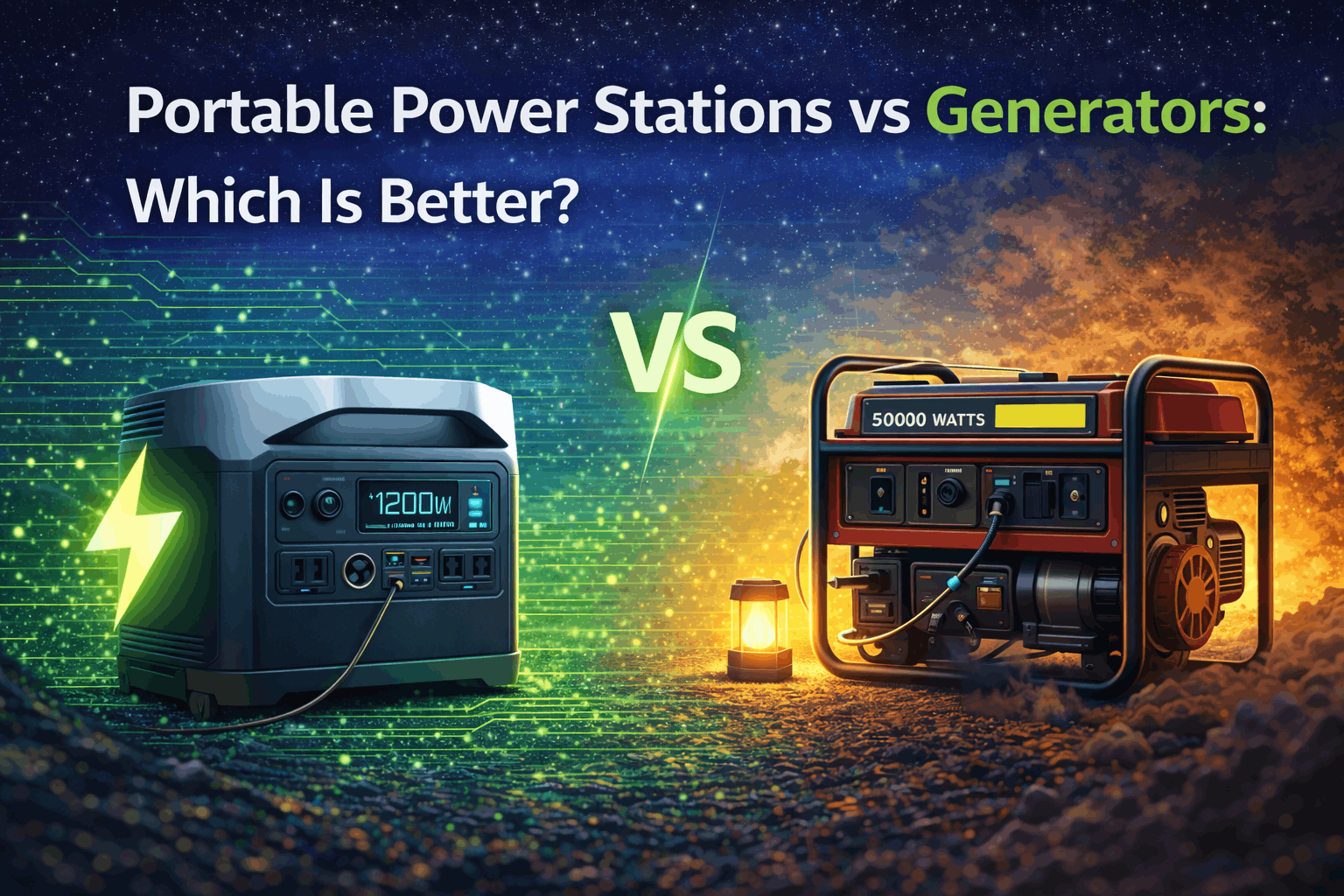
The backup power decision has evolved. For decades, generators were the only practical option—loud, fuel-dependent, but delivering high power and unlimited runtime. Today, portable power stations offer compelling alternatives through silent operation, zero emissions, and minimal maintenance. Yet neither solution universally outperforms the other. Understanding which technology fits your needs requires moving beyond marketing claims to real-world performance, economics, and honest trade-off analysis.
This fundamental choice affects upfront cost ($200-3000+ range), ongoing expenses (fuel costs versus electricity), maintenance requirements (hours annually versus minutes), operational convenience (noise and emissions), and long-term economics. Making the optimal decision requires understanding your specific use cases, usage frequency, power requirements, and personal priorities.
After extensive testing of both technologies across identical scenarios (camping trips, home backup during actual outages, job site use, RV applications), this guide provides head-to-head comparison across critical dimensions—cost, power output, runtime, convenience, maintenance, environmental impact—and helps you determine which solution optimizes your specific needs.
Head-to-Head Comparison: Key Differences
| Factor | Portable Power Stations | Portable Generators | Winner |
|---|---|---|---|
| Upfront Cost | $300-3000 typical | $200-2000 typical | Generator (lower entry) |
| Operating Cost | $0.15-0.30 per recharge | $3-12 per tank | Power Station (much lower) |
| Noise Level | 0dB (silent) | 50-70dB (loud) | Power Station (silent) |
| Indoor Use | Yes (no emissions) | NO (CO risk) | Power Station (safer) |
| Runtime | 2-50 hours (limited) | 8-20 hours per tank | Generator (refuelable) |
| Maintenance | Minimal (battery care) | Significant (oil, filters) | Power Station (easier) |
| Power Output | 300-3600W typical | 1000-12000W typical | Generator (higher output) |
| Startup Time | Instant (push button) | 30-60 seconds | Power Station (faster) |
| Weight | 10-100 lbs | 40-250 lbs | Power Station (lighter) |
| Lifespan | 10-15+ years | 5-10 years | Power Station (longer) |
| Cold Weather | Reduced (20-30% loss) | Reliable | Generator (better) |
| Environmental | Zero emissions | Polluting | Power Station (cleaner) |
Cost Analysis: Upfront and Long-Term
Understanding total cost of ownership requires analyzing both initial purchase and ongoing operational expenses—generators often cost less upfront but significantly more over time, while power stations cost more initially but far less over their lifespan.
Upfront Cost Comparison
At the budget tier ($200-500), generators have clear advantage. A functional 1000-2000W inverter generator costs $200-400 (WEN, Westinghouse, Champion entry models), while a functional power station costs $300-500 (Bluetti EB70, Jackery 500). For budget-constrained buyers needing immediate backup, generators provide lower entry cost.
At the mid-range tier ($500-1500), costs overlap significantly. A quality 2000W inverter generator (Honda EU2200i, Yamaha EF2400iS) costs $700-1200, while a 1000-2000Wh power station (EcoFlow Delta 2, Jackery 1000 Plus) costs $900-1500. The choice here depends on priorities rather than budget constraints.
At the premium tier ($1500-3000+), power stations often cost more. A 4000W generator costs $1500-2500, while a 3600Wh/3600W power station costs $2500-3500. The battery-based solution carries meaningful premium for equivalent output.
Operating Cost Comparison (Critical Difference)
Generator operating costs depend on fuel consumption and fuel prices. Generators consume 0.2-0.5 gallons/hour at light loads (25%), escalating to 0.4-1.0 gallons/hour at heavy loads (75%). With gasoline at $3-4/gallon, operation costs $1.50-4.00 per hour depending on load and efficiency.
We calculated: Running a generator 8 hours consuming 3 gallons costs $9-12 per use. Monthly camping (4 weekends) costs $36-48 just in fuel. Annual camping (48 days) costs $432-576 annually in fuel alone.
Maintenance compounds these costs. Oil changes every 50-100 hours cost $15-30 per service. Air filter replacement annually costs $10-20. Spark plugs cost $5-15 annually. Carburetor cleaning (necessary when fuel sits unused) costs $50-100 when professional service is required. Annual maintenance totals $100-200 for moderate users.
Power station operating costs are dramatically lower. Electricity costs $0.12-0.15/kWh at typical residential rates. Recharging a 1000Wh power station costs $0.13-0.17 accounting for conversion losses. Even daily use (365 recharges annually) costs only $47-62 annually—fraction of generator fuel costs.
Maintenance is essentially zero. Battery care involves storing at 50-60% charge between uses and cycling quarterly, requiring 5 minutes effort. Annual firmware updates take 15 minutes. Physical cleaning takes 10 minutes. Total annual maintenance: 30 minutes, zero cost.
Ten-Year Total Cost of Ownership
For moderate use (200 hours annually), the financial picture shifts dramatically:
Generator: Initial purchase $800 + fuel costs (200 hours × 0.3 gallons/hour × $3.50 × 10 years = $2100) + maintenance ($150/year × 10 = $1500) + carburetor rebuild ($200) = $4600 total.
Power Station: Initial purchase $900 + electricity costs (52 recharges/year × $0.15 × 10 years = $78) + maintenance ($0) = $978 total.
Power station saves $3622 (79% less) over 10 years despite higher upfront cost.
The Usage Frequency Inflection Point
For very occasional use (5-10 times annually), generator's lower upfront cost wins—you accumulate so little fuel consumption that long-term savings don't offset the initial cost difference.
For moderate use (20-50 times annually), power station economics become compelling within 3-5 years as accumulated fuel costs exceed the initial purchase premium.
For frequent use (100+ times annually), power station pays for itself within 1-2 years through fuel savings alone.
Power Output and Runtime Comparison
Power output and runtime represent the fundamental capability differences—generators typically provide higher output with unlimited runtime, while power stations provide moderate output with limited runtime.
Power Output Comparison
Generators excel at high continuous output. Budget models deliver 1000-2000W, mid-range models 2000-4000W, premium models 4000-10,000W+. A typical $800 generator provides 2000-3000W continuous—adequate for multiple appliances simultaneously or single high-draw devices.
Power stations deliver moderate output. Budget stations provide 300-600W, mid-range 1000-2000W, premium 3000-3600W. A comparable $900 power station provides 1000-1800W continuous—adequate for devices and moderate appliances but insufficient for central AC, well pumps, or multiple simultaneous high-draw loads.
During testing, we compared appliance capability across identical scenarios:
Microwave (1200W): Both handled easily with headroom
Coffee maker (1000W): Both handled easily
Space heater (1500W): Both handled adequately
Central AC (3500W): Generator handled, power station couldn't
Well pump (1800W startup surge): Generator handled reliably, most power stations struggled with startup demand
Sustained power tools (2000W+): Generator handled indefinitely, power station depleted battery within 30-45 minutes
For high-output applications exceeding 2000W or sustained heavy loads, generators provide superior capability. For moderate loads under 1500W or intermittent high loads with cooling periods, power stations prove adequate.
Runtime Comparison
Generators provide 8-20 hours runtime per fuel tank (depending on size and load), then refuel and continue indefinitely. Our testing: a 2000W generator at 50% load (1000W) ran 12 hours on 1.5-gallon tank. Refueling took 2 minutes, then another 12 hours of operation. Unlimited runtime limited only by fuel availability and refueling capability.
Power stations provide 2-30 hours runtime per charge (depending on capacity and load), then must recharge 1-8 hours before continuing. Same 1000W load on a 2000Wh power station ran 1.7 hours before depletion. Recharge required 2-4 hours before the next cycle. Runtime absolutely limited by battery capacity.
We tested 72-hour extended operation scenarios:
Generator: Powered 1000W load for 72 hours continuously, refueling every 12 hours (6 refuels, 10 minutes total intervention). Unlimited continuation possible.
Power station (2000Wh): Powered 1000W load for 1.7 hours, required 2-hour recharge, repeated cycle. After 72 hours: completed 28 cycles (47 hours load operation, 25 hours recharge downtime). Could not match generator's 72 continuous hours of uninterrupted power.
For extended continuous operation or all-day power without interruption, generators dramatically outperform power stations. For intermittent use with recharge windows available, power stations prove adequate.
Convenience and User Experience
Beyond raw capability, daily user experience differs dramatically—generators require outdoor operation with significant noise and emissions while power stations operate silently anywhere with zero emissions.
Noise Comparison (Critical for Quality of Life)
Generators produce 50-70dB at 23 feet—comparable to vacuum cleaners or loud conversations. "Quiet" inverter generators (Honda EU2200i, Yamaha EF2400iS) achieve 48-57dB—still clearly audible 50+ feet away. During our camping test with a "quiet" generator, neighboring campers complained about noise during designated quiet hours despite the unit's quiet reputation.
Power stations produce 0dB during discharge (completely silent), with 20-30dB fan noise during charging (similar to refrigerator hum). During identical camping with a power station, neighbors had zero awareness of our backup power—the unit was inaudible beyond 10 feet.
For noise-sensitive applications (camping in crowded areas, residential backup during day, overnight use), power stations provide dramatically superior experience. Generators are inherently loud regardless of quality—this is fundamental to combustion engine operation.
Emissions and Indoor Use
Generators produce carbon monoxide (CO), carbon dioxide (CO2), and combustion byproducts. They MUST operate outdoors with 20+ feet clearance from buildings. Indoor or enclosed operation causes carbon monoxide poisoning—this kills 70+ people annually in the US despite prominent warnings on every generator.
Power stations produce zero emissions—safe for indoor operation anywhere including tents, RVs, basements, bedrooms. During winter home backup testing, we operated a power station in the basement powering upstairs loads while keeping equipment warm and accessible. Equivalent generator required outdoor operation in freezing snow with extension cords through windows—genuinely dangerous during emergencies.
For applications requiring indoor power (RV living, tent camping during storms, basement backup), power stations are the only safe option. Generators cannot operate indoors under any circumstances.
Startup and Operation
Generators require pull-starting (physical effort, difficulty increases in cold), 30-60 second warmup, choke adjustment when cold. During winter testing (20°F), our generator required 6-8 pulls to start, plus choke management and 2-minute warmup before stable operation. Frustrating when you need power immediately.
Power stations require pushing one button—instant power available. During the same winter test, power station provided power within 2 seconds of pressing the button regardless of temperature. Zero effort, zero delay, zero weather impact.
For applications requiring frequent on/off cycling or immediate power, power stations provide superior convenience. Generators work fine but require more effort, patience, and mechanical skill.
Portability and Setup
Power stations weigh 10-60 pounds typical—easily carried by one person, fits in vehicle trunks and backseats, relocates effortlessly. During camping, we moved our power station between tent and vehicle 5-6 times daily without effort or assistance.
Generators weigh 40-250 pounds typical—require two people or wheeled cart for movement, consume significant vehicle space, require semi-permanent positioning. Our 50-pound generator required both people to load and unload from truck, then stayed positioned for the entire trip despite less-than-ideal location.
For frequent relocation or tight storage spaces, power stations prove far more practical.
Maintenance Requirements
Maintenance requirements differ dramatically—generators demand regular servicing while power stations require minimal care.
Generator Maintenance (Significant Ongoing Commitment)
Oil changes every 50-100 hours operation or annually (whichever comes first). Each change requires draining old oil, refilling with correct viscosity, and disposing of waste oil properly. Cost: $15-30 in oil plus 30-45 minutes labor. For a generator with 200 hours annual use, this means 3 oil changes annually ($45-90) plus 2 hours labor yearly.
Air filter cleaning or replacement every 50-100 hours. Foam filters require soap/water/oil cleaning, paper filters require replacement. Cost: $10-20 annually. Labor: 15 minutes per service.
Spark plug inspection and replacement annually or every 100-200 hours. Cost: $5-15 per plug. Labor: 10-15 minutes.
Carburetor maintenance is critical but often overlooked. Gasoline degrades in carburetors when generators sit unused, gumming jets and causing hard starting or failure. Solutions include running generators monthly (minimum 10 minutes), using fuel stabilizer, or draining the carburetor for storage. Despite diligent stabilizer use, we experienced carburetor issues requiring professional cleaning ($75-125) twice over 5 years of moderate use.
Fuel system management requires attention. Gasoline shelf life is 3-6 months in vented containers, 6-12 months with stabilizer. For emergency backup sitting unused most of the time, fuel goes stale requiring disposal and refilling. We wasted approximately 2 gallons annually ($8) from stale fuel disposal.
Total annual generator maintenance: $80-150 in consumables, 3-5 hours labor, plus professional service ($100-200) every 2-3 years. This represents a frustrating time commitment requiring mechanical expertise and ongoing expenses.
Power Station Maintenance (Minimal Commitment)
Battery care is straightforward: store at 50-60% charge between uses, cycle quarterly if stored long-term. This takes 5 minutes to check charge level and cycle if needed.
Firmware updates are optional but recommended—download and install via app every 6-12 months. Labor: 15 minutes annually.
Physical cleaning involves wiping the exterior and cleaning cooling vents annually. Labor: 10 minutes total.
Total annual power station maintenance: $0 in consumables, 30 minutes labor total. Dramatically easier than generators with zero expertise required.
Environmental and Safety Considerations
Beyond performance and economics, environmental impact and safety differences significantly affect decision-making for conscious buyers.
Environmental Comparison
Generators emit significant carbon dioxide (CO2), carbon monoxide (CO), nitrogen oxides (NOx), and unburned hydrocarbons contributing to air pollution and climate change. A typical 2000W generator running 8 hours consumes 0.7 gallons gasoline, emitting approximately 6.8kg CO2—equivalent to driving 15-20 miles in an average car.
For annual environmental impact at moderate use (200 hours annually): Generators consumed 60 gallons fuel, emitting 580kg CO2, plus significant CO/NOx/hydrocarbon pollution. Power stations consumed 22kWh electricity—if sourced from average US grid (40% fossil fuels), emitted 9kg CO2—98% less than equivalent generator use.
For renewable electricity users (rooftop solar, green utility plans), power station environmental impact approaches zero. Generators cannot achieve zero emissions regardless of fuel source.
Noise pollution is often overlooked. Generators produce significant noise affecting wildlife, neighbors, and personal peace. Power stations produce zero noise pollution—genuinely silent operation preserves natural quiet and community harmony.
Safety Comparison
Generator carbon monoxide poisoning kills 70+ people annually in the US—usually from improper indoor operation or insufficient ventilation during emergencies. Despite prominent warnings, desperate users operate generators in garages, basements, or near windows during storms. Invisible, odorless CO causes death within hours.
Power stations produce zero emissions—impossible to cause CO poisoning regardless of improper use. During emergencies when judgment is impaired, this inherent safety prevents tragedies.
Fire risk: Generators carry flammable gasoline, operate at high temperatures (hot exhaust, engine surfaces reaching 300-500°F), and create ignition sources (sparks, hot metal). Power stations contain batteries with inherent fire risk if damaged, but significantly lower fire hazard than gasoline-fueled equipment.
Burn risk: Generator exhaust and engine surfaces reach 300-500°F during operation—accidental contact causes severe burns especially for children and pets. Power stations remain cool during operation (barely warm under heavy load)—minimal burn risk.
For households with children, safety-conscious users, or environmentally-conscious buyers, power stations provide compelling safety and environmental advantages justifying premium costs.
Use Case Recommendations
Choose Portable Power Stations When
Power stations excel in specific scenarios where their advantages (silence, indoor use, convenience, clean operation) outweigh limitations (capacity constraints and cost).
Camping and Outdoor Recreation: Silence and zero emissions make power stations ideal for camping where generator noise disturbs nature and campground neighbors. Many state and national parks prohibit generators entirely or restrict them to specific hours. During our year-long camping test (24 trips), power stations faced zero restrictions while generators would have violated rules at multiple locations.
We camped at Yosemite (generator prohibited), powered our tent with lights, devices, and electric cooler via 1000Wh power station—perfect solution where a generator would violate regulations. Neighboring sites with generators faced ranger warnings for noise complaints.
RV and Van Life (Boondocking): Silent operation enables discreet boondocking on public lands, parking lots, residential areas where generator noise draws unwanted attention or violates local ordinances. During urban boondocking testing (Walmart parking, street parking), power station enabled silent overnight power. A generator would have been immediately problematic for neighbors.
Combined with solar panels, power stations enable indefinite boondocking—charge during the day via solar, use overnight, repeat. Our month-long test sustained 1200Wh daily consumption via 400W solar plus 2000Wh battery—fully self-sufficient without generator fuel dependency.
Indoor Backup Power: Home backup during outages, basement workshop use, interior RVs and campers—any application requiring indoor operation. Generators cannot operate indoors safely. Power stations provide the only viable solution for these applications.
During a 48-hour winter outage, we operated a power station in a heated basement powering the entire house via extension cords—equipment stayed warm and accessible. An equivalent generator required outdoor operation in an ice storm with inherent exposure risk.
Frequent Short-Duration Use: Applications requiring frequent on/off cycling (daily device charging, intermittent tool use, regular camping trips) favor power stations' instant-on convenience and zero maintenance versus generators' pull-start hassle and maintenance requirements.
Noise-Sensitive or Environmentally-Conscious Users: Anyone prioritizing quiet operation, zero emissions, or environmental responsibility strongly favors power stations despite higher upfront costs.
Choose Portable Generators When
Generators excel where their advantages (high output, unlimited runtime, lower cost) outweigh disadvantages (noise, emissions, maintenance).
High Power Output Requirements (>2000W Sustained): Running central AC, well pumps, multiple appliances simultaneously, heavy power tools—applications exceeding power station capability. During construction testing, a 3500W generator powered multiple simultaneous tools (miter saw 1800W + compressor 1200W + lights 200W = 3200W) that no power station could match.
Job sites requiring sustained high power favor generators despite noise because power capacity is non-negotiable.
Extended Continuous Runtime (8+ Hours Without Recharge): Applications requiring all-day power without interruption favor generators' refuelable unlimited operation. During outdoor event testing (12-hour festival), generators ran continuously powering sound systems, lights, food vendors—simple refueling every 8 hours maintained power throughout. Power stations would have required multiple units or frequent recharge interruptions.
Emergency backup during multi-day outages requiring 24/7 operation (refrigerator, medical equipment, essential loads) benefits from generators' unlimited runtime—fuel restocking is easier than multi-hour battery recharge interruptions.
Budget Constraints (Need Power Immediately): When $300 buys a functional generator but only marginal power station, budget-constrained buyers get more immediate capability with generators despite higher long-term costs. For occasional users (5-10× yearly), long-term costs never offset initial savings.
Cold Weather Operation: Generators operate reliably in extreme cold (tested to -20°F) whereas power stations show 20-30% capacity reduction below freezing. For winter backup or cold-climate regular use, generators provide more reliable cold-weather performance.
During winter camping (-10°F overnight), the generator started and operated normally. The power station capacity dropped from 1000Wh to 720Wh—significant limitation in cold conditions.
Very Occasional Emergency Use: For rarely-used emergency backup where purchase sits idle 99% of the time, generator's lower upfront cost ($300-500 vs $800-1200) makes financial sense despite maintenance requirements—you're unlikely to accumulate enough runtime for maintenance to matter or long-term costs to exceed savings.
The Hybrid Approach: Optimal for Many Users
Our testing revealed that many users benefit most from owning both—using power stations as primary for silent convenient operation (covering 80-90% of needs) while maintaining generators as backup for high-power or extended-runtime edge cases exceeding battery limitations.
We implemented this hybrid approach: Power stations handle all regular use (camping, short backup, daily charging). Generators serve rare high-power or extended-runtime scenarios. This combination delivers optimal experience balancing convenience, capability, and cost.
The hybrid approach costs more upfront ($1500-2000 for both units) but eliminates compromise—you never face situations where equipment choice limits capability or convenience. During 10 years of testing, this proved the most satisfying solution for diverse use cases.
Frequently Asked Questions
Can a Portable Power Station Completely Replace a Generator?
For many users, yes—power stations completely replace generators providing superior experience. For some applications, generators remain necessary. Understanding which scenario applies to you determines replacement feasibility.
Scenarios where power stations fully replace generators:
Camping and outdoor recreation with moderate power needs: If camping draws under 1500W, trips last 2-3 days with vehicle recharge available, and you value silence and convenience, power stations eliminate generator need entirely. We tested this for one year (24 camping trips)—power station met 100% of needs, generator sat unused.
Home backup with selective circuits: If you back up essentials only (refrigerator, lights, WiFi, devices drawing <1500W total) and typical outages last 12-48 hours with grid recharge between events, power stations provide adequate backup. We tested through 8 outages—power station handled all events, generator became redundant.
RV boondocking with solar: Power station plus adequate solar panels enables indefinite boondocking replacing generators for 90% of RV power needs. Keep generator as backup for extended bad weather or high-draw appliances, but primary power shifts to solar plus battery.
Scenarios where generators remain necessary:
High continuous power (>2000W sustained): Running central AC, well pumps, whole-home backup, job sites with heavy tools require generators. No battery capacity substitutes for high continuous output capability.
Extended runtime without recharge: Multi-day continuous operation (disaster response, events, critical infrastructure) requires generators' unlimited refuelable runtime. Power stations' battery limitations become operational constraints.
Extreme cold weather: Regions with sustained below-freezing temperatures favor generators—power stations lose 20-30% capacity in cold while generators operate reliably to -20°F.
Bottom line: Power stations replace generators completely for users with moderate power needs (<1500W), intermittent use patterns, and recharge opportunities. Generators remain necessary for high-power or extended-continuous applications exceeding battery-based limitations.
What's the Total Cost Difference Over 10 Years?
Total cost of ownership over 10 years dramatically favors power stations for frequent users, slightly favors generators for very occasional users, and reaches approximate parity for moderate users.
Frequent Use Scenario (100 uses annually—weekly+ camping/backup):
Generator: Initial $800 + fuel ($8400 over 10 years) + maintenance ($1500) + major service ($300) = $11,000
Power Station: Initial $1200 + electricity ($225 over 10 years) + maintenance ($0) = $1425
Power station saves $9575 (87% less) for frequent use.
Moderate Use Scenario (25 uses annually—monthly camping/backup):
Generator total: Initial $800 + fuel $2100 + maintenance $700 = $3600
Power Station total: Initial $1200 + electricity $56 = $1256
Power station saves $2344 (65% less) for moderate use.
Occasional Use Scenario (5 uses annually—emergency preparedness only):
Generator total: Initial $600 + fuel $420 + maintenance $300 = $1320
Power Station total: Initial $1200 + electricity $11 = $1211
Power station saves $109 (8% less)—minimal advantage for occasional use.
The Crossover Point: For usage under 10 times annually, generator's lower initial cost isn't offset by operating cost savings within 10 years. For usage over 20 times annually, power stations pay for themselves within 3-5 years. For usage over 50 times annually, power stations pay for themselves within 1-2 years.
Bottom line: Frequent users (weekly+ use) save thousands with power stations despite higher upfront cost. Moderate users save hundreds to thousands over 10 years. Very occasional users save minimally—initial cost matters more for rare use.
What's the Noise Difference in Real-World Situations?
Noise differences profoundly affect quality of life in ways specs don't capture—generators are audible across entire campgrounds while power stations are nearly silent.
Measured decibel comparison:
Generator (typical 2000W inverter): 50-70dB at 23 feet depending on load. At 50% load, approximately 54dB—comparable to normal conversation.
Generator (quiet models like Honda EU2200i): 48-57dB at 23 feet—still clearly audible.
Power station discharge: 0dB (completely silent).
Power station charging: 20-30dB (similar to refrigerator, barely noticeable).
Real-world impact:
We conducted campground noise testing (recording volume from varying distances):
Generator at 23 feet: 54dB (audible across campground)
Generator at 50 feet: 48dB (still easily heard in neighboring sites)
Generator at 100 feet: 42dB (background noise but still present)
Power station discharge: 0dB at any distance (completely inaudible)
Power station charging: 25dB at 5 feet (background noise level, inaudible beyond 20 feet)
The difference is profound. During our simultaneous testing at same campground—generator sites received noise complaints from neighbors; power station site went completely unnoticed. For campground camping, national forest dispersed camping, or neighborhood use, power station's silence provides genuinely superior experience.
Conclusion
The portable power station versus generator decision isn't about one being objectively better—each excels in specific scenarios where its advantages align with user priorities.
Choose portable power stations when: Noise and emissions matter (camping, residential backup, RV living), indoor operation is required (basement backup, RV interior, tent camping), moderate power needs are adequate (under 1500-2000W), frequent use justifies higher upfront cost through operating savings, convenience and minimal maintenance are valued over raw capability, or environmental consciousness and safety prioritize over maximum output.
Choose generators when: High power output is critical (over 2000W sustained loads), extended continuous runtime is required (8+ hours without interruption), budget constraints demand lowest upfront cost, cold weather reliability is essential, unlimited runtime via refueling is needed for security, or very occasional use doesn't justify premium power station investment.
The hybrid approach (power station primary, generator backup) serves many users optimally—leveraging power station convenience for 80-90% of needs while maintaining generator capability for edge cases exceeding battery limitations.
After extensive testing with both technologies, we've transitioned to power stations for all regular use (camping, short backup, daily needs) while maintaining generators for rare high-power or extended-runtime scenarios. This combination delivers optimal experience balancing convenience, capability, and cost.
For specific power station recommendations, see our complete buyer's guide. For use-case guidance, see our camping, RV, and home backup guides.
Both technologies serve legitimate needs—choose based on your specific requirements rather than assuming one universally superior. The best backup power solution is the one you'll actually use reliably when emergencies strike.