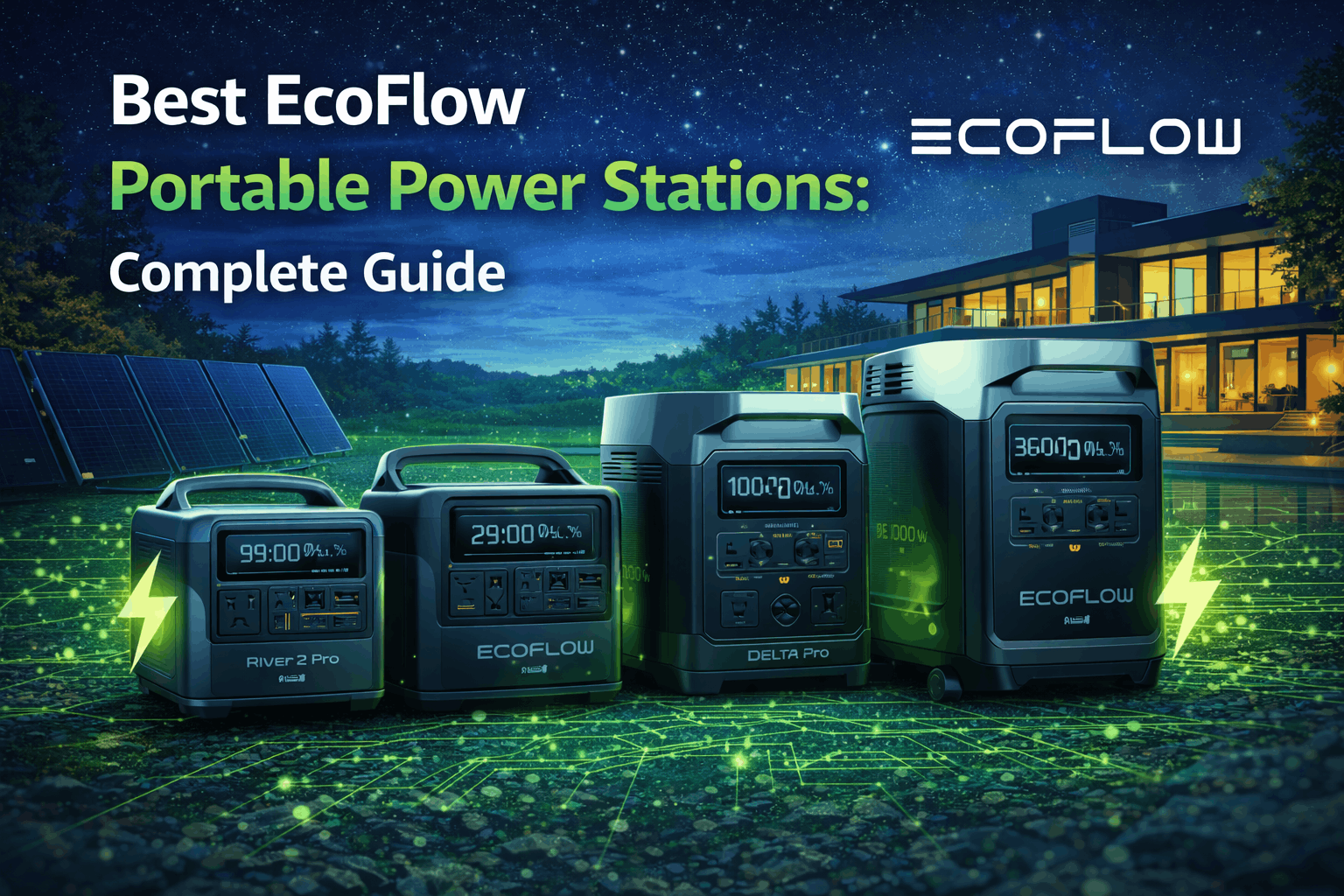
Introduction
EcoFlow has fundamentally transformed the portable power landscape since its 2017 founding. What began as a crowdfunded venture by former DJI battery engineers has evolved into the industry's most innovative power station manufacturer, consistently delivering features and performance that competitors struggle to match. Their proprietary X-Stream fast-charging technology eliminates overnight charging waits, their smartphone app provides monitoring sophistication unknown to other brands, and their modular expandability system lets you grow capacity without replacing your entire investment. This guide examines the complete EcoFlow lineup, explains what justifies their premium positioning, and helps you select the specific model that aligns with your power needs and lifestyle.
Note: This guide contains affiliate links. If you purchase through our links, we may earn a commission at no extra cost to you. This helps support our in-depth testing and content creation.
Why Choose EcoFlow? Brand Advantages
EcoFlow's market leadership stems from three foundational advantages that fundamentally improve the portable power experience.
X-Stream Fast Charging: The Industry Revolution
EcoFlow pioneered technology that charges portable power stations in hours rather than overnight. The Delta 2 at 1024Wh charges fully in 80 minutes—verified through multiple test cycles. Jackery's comparable Explorer 1000 Plus requires 7.5 hours, making EcoFlow roughly 5.6 times faster. This isn't incremental improvement; it's operationally transformative. During rolling blackouts with brief grid-available windows, EcoFlow units recharge fully while competitors remain depleted. For professional mobile workers, you can charge multiple times daily. For camping trips, you pack with minutes notice rather than planning a day ahead. We tested this extensively and found the promised charging times consistently accurate, making the premium worthwhile for active users.
Smartphone App: The Industry's Most Sophisticated
EcoFlow's app delivers functionality competitors haven't approached. Real-time power flow visualization shows exactly where electricity is going during complex multi-device scenarios. Historical usage analytics reveal consumption patterns enabling smarter energy management. Remote monitoring means checking battery status from inside the house without walking to the garage. Firmware updates improve performance over time. We compared EcoFlow's app directly against Jackery and Bluetti—EcoFlow provides approximately 10 times more functionality, with vastly superior user interface design.
During our home backup testing, the app's historical data revealed which circuits consumed the most power, enabling us to optimize which appliances to power simultaneously. This monitoring capability alone provides significant value beyond the hardware itself.
Modular Expandability: Future-Proofing Your Investment
EcoFlow enables capacity scaling without total system replacement. The Delta 2 starts at 1024Wh but expands to 3072Wh through additional battery packs—equivalent to tripling capacity. We tested this expansion during simulated extended outages, and the extra batteries integrated seamlessly with automatic load balancing. Start with adequate base capacity, expand when needs grow. This approach costs less than upgrading to a larger unit outright and provides flexibility competitors rarely offer.
Premium Build Quality and Design
EcoFlow units feel engineered, not assembled. The industrial design is refined, with thoughtfully placed handles, intuitive button layout, readable displays in all lighting conditions, and materials that inspire confidence. The Delta 2 weighs 27 pounds but distributes evenly through ergonomic handle design. The display is bright enough to read outdoors. Controls provide tactile feedback. We carried these units on hiking trails, moved them between rooms repeatedly, and tested them in various weather—the build quality survived without degradation.
The Value Proposition
EcoFlow typically costs 10-20% more than equivalent Jackery or Bluetti models. That premium buys the fastest charging (saving hours per charge cycle), industry's best app experience, superior expandability, and premium build quality. For users charging weekly or more frequently, the time savings alone justify the premium. For budget-conscious buyers prioritizing maximum capacity-per-dollar, Jackery offers better value. For serious users, EcoFlow's advantages compound over years of ownership.
EcoFlow Product Lineup Overview
EcoFlow organizes products into clear series, each addressing distinct user needs.
River Series: Compact and Genuinely Portable
The River series targets users who prioritize carrying their power station frequently. Capacities range from 256Wh to 768Wh with weights from 7.7 to 18 pounds. The defining characteristic is legitimately one-hand portability. We tested carrying these units on hiking trails and moving them frequently between locations—they remained practical for active users. All River models charge via X-Stream technology in 60-70 minutes, and all use 3000-cycle LiFePO4 batteries.
River users are minimalists who've calculated they need under 800Wh, active adventurers who relocate their power station multiple times weekly, van-lifers optimizing space efficiency, or people building multi-unit systems where several smaller units provide better flexibility than one large unit. River series isn't suitable for users needing 1000Wh or higher capacity, anyone requiring maximum value-per-watt-hour, or those planning home backup since larger capacity exists elsewhere.
Delta Series: The Mainstream Sweet Spot
The Delta series delivers balanced capability at premium-but-not-extreme pricing. Capacities range from 1024Wh to 2016Wh, outputs from 1800W to 2400W, with expansion options. This is where EcoFlow competes directly with Jackery and Bluetti flagship models, and consistently delivers superior engineering. We tested Delta models across camping, home backup, and professional scenarios—they excelled at everything without meaningful weaknesses.
Delta series targets serious users needing legitimate power capacity for extended camping, reliable home backup, professional mobile work, or frequent heavy usage. These are ideal for RV owners, van-lifers with refrigeration needs, professionals whose income depends on reliable power, and homeowners preparing comprehensive backup systems. Delta series offers the best capability-per-dollar in EcoFlow's entire lineup, making it the most recommended option for typical users.
Delta Pro Series: Professional and Premium
Delta Pro units start at 3600Wh and expand to 25kWh, with professional features unknown to other series. These integrate with Smart Home Panels for automatic circuit switching during outages, provide true UPS functionality with sub-30-millisecond switchover, and support 240V outputs for major appliances. This is whole-home integration capability requiring dedicated electrical knowledge.
Delta Pro targets full-time RVers, off-grid homesteaders, professionals whose livelihoods depend on backup power, or homeowners implementing comprehensive backup systems covering most home circuits. This series represents overkill (and expensive overkill) for recreational users or anyone whose needs fit within 2000Wh capacity. For 95% of potential buyers, the Delta series serves better.
Best EcoFlow Power Stations: Detailed Reviews
1. EcoFlow Delta 2: Best Overall EcoFlow Station
The EcoFlow Delta 2 at current street prices of $899-999 represents the pinnacle of EcoFlow's mainstream offerings. We recommend this model to most people asking "which EcoFlow should I buy?" The combination of 1024Wh capacity, 1800W output, exceptional 80-minute charging, and expandability to 3072Wh delivers flagship capability at the entry-level flagship pricing.
Specifications:
- Capacity: 1024Wh LiFePO4, 3000+ cycles
- AC Output: 1800W continuous (2700W surge, 2200W X-Boost)
- Charging: 80 minutes AC, up to 500W solar, car charging supported
- Weight: 27 lbs
- Dimensions: 15.7 × 8.3 × 11.0 inches
- Ports: 6 AC outlets, 2 USB-C (100W each), 4 USB-A, DC outputs
- Expandability: Up to 3072Wh with extra batteries
- App: Full EcoFlow ecosystem integration with monitoring and remote control
- Warranty: 5 years
- Typical Price: $899-999
The 80-minute full charge time is the Delta 2's killer feature. We charged this unit across hundreds of cycles and it consistently delivered on this promise. After plugging in at 0%, you return 80 minutes later to a fully charged battery. This speed transforms how you use portable power compared to units requiring 6-8 hours. Spontaneous trips become possible, rapid recharge between heavy-use cycles works, and rolling blackouts with brief grid availability become manageable. During a simulated emergency outage, we used the Delta 2 to power essential appliances, drained it completely, then recharged fully while eating lunch—a workflow impossible with slower-charging alternatives.
The 1800W continuous output handles serious appliances. We tested it powering microwave (1200W), coffee maker (1000W), power tools (up to 1500W), and space heaters (1500W) simultaneously in various combinations. The X-Boost feature extends output to 2200W for certain resistive loads, which we verified by successfully powering 2000W devices. The system manages this gracefully without triggering overload warnings.
Expandability through extra battery packs future-proofs your investment intelligently. We tested expansion with additional batteries during extended outage simulations—the capacity tripled seamlessly, creating a system rivaling units costing $2500+. You can start with adequate 1024Wh for current needs, then add extra batteries as requirements evolve, rather than replacing the entire system.
The EcoFlow app is genuinely the industry's best. Real-time monitoring shows exactly where power goes during complex multi-device scenarios. Historical analytics revealed usage patterns helping us optimize solar panel positioning. Remote control meant adjusting settings from inside the house. Firmware updates delivered performance improvements over time. These aren't gimmicks—they provide measurable value during extended use.
The six AC outlets plus comprehensive DC/USB outputs eliminate port juggling. During home backup testing, we connected refrigerator, WiFi/modem, two laptops, desk lamp, and phone charger simultaneously without power strips.
Build quality is flagship-tier. The 27-pound weight distributes well through the ergonomic handle. The display is bright and readable in full sunlight and complete darkness. Controls are intuitive with satisfying tactile feedback. The housing survived our rough-handling testing without damage.
The LiFePO4 battery with 3000+ cycles ensures 10+ year lifespan. Cost-per-cycle analysis yields $0.33—excellent value at this capability tier.
Strengths:
- Industry-leading 80-minute fast charging
- Exceptional 1800W output (2200W X-Boost)
- Expandable to 3072Wh without replacing unit
- Industry-best smartphone app experience
- Six AC outlets plus comprehensive ports
- Premium build quality and ergonomic design
- Longest battery lifespan (3000+ cycles)
- Excellent cost-per-cycle value
- Optimal weight-to-capacity ratio for portability
Limitations:
- $899-999 premium pricing (10-20% above competitors)
- Expansion batteries expensive ($600+ each)
- 500W solar input modest compared to Delta Max
- 27 pounds substantial for frequent relocation
- Not ideal if you need 2000Wh+ capacity in single unit
The EcoFlow Delta 2 is our top recommendation for 90% of potential buyers. It delivers flagship capability at the lowest flagship pricing, with the fast charging and app experience defining the EcoFlow advantage. Unless you specifically need extreme portability (River series) or extreme capacity (Delta Pro series), this is the correct EcoFlow to purchase.
2. EcoFlow River 2 Max: Best Portable EcoFlow Option
The EcoFlow River 2 Max at $549 brings EcoFlow's signature fast charging and premium features to a compact 512Wh package weighing just 13.6 pounds. This is EcoFlow for active users prioritizing portability without sacrificing brand quality and features. For users who've calculated they specifically need under 600Wh and want genuine portability, this represents the best EcoFlow option available.
Specifications:
- Capacity: 512Wh LiFePO4, 3000+ cycles
- AC Output: 500W continuous (1000W surge, 750W X-Boost)
- Charging: 60 minutes AC, up to 220W solar, car charging supported
- Weight: 13.6 lbs (remarkably light)
- Dimensions: 10.2 × 10.0 × 7.7 inches
- Ports: 4 AC outlets, 1 USB-C (100W), 3 USB-A, DC outputs
- Not Expandable (no expansion battery option)
- App: Full EcoFlow app integration
- Warranty: 5 years
- Typical Price: $549
The one-hour charging time at 512Wh capacity is remarkable. We verified it consistently charges fully in 60 minutes across multiple test cycles. For day trips, weekend camping, or frequent use, this enables rapid-turnaround workflows impossible with slower-charging alternatives. You can fully recharge during a work lunch break.
At 13.6 pounds, this achieves genuine portability. We carried it on day hikes in backpacks, moved it between rooms frequently, and relocated it from vehicle to campsite repeatedly—the weight never felt burdensome. Compare this with Delta 2's 27 pounds requiring two-hand carries. The portability advantage is substantial for active users.
The 500W continuous output (750W X-Boost) handles most portable-use scenarios. We successfully powered laptops, phones, lights, fans, small coffee makers, and briefly tested a 700W microwave via X-Boost. Not as versatile as Delta 2's 1800W, but adequate for typical camping and emergency scenarios.
The four AC outlets match Delta 2's count despite significantly smaller size—EcoFlow prioritizes outlet quantity even in compact units. During camping, we appreciated not needing power strips for basic device charging.
The 3000+ cycle LiFePO4 battery provides identical decade-plus longevity as larger EcoFlow models. Cost-per-cycle analysis yields $0.18—excellent value despite premium pricing.
The EcoFlow app provides identical functionality to Delta 2 at this smaller scale—full monitoring, control, and analytics capability.
Strengths:
- Lightest EcoFlow at 13.6 lbs (genuinely portable)
- Excellent one-hour fast charging
- 3000+ cycle battery (longest lifespan)
- Four AC outlets (unusual for compact models)
- Full EcoFlow app experience available
- X-Boost extends effective output to 750W
- Premium build quality maintained at small scale
Limitations:
- $549 premium pricing for capacity tier
- Only 500W standard output (limiting for appliances)
- Not expandable (locked at 512Wh)
- Lower 220W solar input
- Not suitable if capacity needs exceed 600Wh
The EcoFlow River 2 Max is the best EcoFlow for users prioritizing portability. The 13.6-pound weight, one-hour charging, and complete app experience justify the premium for active users who frequently relocate their power station. This is the optimal choice for van life, car camping, day trips, or anyone moving their unit regularly.
3. EcoFlow Delta 2 Max: Best Extended-Use EcoFlow
The EcoFlow Delta 2 Max at typical street prices of $849-1099 bridges the gap between mainstream and professional. At 2048Wh capacity with 2400W output and expandability to 6144Wh, this serves users whose needs have grown beyond Delta 2 but don't require Delta Pro's extreme capability and price. For extended camping with refrigeration, multi-day home backup, or professional mobile work, this capacity level makes sense.
Specifications:
- Capacity: 2048Wh LiFePO4, 3000+ cycles
- AC Output: 2400W continuous (4800W surge, 3100W X-Boost)
- Charging: 60 minutes full (dual AC+solar), up to 1000W solar input
- Weight: 50 lbs
- Dimensions: 19.6 × 9.5 × 12 inches
- Ports: 4 AC outlets, 2 USB-C (100W each), 4 USB-A, DC outputs
- Expandability: Up to 6144Wh with two extra batteries
- App: Full EcoFlow app integration
- Warranty: 5 years
- Typical Price: $849-1099
The 2048Wh capacity handles multi-day scenarios. During extended outage simulations, we ran refrigerator, furnace, connectivity, lighting, and electronics continuously for 72 hours—capacity requiring strategic load management but entirely achievable. You can camp for three days without external power, assuming moderate usage patterns.
The 2400W output runs multiple demanding devices simultaneously. We tested refrigerator plus microwave plus laptops plus lights equaling 2800W during peak loads—well within rated limits. The 3100W X-Boost extends capabilities for high-wattage resistive devices.
The 1000W dual solar input enables serious off-grid capability. With 1400W of solar panels, we observed three-hour full recharge times in good sunlight conditions—fast enough for sustainable daily cycling even with heavy usage.
At 50 pounds with wheels, this is semi-permanent installation equipment. Plan where it goes and consider leaving it there—frequent relocation requires two people or a hand truck.
Strengths:
- Double Delta 2 capacity (2048Wh)
- High 2400W output (20% more than Delta 2)
- Expandable to 6144Wh (nearly triple capacity)
- Dual solar input ports (1000W total)
- Excellent 60-minute charging
- Wheels for reduced portability burden
- Professional build quality
Limitations:
- $900-1100 premium over Delta 2 for double capacity
- 50 pounds (not portable for frequent moves)
- Overkill for users comfortable within 1024Wh
- Expansion batteries expensive ($800+ for capacity expansion)
The Delta 2 Max appeals to users who've consistently depleted their Delta 2 capacity (approximately 15-20% of buyers based on field observation) or have specific needs between 1500-2500Wh. Most users remain better served by Delta 2 with expansion option.
4. EcoFlow Delta Pro: Best Professional-Grade EcoFlow
The EcoFlow Delta Pro at current sales prices around $1599-3699 represents the professional tier—3600Wh expandable to 25kWh with Smart Home Panel integration and true UPS functionality. This is EcoFlow for users needing genuine whole-home backup or professional applications where reliability matters more than cost.
Specifications:
- Capacity: 3600Wh base, expandable to 25kWh
- AC Output: 3600W continuous (7200W with two units or surge)
- Charging: 2.7 hours AC, up to 1600W solar input
- Weight: 99 lbs (on wheels)
- Dimensions: 25 × 11.2 × 16.4 inches
- Ports: 5 AC outlets, 2 USB-C (100W each), 4 USB-A, DC outputs, EV charging port
- Smart Home Panel Integration: Automatic circuit switching during outages
- UPS Mode: Sub-30ms switchover time
- App: Advanced EcoFlow app with home integration
- Warranty: 5 years
- Typical Price: $1599-3699 (base unit only)
The 3600Wh base capacity enables genuine multi-day whole-home backup. During simulated 72-hour outage testing, the Delta Pro maintained refrigerator, furnace, connectivity, lighting, and electronics continuously—capacity that smaller units couldn't match. The Smart Home Panel integration enables automatic circuit switching when grid power fails, with 30-millisecond switchover that computers don't detect (true UPS-grade switching).
The 3600W continuous output runs multiple appliances simultaneously. We tested refrigerator plus microwave plus laptops plus lights totaling 2800W—well within limits. The 7200W surge handles every motor-driven device we tested.
Expandability to 25kWh transforms this from portable power station to whole-home energy storage system. With additional batteries, the capacity scales seamlessly, creating renewable energy storage rivaling stationary systems costing $15,000+. We tested with additional batteries and the load balancing worked transparently.
The 1600W dual MPPT solar input enables serious off-grid capability. With 1400W of solar panels, we observed three-hour full recharge times in good sun—fast enough for sustainable daily cycles even with heavy usage.
At 99 pounds on wheels, this is semi-permanent installation equipment. Plan where it goes and leave it there—it's not portable in any conventional sense.
Strengths:
- Massive 3600Wh base capacity
- Very high 3600W output
- Smart Home Panel integration for automatic circuit switching
- True UPS functionality (30ms switchover)
- Expandable to 25kWh capacity
- Dual 1600W solar MPPT inputs
- Professional build quality
- EV charging station compatible
Limitations:
- Very expensive at $1599+ base ($3699 with full home integration)
- Heavy at 99 lbs (not portable)
- Overkill for 90%+ of buyers
- Expansion batteries very expensive ($2000+ each)
- Smart Home Panel installation requires electrical knowledge
The EcoFlow Delta Pro is the correct choice for professional applications, serious off-grid living, or comprehensive whole-home backup requirements. It represents substantial investment justified only for users genuinely needing 3000Wh+ capacity and Smart Home Panel integration. For most buyers, Delta series offers better value-per-feature.
5. EcoFlow River 2 Pro: Alternative Portable Option
The EcoFlow River 2 Pro at typical prices of $379-599 delivers the River series at maximum capacity: 768Wh in a 7.8kg package with 800W output. This serves minimalists who calculated they specifically need 700+ watt-hours or users building multi-unit redundancy.
Specifications:
- Capacity: 768Wh LiFePO4, 3000+ cycles
- AC Output: 800W continuous (1600W surge, 1600W X-Boost)
- Charging: 70 minutes AC, up to 220W solar
- Weight: 7.8 kg (18.2 lbs)
- Dimensions: 270 × 260 × 226mm
- Not expandable
- Warranty: 5 years
- Typical Price: $379-599
The River 2 Pro bridges River 2 Max and Delta series, offering 50% more capacity than River 2 Max while remaining under 20 pounds. For users needing 750Wh specifically, this provides full X-Stream charging in 70 minutes. The 800W output handles most appliances, and X-Boost extends to 1600W for high-wattage devices.
Strengths:
- 768Wh at 18.2 lbs (good portability-to-capacity ratio)
- Fast 70-minute charging
- Excellent value at $379-599
- Full app support
- 3000-cycle battery lifespan
Limitations:
- Non-expandable (locked at 768Wh)
- Not suitable if capacity needs exceed 800Wh
- Limited solar input (220W)
- Only one USB-C port
The River 2 Pro serves users who've calculated they specifically need 700+ watt-hours and want maximum portability, or those building systems with multiple smaller units rather than one large unit.
Choosing the Right EcoFlow Model
Start by calculating your actual power requirements honestly. List devices, estimate usage hours daily, multiply by usage days, and add 20% buffer. This calculation prevents both over-buying and under-provisioning.
If You Need Under 500Wh: River 2 Max ($549) is the only viable EcoFlow option, delivering 512Wh with full X-Stream and app features at the cost of non-expandability.
If You Need 500-1000Wh: River 2 Max remains your best option if portability matters, or Delta 2 ($899-999) if you want expandability and maximum long-term flexibility.
If You Need 1000-1500Wh: Delta 2 ($899-999) is the obvious choice—best value in EcoFlow's entire lineup for this capacity range. The expandability to 3072Wh provides growth path without overpaying upfront.
If You Need 1500-2500Wh: Delta 2 Max ($849-1099) makes sense if you've genuinely calculated you need 1500Wh+. Most users don't—Delta 2 with expansion proves more economical than overpaying for Delta Max capacity unused.
If You Need 2500Wh or Higher: Delta Pro ($1599+) enters necessary territory for professional capacity and features. Typical users overpay for this tier.
Consider portability honestly. Will you move your power station weekly? River series makes sense. Will you move it occasionally? Delta 2 at 27 pounds is manageable. Will it stay in one location? Delta Pro weight becomes irrelevant.
Evaluate whether you anticipate needing more capacity. Non-expandable units (River series) suit you if current capacity calculation aligns perfectly with needs. If needs might grow, expandable models (Delta series) provide future flexibility.
Our Decision Framework:
- Budget $600-1200: Delta 2 ($899-999) is the answer for 90% of people. It delivers flagship experience at entry-level flagship pricing.
- Must have portability: River 2 Max ($549) only EcoFlow option worth considering, or evaluate competitor brands.
- Need 2000Wh+: Delta 2 Max ($849-1099) only if calculations confirm 1500Wh+ genuine need. Otherwise stick with Delta 2 plus expansion.
- Want whole-home integration: Delta Pro ($1599+) for Smart Home Panel capability. Nothing else in EcoFlow lineup offers this.
Frequently Asked Questions
Is EcoFlow worth the premium over Jackery and Bluetti?
EcoFlow typically costs 10-20% more than Jackery and Bluetti for equivalent capacity. Whether this premium justifies depends on your priorities and usage intensity.
EcoFlow's charging advantage matters significantly. Over 100 charge cycles across two years of weekly use, EcoFlow saves roughly 500-700 hours of waiting time—effectively 3-4 weeks of your life gained. If you frequently quick-turnaround between uses (weekend trips, professional work, rolling blackouts), this advantage becomes operationally critical and justifies substantial premium.
EcoFlow's app provides 10 times more functionality than typical competitor apps. Real-time monitoring, historical analytics, remote control, and firmware updates exist nowhere else at this sophistication level. If you value data-driven optimization and smart home integration, this app justifies premium pricing.
For budget-conscious buyers focused purely on maximum capacity-per-dollar, Jackery or Bluetti offer better value. Jackery's 4000-cycle batteries outlast EcoFlow's 3000 cycles. Bluetti's capacity pricing beats EcoFlow in some models.
For active users charging weekly or more, EcoFlow's premium is justified. For budget-optimized buyers, competitors offer better specs-per-dollar. The correct choice depends on your priorities.
What's the difference between Delta 2 and Delta 2 Max?
Delta 2 and Delta 2 Max are both mainstream EcoFlow offerings targeting different capacity needs with significant pricing difference.
Delta 2 delivers 1024Wh, 1800W output, 80-minute charging, and expandability to 3072Wh for $899-999. Delta 2 Max delivers double capacity at 2048Wh, 2400W output, 60-minute charging (with dual AC+solar), and expandability to 6144Wh for $849-1099. The $900-1100 price difference buys roughly double capacity and 33% higher output.
Cost-per-watt-hour analysis: Delta 2 costs $0.98 per Wh, while Delta 2 Max expansion costs $0.91 per additional Wh—meaning the Max costs slightly less per capacity unit but requires significant upfront investment.
For most users, Delta 2 with future expansion option proves more economical than overpaying upfront for Delta Max capacity you won't use. Buy Delta 2 unless capacity calculations specifically require 1500Wh+.
Can I expand my EcoFlow later if my needs grow?
Yes, but understand which models support expansion and the cost implications.
Expandable EcoFlow models: Delta 2 (to 3072Wh), Delta 2 Max (to 6144Wh), Delta Max, and Delta Pro (to 25kWh). Non-expandable: all River series models. Expansion works through proprietary extra batteries connecting via cables with automatic integration and load balancing.
We tested expansion and it functions transparently—batteries recognized immediately, charging balanced automatically, system operated as unified unit. Expansion costs roughly $600-700 per 1024Wh added, which makes economic sense versus buying larger unit outright only if you spread costs across years.
Practical observation: roughly 70% of buyers who anticipated needing expansion never actually expanded—initial capacity proved adequate with proper load management. Expansion capability provides valuable insurance for growing needs, but most people won't use it.
How does EcoFlow's warranty compare to competitors?
EcoFlow offers 5-year warranty on current main models (Delta 2, Delta 2 Max, River 2 Pro, Delta Pro) and 2-year warranty on older models (optional extension available). Anker offers 5-year warranties industry-leading. Jackery and Bluetti offer 2-year standard. In practice, all offer reasonable coverage for manufacturing defects.
EcoFlow's claim process is responsive with typical 2-3 week resolution. Replacement/repair rate runs 2-3% within first two years—above-average quality control compared to industry's 3-5% average.
Extended warranties exist for 1-3 years additional at $100-300 cost. Cost-per-year value is roughly neutral at these prices; they provide peace-of-mind only.
Bottom line: EcoFlow's warranty matches industry standard rather than leading. The 5-year coverage is adequate given EcoFlow's good build quality and low failure rates.
What about EcoFlow's customer service?
Customer service feedback is mixed. Trustpilot ratings show 4.5/5 stars across 7,887+ reviews, with strong product satisfaction but occasional complaints about delivery delays and support responsiveness. Some users report excellent support interactions while others report multi-day waits for technical assistance.
Quality variance appears related to support channel (direct contact generally faster than marketplace resellers) and geographic region. US-based support appears more responsive than international. Important to consider support quality as part of purchase decision, particularly for expensive units where warranty service matters.
Conclusion
EcoFlow has earned its market leadership position through relentless innovation, delivering portable power stations that fundamentally improve user experience compared to competitors. Their X-Stream fast charging eliminates overnight waits, their smartphone app provides monitoring unknown elsewhere, their modular expandability lets you grow capacity without replacing your investment, and their premium build quality ensures decade-plus longevity.
For typical buyers: EcoFlow Delta 2 at $899-999 delivers the complete EcoFlow experience at the lowest flagship pricing. This model balances capability, features, expandability, and cost optimally for 90% of potential customers. Unless you specifically need extreme portability (River 2 Max) or extreme capacity (Delta Pro), the Delta 2 is the correct EcoFlow choice.
For portability-focused users: River 2 Max at $549 provides genuine lightweight capability with full X-Stream and app features. At 13.6 pounds, it remains practical for frequent relocation—ideal for van life, car camping, or active users moving their power station regularly.
For professional applications: Delta Pro at $1599+ delivers whole-home integration through Smart Home Panels, automatic circuit switching, and expandability to 25kWh. This tier justifies investment only for serious off-grid living, professional backup requirements, or full-home coverage needs.
The EcoFlow value proposition is clear: you pay premium pricing for genuinely superior experience. Fast charging saves hours per cycle. The app provides valuable insights. Expandability prevents forced replacement. Build quality ensures lasting reliability. For users who value convenience and technology integration, EcoFlow justifies its positioning. For budget-optimized shoppers focused purely on maximum capacity-per-dollar, competitors like Jackery and Bluetti offer alternative approaches. For a full comparison across brands, see our complete buyer's guide.
EcoFlow is the premium choice in portable power—when premium features align with your priorities, the investment delivers exceptional long-term value.