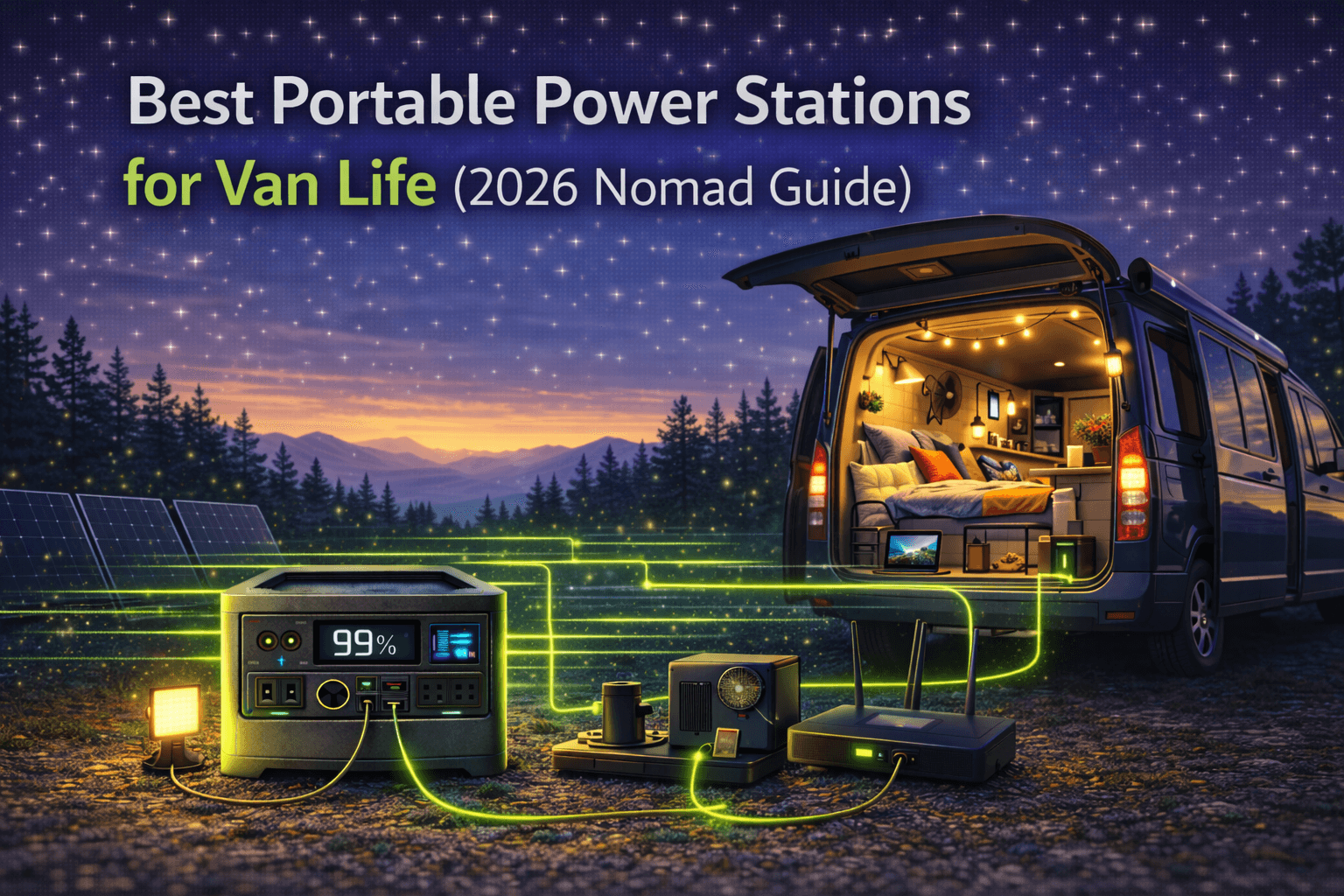
Van life isn’t camping with extra steps. It’s full-time residential living in a compact, mobile space — and the power demands reflect that. Your fridge runs 24/7, your laptop is your paycheck, and you might not see a wall outlet for weeks.
That’s a fundamentally different challenge than weekend camping or RV life. RVers get shore power at parks and have room for permanent installations. Campers pack up after three days and recharge at home. Vanlifers need a system that generates and stores enough energy to sustain daily life indefinitely — while fitting in a space the size of a closet.
Portable power stations changed the game. They pack 1,000–5,000Wh of capacity with built-in inverters, solar charge controllers, and multiple outlet types into a single removable box. No electrician needed. No permanent wiring. Just plug in your solar panels, connect your gear, and go.
This guide breaks down realistic daily power budgets, capacity sizing for different van life styles, solar integration strategies, and our top portable power station picks for nomadic living.
Note: This guide contains affiliate links. If you purchase through our links, we may earn a commission at no extra cost to you.
How Much Power Does Van Life Actually Use?
Most van builds fail on power because the builder guessed instead of calculated. Here’s what real consumption looks like.
The 24/7 Loads
Refrigeration is your biggest draw. A typical 12V compressor fridge (35–65 liters) cycles on and off throughout the day. The compressor pulls 40–60W while running, but it’s the duty cycle that determines real consumption:
- Hot climate (90–100°F ambient): ~25W average continuous → 600Wh/day
- Moderate climate (65–80°F): ~16W average → 384Wh/day
- Cold climate (32–50°F): ~10W average → 252Wh/day
One detail most guides skip: manufacturer specs dramatically underestimate real-world fridge consumption. Lab tests show neat numbers like 1.3Ah/hour, but field testing by long-term vanlifers documents averages closer to 2Ah, spiking to 4.5Ah in heat. Budget conservatively. Your fridge will likely eat 30–50% of your total daily power.
Ventilation matters more than you’d think. Roof vent fans (Maxxair, Fantastic Fan) pull 10–15W on low and 30–50W on high. In mild weather, figure 4–6 hours of use at 80–150Wh/day. During summer heat waves, you’ll run fans 8–12 hours on high — easily 240–600Wh/day. This is the hidden power drain that catches people off guard.
The Work and Life Loads
Laptop work (digital nomads): Modern laptops consume 30–60W for typical tasks (browsing, documents, video calls), climbing to 60–100W for intensive work like video editing. An 8-hour remote work day (our Starlink guide covers satellite internet power needs) runs 320–600Wh depending on workload. For many vanlifers, this is the second-largest power consumer after the fridge.
Devices and charging: Two phones, a tablet, camera batteries, headlamp, e-reader, portable speaker — collectively around 120–140Wh/day for a typical vanlifer, up to 200–250Wh/day for content creators and photographers.
LED lighting: Interior strips plus reading lights usually total 50–80Wh per evening. Low draw, but it adds up over time.
Electric cooking: Most vanlifers stick to propane for cooking and only use electrical appliances occasionally. An electric kettle (1,500W × 5 minutes) adds 125Wh. An induction cooktop (1,800W × 20 minutes) burns through 600Wh — use it sparingly unless you have serious capacity.
Realistic Daily Power Budgets
Here’s what these numbers look like in practice:
Minimalist weekend warrior (occasional trips, basic needs): Fridge (moderate) 384Wh + devices 50Wh + lighting 50Wh = ~484Wh/day
Standard vanlifer (extended trips, moderate use): Fridge (summer) 600Wh + laptop 4hrs 220Wh + devices 120Wh + lighting 60Wh + vent fan 120Wh = ~1,120Wh/day
Digital nomad full-timer (intensive laptop work, year-round): Fridge (summer) 600Wh + laptop 8hrs 440Wh + devices 200Wh + lighting 80Wh + vent fan 180Wh = ~1,500Wh/day
Content creator (heavy camera/drone/editing): Fridge 600Wh + laptop editing 8hrs 600Wh + camera/drone batteries 250Wh + devices 150Wh + lighting 100Wh + vent fan 200Wh = ~1,900Wh/day
Season Makes a Huge Difference
Summer increases fridge load 40–60% and vent fan usage dramatically, but solar generation also climbs 30–50% with longer days. Winter drops fridge consumption but slashes solar output by 40–60%. If you’re using electric heating (most vanlifers use propane instead), winter can add 1,000–3,000Wh/day — a budget-breaker for most setups.
The bottom line: summer runs hot on both consumption and generation, roughly balancing out. Winter is the real challenge — less generation and potentially higher demand create a deficit that requires either reduced consumption, alternator charging, or occasional shore power.
The Capacity Sizing Formula
Here’s the math that keeps you off-grid without anxiety:
Battery capacity = Daily consumption × 2.5 (weather buffer) ÷ 0.50 (target depth-of-discharge)
Solar wattage = Daily consumption × 1.5 ÷ Peak sun hours (3–4 average) ÷ 0.75 (real-world efficiency)
For a standard vanlifer at 1,120Wh/day: battery ideal = 5,600Wh, solar needed ≈ 640W. That’s the “never worry” target.
The practical compromise: 2,000–2,500Wh battery capacity + 400W solar gets most vanlifers through comfortably. Solar generates 1,200Wh+ on sunny days (exceeding daily consumption), and battery capacity buffers 1.5–2 cloudy days. It’s tight but manageable with awareness, and it’s where most successful van builds land.
Portable Power vs. Built-In: Why Not Both?
This is the most debated topic in van life communities, and the honest answer is that both approaches have real advantages.
Why Portable Wins for Many Vanlifers
Security is the killer feature. You can grab a portable station and take it with you when parking somewhere sketchy overnight. Built-in systems are theft targets — a smashed window and your entire $3,000+ electrical system disappears. With a portable unit, you walk into an Airbnb or café with your power and laptop. Thieves find an empty van.
Flexibility matters daily. A portable station moves to follow the sun (morning east side, afternoon west side), repositions to a tent for side trips, and transfers between vehicles when you upgrade vans. Built-in systems stay bolted in place.
Upgrades are simple. Swap out a portable unit in minutes. Upgrading built-in wiring takes days and potentially professional help.
Where Built-In Systems Win
Alternator charging integration. A DC-DC charger connected to your alternator delivers 30–60A while driving — far more than the 60W trickle you get through a portable station’s 12V car port. A 2-hour drive can push 400–700Wh into a built-in battery versus ~120Wh into a portable.
Higher sustained loads. Built-in wiring handles continuous high-draw appliances (induction cooktops, air conditioning, space heaters) more reliably through dedicated circuits.
Lower cost per Wh (DIY). A DIY LiFePO4 build with commodity cells runs $0.30–0.50/Wh versus $0.70–1.00/Wh for portable stations.
The Hybrid Approach (What Experienced Nomads Do)
Many long-term vanlifers run both: a small built-in battery (100Ah LiFePO4, ~1,280Wh) with alternator charging handles the fridge and base loads. A portable 1,000–2,000Wh station covers laptop work, devices, and removable security. Combined capacity of 2,300–3,300Wh with built-in redundancy. If either system fails, you still have power.
Best Portable Power Stations for Van Life
1. EcoFlow Delta 2 — Best Van Life Value
Price: $999 | Capacity: 1,024Wh (expandable to 3,072Wh) | Output: 1,800W
The Delta 2 hits the sweet spot for standard van life. The 1,024Wh base handles a typical daily budget of ~1,100Wh with solar discipline, and you can expand to 3,072Wh later if your needs grow.
| Spec | Detail |
|---|---|
| Capacity | 1,024Wh (expandable to 3,072Wh with extra battery) |
| AC Output | 1,800W continuous (2,700W surge) |
| Weight | 27 lbs |
| AC Charging | 0–100% in 80 minutes |
| Solar Input | 500W max |
| Battery | LiFePO4, 3,000+ cycles |
| Ports | 6× AC, 2× USB-C (100W), 4× USB-A, 2× DC |
| Warranty | 5 years |
Why it works for van life: The 27-pound weight is the practical ceiling for daily carry-in/carry-out security. You can take it into a grocery store, a coffee shop, or a tent without killing yourself. Heavier units (50–60+ lbs) become semi-permanent installations, eliminating the portability advantage.
The 80-minute AC charging is a genuine game-changer for nomadic life. Stop at a café for 90 minutes of WiFi and laptop work, leave with a fully charged battery. Competitors that take 4–6 hours force you to stay overnight somewhere with power — reducing the flexibility that makes van life worthwhile.
The 500W solar input accommodates typical van roof arrays (3–4 × 100W panels). A 300W roof setup recharges the Delta 2 in 3–4 hours of decent sun, maintaining a positive daily energy balance in most conditions.
Where it’s tight: 1,024Wh is ~92% of a standard vanlifer’s daily consumption. No margin for cloudy days or heavy-use days without solar. This requires daily charging discipline — either consistent solar or regular town stops. Adding the expansion battery ($799+) doubles capacity but nearly doubles cost.
Best for: Solo vanlifers with moderate power needs, digital nomads who hit cafés regularly, anyone prioritizing portability and fast charging over raw capacity.
For a deeper look at EcoFlow’s full lineup, see our Best EcoFlow Portable Power Stations guide.
2. Bluetti AC200L — Best for Full-Time Van Life
Price: ~$1,099–1,399 | Capacity: 2,048Wh (expandable to 8,192Wh) | Output: 2,400W
The AC200L targets committed full-timers who need comfortable daily margins rather than razor-thin budgets — and it does it at a significantly lower price than its predecessor while delivering more power and faster charging.
| Spec | Detail |
|---|---|
| Capacity | 2,048Wh (expandable to 8,192Wh with 2× B300) |
| AC Output | 2,400W continuous (3,600W Power Lifting Mode) |
| Weight | 62.4 lbs |
| AC Charging | 0-80% in 45 minutes (2,400W input) |
| Solar Input | 1,200W max |
| Battery | LiFePO4, 3,500+ cycles |
| Connectivity | WiFi + Bluetooth |
| UPS | 20ms automatic switchover |
| Noise Level | ≤50dB |
| Ports | 4× AC, 1× TT-30 RV, 1× USB-C (100W), 2× USB-A, 1× 48V/8A DC, 1× 12V/10A car |
| Expandability | B300K (2,764.8Wh), B300 (3,072Wh), B230 (2,048Wh), B210 (2,150Wh) — max 2 modules |
| Warranty | 5 years |
Why full-timers love it: A digital nomad consuming 1,500Wh/day uses 73% of the AC200L’s capacity, leaving real margin for unexpected loads, cloudy stretches, or summer heat-wave vent fan marathons. That buffer eliminates the daily power anxiety that smaller units create.
The 1,200W solar input maximizes van roof potential — a 33% increase over the previous generation. A 600W roof array (feasible on a standard Sprinter or ProMaster) charges this unit fully in good sun, generating 2,400Wh+ on clear days. That’s well above daily consumption for indefinite boondocking.
The 2,400W output (3,600W in Power Lifting Mode) opens the door to electric cooking that lighter units can’t handle. Running an induction cooktop for a quick dinner (1,800W × 20 min = 600Wh) uses 29% of daily capacity — acceptable as a supplement to propane rather than a replacement. Power Lifting Mode handles even demanding heating appliances up to 3,600W.
The charging speed changes the game. The AC200L’s 0-80% in 45 minutes via 2,400W AC input is a massive upgrade. Stop at a laundromat for an hour, leave with a nearly full battery. Previous-gen units in this capacity tier took 4–6 hours for a full charge, forcing you to stay overnight somewhere with power. The AC200L eliminates that constraint.
WiFi monitoring from inside the van. Unlike older Bluetti models limited to short-range Bluetooth, the AC200L connects via WiFi. Check battery levels, consumption rates, and charging status from the Bluetti app without crawling to the back of the van to read the display — especially useful when the unit is buried under gear or mounted in a cabinet. The 20ms UPS switchover also protects sensitive electronics if you’re switching between shore power and battery.
The weight trade-off: At 62.4 lbs, you’re not casually carrying this into a grocery store. Most AC200L vanlifers install it semi-permanently and use a cable lock for security rather than removing it daily. That’s a real compromise — you lose the grab-and-go flexibility of lighter units.
Best for: Full-time vanlifers and couples, digital nomads with heavy daily consumption, anyone prioritizing capacity, solar input, and fast charging over daily portability.
Check Price on Bluetti
Also on Amazon
Check out our Best Bluetti Portable Power Stations comparison for more Bluetti options.
3. Jackery Explorer 1000 Plus — Best Long-Term Value
Price: $899 | Capacity: 1,264Wh (expandable to 5,056Wh) | Output: 2,000W
The 1000 Plus balances capacity, longevity, and price better than anything else in this range.
| Spec | Detail |
|---|---|
| Capacity | 1,264Wh (expandable to 5,056Wh with 3× battery packs) |
| AC Output | 2,000W continuous (4,000W surge) |
| Weight | 32 lbs |
| AC Charging | ~100 minutes (wall outlet) |
| Solar Input | 800W max |
| Battery | LiFePO4, 4,000 cycles to 70%+ capacity |
| Ports | 3× AC, 2× USB-C (100W), 2× USB-A, 1× car port |
| Warranty | 3+2 years |
Why the battery life matters: 4,000 LiFePO4 cycles is the headline spec here. Full-time van life cycling daily means 365 cycles/year — that’s nearly 11 years before reaching 70% capacity. For comparison, the Delta 2’s 3,000 cycles reaches that point in ~8 years. Over a decade of van life, the Jackery costs less per year of service despite similar upfront pricing.
The 1,264Wh capacity edges out the Delta 2 by 23%, providing a small but meaningful daily buffer. At 1,120Wh/day standard consumption, you’re at 89% capacity instead of 92% — still tight, but a bit more breathing room.
The 800W solar input future-proofs for expansion. If you start with 300W on the roof and later upgrade to a 600W+ array, the charge controller handles it without needing a new unit.
The portability compromise: 32 lbs is manageable but noticeable. It’s a two-handed carry, and you’ll feel it climbing van steps. Most people remove it for genuinely sketchy overnight parking (maybe 2–3 times a week) rather than every time they run errands.
Best for: Budget-conscious van builds prioritizing long-term value, vanlifers who keep units 5+ years, anyone who values reliability and proven brand reputation over cutting-edge features.
Check Price on Jackery
Also on Amazon
For more Jackery options, see our Best Jackery Portable Power Stations guide.
Quick Comparison
| Feature | EcoFlow Delta 2 | Bluetti AC200L | Jackery 1000 Plus |
|---|---|---|---|
| Capacity | 1,024Wh | 2,048Wh | 1,264Wh |
| Output | 1,800W | 2,400W (3,600W lifting) | 2,000W |
| Weight | 27 lbs | 62.4 lbs | 32 lbs |
| Battery Cycles | 3,000+ | 3,500+ | 4,000 |
| Solar Input | 500W | 1,200W | 800W |
| AC Charge Time | 80 min | 45 min to 80% | ~100 min |
| Expandable To | 3,072Wh | 8,192Wh | 5,056Wh |
| Connectivity | WiFi + Bluetooth | WiFi + Bluetooth | Bluetooth |
| Price | $999 | ~$1,099–1,399 | $899 |
| Best For | Fast charging, portability | Full-time capacity + solar | Long-term value |
Need help matching capacity to your specific situation? Our How to Choose a Portable Power Station guide walks through the decision framework step by step. And if you’re still weighing whether a power station or generator makes more sense for your van, see Portable Power Stations vs. Generators.
Solar Integration for Van Life
Solar is what makes indefinite boondocking possible. Without it, you’re just draining batteries and hunting for outlets.
Realistic Roof Solar Capacity
Your van’s roof determines your upper limit:
- Compact vans (Transit Connect, ProMaster City): 200–300W max (2–3 rigid panels)
- Standard vans (Transit, Sprinter, ProMaster): 400–600W typical (4–6 panels)
- Extended/large vans (extended Sprinter, box trucks): 600–800W+ possible
A 400W roof array generates approximately 1,200–1,600Wh/day in summer (4–5 peak sun hours), 800–1,200Wh in spring/fall, and 400–800Wh in winter. Annual average hovers around 900Wh/day sustained — enough to cover a standard vanlifer’s daily consumption with modest margin.
Portable Panel Supplements
Portable foldable panels (100–200W) are the secret weapon for maximizing generation. While roof panels are locked to your van’s parking angle, portable panels deploy at optimal angles wherever the sun is strongest.
Adding a 200W portable supplement to a 400W roof array bumps total potential to 600W. On a sunny stationary day, that portable panel alone adds ~600Wh of generation — a 67% increase over roof panels alone. At $300–400 for a good 200W foldable, it pays for itself quickly through reduced dependence on shore power.
For a detailed guide on pairing panels with your power station, check out our Solar Panel Guide: Setup & Sizing. If you want pre-matched kits, our Best Solar Bundles roundup covers the top options.
The Sustainable Sizing Formula
Required solar wattage = Daily consumption × 1.5 ÷ Peak sun hours (3–4) ÷ 0.75 (efficiency losses)
For a standard vanlifer at 1,120Wh/day: 1,120 × 1.5 ÷ 3.5 ÷ 0.75 ≈ 640W
In practice, 400W roof panels plus a 200W portable supplement (600W total) provides sustainable generation for indefinite boondocking when paired with 2,000–2,500Wh battery capacity. The portable supplement covers generation gaps during cloudy weather or high-consumption days.
Van Life Power Tips From the Road
Track your actual consumption for two weeks before buying. A $15 power meter on your fridge alone reveals whether manufacturer claims match reality. Most vanlifers discover their fridge draws 20–40% more than spec sheets promise.
Charge during errands, not as a dedicated stop. Fast-charging stations (EcoFlow Delta 2 especially) turn a 90-minute grocery and coffee run into a full recharge. Build charging into activities you’re already doing rather than chasing outlets.
Manage loads actively during cloudy stretches. Skip the electric kettle, reduce vent fan speed, close the fridge less often. Shaving 200–300Wh/day during a 3-day cloudy spell is the difference between making it through and running dry.
Keep your battery between 20% and 80% for daily cycling. LiFePO4 batteries handle deep discharges, but staying in the middle range maximizes cycle life. Save 0–100% cycles for when you actually need the full capacity.
Winter changes everything. If you’re chasing warmth (most vanlifers head south October–March), solar generation stays reasonable. If you’re winter camping in northern latitudes, plan on alternator charging or occasional shore power — solar alone won’t sustain daily needs with 6–8 hours of weak winter sun.
For more on keeping your battery healthy through seasons and years, see our Portable Power Station Lifespan Guide and Winter Guide.
Frequently Asked Questions
How much battery capacity do I actually need for van life?
It depends on your lifestyle and risk tolerance. Here’s the practical breakdown:
Budget approach ($900–1,500): 1,000–1,500Wh + 300W solar. Requires daily charging discipline and active load management. Works if you’re consistent, but cloudy weather stresses the system.
Comfortable approach ($1,500–2,500): 2,000–2,500Wh + 400–600W solar. Tolerates 1–2 cloudy days without behavioral changes. This is where most successful full-time vanlifers land.
Heavy-duty approach ($2,500+): 3,000–4,000Wh + 600W+ solar. Justified for couples, content creators, or anyone running significant equipment. Overkill for solo standard use.
The right answer for most solo vanlifers: 1,500–2,500Wh capacity with 400–500W solar. Minimalists manage on less. Digital nomad couples need more.
Can a portable power station replace a full van electrical build?
For most solo vanlifers and couples with moderate needs, yes. A 1,000–2,000Wh portable station with roof solar covers fridge, laptop, devices, lighting, and ventilation without permanent wiring.
Where portables fall short: alternator charging efficiency (built-in DC-DC chargers capture 3–4× more energy while driving), maximum sustained draw for power-hungry appliances (AC units, space heaters), and seamless integration with 12V van systems. The hybrid approach solves most of these gaps.
How long can I boondock on a single charge?
With no solar and a 2,000Wh battery at standard 1,120Wh/day consumption: roughly 1.5 days before hitting 20% reserve. Add 400W of solar generating 1,200Wh on sunny days, and you can boondock indefinitely — solar generation exceeds daily consumption, and the battery buffers cloudy spells.
Use our Runtime Calculator to estimate runtimes based on your specific devices and consumption.
Should I get one large unit or two smaller ones?
Two smaller units provide redundancy (if one fails, you still have power), flexibility (take one to a tent, leave one in the van), and potentially better security (easier to carry). One large unit simplifies cable management and typically costs less per Wh.
For full-time living where equipment failure means a serious disruption, redundancy has real value. A 1,000Wh + 500Wh combo covers more scenarios than a single 1,500Wh unit, even though total capacity is the same.
Our Van Life Recommendations
Best value for standard van life: EcoFlow Delta 2 ($999) — 1,024Wh, 27 lbs, 80-minute fast charging. The right balance of capacity, portability, and charging speed for solo vanlifers who hit town regularly.
Best for full-timers: Bluetti AC200L (~$1,099–1,399) — 2,048Wh, 2,400W output, 1,200W solar input, 45-minute fast charging, WiFi monitoring, expandable to 8,192Wh. Comfortable daily margins and maximum solar potential for committed nomads who’ve moved past worrying about portability.
Best long-term value: Jackery Explorer 1000 Plus ($899) — 1,264Wh, 4,000-cycle battery, proven reliability. The smart buy for vanlifers who plan to keep their setup for years and prioritize durability over bleeding-edge features.
For broader comparisons across all use cases and budgets, see our complete Best Portable Power Stations Buyer’s Guide.