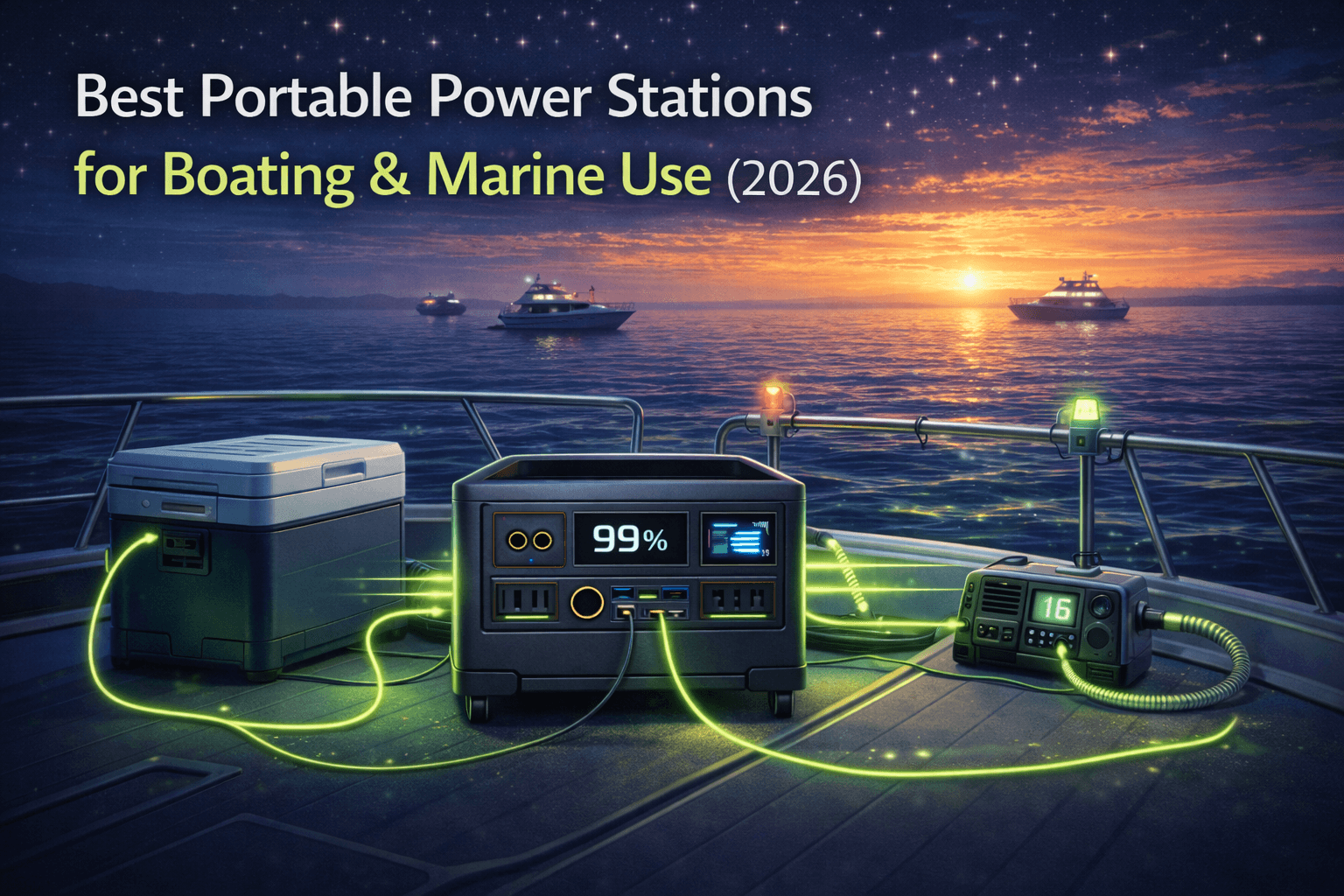
Most fishing boats, pontoons, jon boats, kayaks, and small cruisers were designed with a starting battery and minimal 12V wiring. That setup barely handles a basic fish finder, let alone a modern chartplotter, VHF radio, livewell pump, LED lighting, and USB charging — all running simultaneously for eight hours.
A portable power station solves this cleanly. One compact, silent battery with a built-in inverter and regulated DC outputs can power your electronics all day without running the main engine or dragging along a gas generator with its noise, fumes, and maintenance headaches. For anglers who need reliable sonar from dawn to dusk, families anchoring out overnight, or kayakers running cameras and navigation gear, it’s essentially a miniature house bank without the rewiring.
But here’s the catch: the marine environment will destroy equipment that works perfectly on land. Saltwater spray deposits conductive crystals into every seam and onto circuit boards. Decks hit 120–140°F under direct sun. Boats pound through chop, vibrate constantly, and heel under power. A portable power station rated for camping trips can fail within weeks of regular marine exposure if you don’t protect it properly.
This guide covers what actually matters for running portable power on the water: realistic waterproofing requirements, marine power loads you’ll encounter, specific setups that work, trolling motor considerations, and the safety practices that keep your gear (and crew) out of trouble.
Note: This guide contains affiliate links. If you purchase through our links, we may earn a commission at no extra cost to you. This helps support our testing and content creation.
Why IP Ratings Matter More on Boats
Most popular portable power stations — including many from EcoFlow, Jackery, and Bluetti — carry no meaningful water resistance rating. Vague marketing terms like “splash-proof” or “weather-resistant” mean nothing around saltwater. If a unit doesn’t have a specific IP rating, treat it as an indoor-only device.
Here’s what the IP ratings actually mean in a marine context:
The first digit (0–6) indicates dust protection. IP6x means dust-tight — critical because fine salt particles behave like conductive dust. The second digit (0–9) indicates water protection. IPx4 handles light splashing. IPx5–x6 withstands water jets. IPx7 survives temporary submersion up to 1 meter for 30 minutes. IPx8 handles continuous submersion at manufacturer-specified depths.
For anything sitting on an open deck, IP67 is the practical minimum — dust-tight and able to survive an accidental dunk or heavy spray. IP68 is better but extremely rare in consumer power stations. The reality is that almost no mainstream portable power station carries a true IP67 rating out of the box.
That gives you three practical options:
Option 1: Buy IP67+ rated equipment. This narrows your choices significantly and costs more, but it’s the simplest approach for deck-mounted gear.
Option 2: Use a standard power station inside an IP67-rated hard case (Pelican-style) with sealed cable glands for power routing. This is the most popular marine approach — you get the power station you want with genuine waterproofing added around it.
Option 3: Keep non-rated units in protected compartments — inside consoles, cabin lockers, or under hardtops — where they stay dry and ventilated. Simple, cheap, and effective on boats with enclosed storage.
Whichever path you choose, corrosion management is ongoing. Even a locker-stored unit gets exposed to humid, salty air every time you open the hatch. Rinse adjacent surfaces with fresh water after each trip, apply dielectric grease to 12V and Anderson connectors, inspect external fasteners for early rust, and store the station ashore between trips whenever possible. These habits extend equipment life dramatically in saltwater environments.
How Much Power Do You Actually Need on a Boat?
Sizing mistakes are expensive. Undersize and you’re dead in the water by mid-afternoon. Oversize and you’re hauling unnecessary weight and spending money you didn’t need to. Here’s how typical marine loads actually break down.
Electronics (the easy part)
Fishing electronics and navigation gear draw modest, steady power. A typical 7–9” fish finder/GPS combo pulls 15–25W at readable brightness. Larger 10–12” multifunction displays draw 25–35W. Standalone GPS units run 5–10W. VHF radios consume about 5–10W on receive, with brief spikes during transmit.
Over an eight-hour fishing day, a combined electronics suite (MFD, GPS, VHF) typically consumes 200–350Wh total. That’s manageable for even a mid-sized power station.
Livewells and Pumps (the hidden drain)
This is where many anglers get surprised. A small aerator draws 40–60W. A recirculation pump can pull 60–100W when running. Eight hours of continuous pump operation at 60W eats 480Wh — potentially more than all your electronics combined.
If you keep bait or catch alive all day, factor this load carefully. It’s often the single biggest draw on a fishing boat.
Trolling Motors (the deal-breaker)
Trolling motors operate on a completely different scale. Even a modest 30–40lb thrust motor draws several hundred watts at higher settings. A 55lb thrust motor in normal mixed-speed use can consume 1,000–1,300Wh over four hours. Larger 80–112lb thrust units can exceed 1,000W continuous draw.
The practical solution for most boats: keep trolling motors on dedicated marine batteries and reserve your portable power station for electronics and comfort loads. Trying to run both from a single portable unit requires 2,000–3,000Wh of capacity and very careful runtime planning.
Day Trip Budget (no trolling motor)
A realistic eight-hour day with fish finder, GPS, VHF, livewell pump, and some LED lighting totals roughly 700–1,000Wh. A 1,000–1,500Wh station handles this with a comfortable margin, keeping you above the 20% battery floor that protects long-term battery health.
Overnight Anchoring Budget
Nights at anchor have a different consumption pattern. LED anchor and nav lights are efficient — often under 10W total. But a DC cooler averaging 25W over 24 hours adds 600Wh alone. A fan running eight hours adds 200Wh. Devices and misc loads add another 80–150Wh.
Total for a comfortable overnight: roughly 1,000–1,100Wh. A 1,500–2,000Wh station covers one full night with margin for a partial second, especially if you can top up with a portable solar panel during the day.
The Sizing Formula
Inventory your specific loads, estimate hours of use for each, multiply to get watt-hours, then add a 30–50% margin. That buffer accounts for inverter efficiency losses (typically 10–15%), unexpected use, and the fact that regularly draining a battery below 20% accelerates degradation. For more detail on calculating runtime, see our runtime calculator guide.
Best Portable Power Stations for Marine Use
1. Jackery Explorer 1000 Plus in IP67 Hard Case — Best Overall Marine Setup
Why it works: The Jackery Explorer 1000 Plus paired with a Pelican-style IP67 hard case is the most practical marine power solution for the majority of boaters. You get proven power station reliability with genuine waterproofing, at a price point well below purpose-built marine systems.
The Explorer 1000 Plus delivers 1,264Wh of LiFePO4 capacity with a 2,000W pure sine wave inverter. That’s enough to run fish finders, GPS, VHF, a livewell pump, and lighting for a full eight-hour day with capacity to spare. The LiFePO4 chemistry gives you 4,000 cycles to 70% capacity — roughly a decade of regular use. At 32 lbs, it’s heavy enough to feel substantial but still manageable for carrying on and off a boat.
The IP67 hard case is what makes this setup marine-worthy. Choose a case sized to fit the 1000 Plus (14 × 10.2 × 11.1 inches) with room for ventilation. Install sealed cable glands for routing power leads, and you’ve got a system that handles heavy spray and even a brief accidental dunk while keeping the power station bone dry inside.
Best for: Day fishing trips, single-night anchorages, boats without dedicated marine battery banks. The station comes home after each trip for charging, further reducing salt exposure.
The trade-offs: Added bulk from the case, and you need to manage internal ventilation to prevent overheating during heavy draws in hot weather. Cable routing through glands requires some initial setup effort. But for most small-boat owners, this approach delivers 90% of the benefit of a marine-rated system at a fraction of the cost.
Check Price on Jackery
Also on Amazon
2. EcoFlow Delta 2 with Covered Storage — Best Lightweight Multi-Use Option
Why it works: If you trailer your boat, split time between land and water, or just want the lightest capable option, the EcoFlow Delta 2 in disciplined covered storage is tough to beat.
At 27 lbs (12 kg), the Delta 2 is meaningfully lighter than most 1,000Wh-class stations. Its 1,024Wh LiFePO4 battery and 1,800W inverter handle a full suite of fishing electronics, LED lighting, fans, and device charging without breaking a sweat. Where it really shines is charging speed: 0–80% in about 50 minutes via AC, with a full charge in around 80 minutes. Pull into the marina, plug in while you clean the boat, and you’re topped off before heading home.
The Delta 2 has no IP rating for water resistance, so the strategy here is placement, not enclosure. Keep it inside a dry console compartment, under a hardtop, in a cabin locker, or anywhere elevated and ventilated that stays dry. Remove it from the boat between trips. The same unit does double duty for camping, home backup, and general off-grid use — which makes the economics look even better.
Best for: Trailered boats with protected storage compartments, boaters who want one power station for both land and marine use, and anyone who values fast recharging and low weight.
The trade-offs: Lower capacity than the Jackery 1000 Plus (1,024Wh vs. 1,264Wh), so overnight anchoring gets tighter. No waterproofing at all — you’re relying entirely on where you stow it. On boats with minimal protected storage, a hard case solution is safer.
3. EcoFlow Delta 2 Max — Best for Trolling Motor Integration or Multi-Night Anchoring
Why it works: When 1,000Wh isn’t enough — you’re running a trolling motor off portable power, anchoring out for multiple nights, or powering heavy comfort loads — the Delta 2 Max’s 2,048Wh capacity and 2,400W inverter move into serious territory.
With roughly 2kWh on tap, you can run a full electronics suite for a long fishing day and keep a trolling motor at moderate settings for several hours, or sustain overnight anchoring loads for two nights with smart management. The 2,400W output handles high-draw devices that smaller stations can’t — think portable AC units, heavy-duty coolers, or multiple pumps running simultaneously. Solar input maxes out at 1,000W, so pairing it with high-wattage panels can significantly extend multi-day autonomy on the water.
Like the Delta 2, the Delta 2 Max has no water resistance rating. At 50 lbs, it’s also not something you’ll casually carry on and off a boat — it’s more of a semi-permanent installation in a protected location. If your boat has a cabin, large console, or dedicated battery compartment, the Delta 2 Max fits naturally as a supplemental house bank without any wiring changes.
Best for: Boats with trolling motors on portable power, multi-night anchoring, larger boats with enclosed storage, and boaters who want one station to handle everything.
The trade-offs: Heavy and expensive. Not easily portable between boats. No water resistance means it absolutely must live in a protected compartment. If you’re not using the extra capacity regularly, the Jackery 1000 Plus or standard Delta 2 offer better value per watt-hour.
How to Protect Any Power Station on a Boat
Even if your station lives in a locker, the marine environment demands active protection. Here’s what actually works.
Hard Case Approach (Best for Deck or Semi-Exposed Locations)
Pelican-style IP67 hard cases are the gold standard. They add waterproofing, impact protection, and prevent UV damage. Key details:
Choose a case with at least 2 inches of clearance around the power station on all sides for airflow. Install sealed cable glands (available from marine electrical suppliers) for power leads — don’t leave the case open with cables draped over the seal. Check the O-ring seal before each trip and replace it if it shows compression set or cracking. Dry the case exterior before opening to prevent trapped spray from dripping onto electronics.
Console or Cabin Storage (Simplest Approach)
If your boat has a dry, ventilated console compartment or cabin, this is the easiest path. Mount the station above bilge level on a non-slip pad. Use positive retention — straps, brackets, or a snug shelf — so the unit can’t shift in rough conditions. Make sure there’s adequate ventilation; a sealed compartment in summer sun can become an oven.
Corrosion Prevention (Non-Negotiable in Saltwater)
Apply dielectric grease to every removable connector — 12V plugs, Anderson connectors, and USB ports you’re not using (cap them if possible). Spray exposed metal fasteners and handles with a marine-grade anti-corrosion product approved for electronics. After each saltwater trip, wipe down the station and any exposed cables with a fresh-water damp cloth. Inspect terminals, screws, and handles monthly for early corrosion signs. Store the station ashore between trips whenever practical — this single habit does more to extend equipment life than anything else.
Marine Safety Essentials
Portable power stations are inherently safer than gas generators on boats — no carbon monoxide, no fuel spills, no hot exhaust. But mixing electricity with water still requires respect.
Placement rules: Never operate a non-rated power station where spray, rain, or puddles can reach it. Keep units above bilge level at all times. Dry external surfaces of cases and enclosures before opening them — trapped water on the lid can drip directly onto electronics.
Securing equipment: Heavy stations must be strapped down or mounted on non-slip surfaces. A 50-lb power station sliding across a deck in rough seas is a serious hazard. Route power cords to avoid trip hazards and chafe points. In an emergency (fire, flooding), you need to be able to disconnect or remove the power source quickly — don’t bury it behind other gear.
Electrical practices: Don’t stand in water when plugging or unplugging devices. Use GFCI-protected circuits where available. Don’t defeat safety features to gain extra outlets. When charging from shore power at a dock, use properly grounded, marine-rated cords only.
For a deeper dive into power station safety considerations, see our safety guide.
Frequently Asked Questions
Are portable power stations safe to use on boats?
Yes — when properly protected and installed. A power station that stays dry, is mounted securely, and powers appropriate loads through correctly rated cables is actually safer than a gasoline generator: no carbon monoxide risk, no fuel spills, and no hot exhaust near flammable materials. The key is treating non-rated consumer stations as indoor equipment, keeping them within weather-tight enclosures or protected compartments rather than exposed on deck.
Can I run a trolling motor from a portable power station?
You can, but the power demands are enormous. Even a modest 55lb thrust trolling motor can consume 1,000–1,300Wh over four hours of mixed-speed use. You’d need a 2,000Wh+ station and would have little capacity left for electronics. Most boaters keep trolling motors on dedicated marine batteries and reserve the portable station for electronics, pumps, and comfort loads — that’s the most practical split.
What size power station do I need for a day of fishing?
For electronics-only use (fish finder, GPS, VHF, livewell pump, LED lights), plan on 700–1,000Wh for an eight-hour day. A 1,000–1,500Wh station covers this with a healthy margin. If you’re adding a trolling motor to the equation, you’ll need 2,000Wh+ and should budget runtime carefully. Use our runtime calculator to model your specific load profile.
Do I need a waterproof power station for boating?
Not necessarily — but you need waterproof protection. Very few consumer power stations are IP67 rated. The practical approach is either housing a standard station in an IP67 hard case with sealed cable glands, or keeping it in a dry, ventilated compartment inside the boat. Either method works well; the important thing is never leaving an unprotected power station exposed to spray or rain on deck.
How do I prevent saltwater corrosion on my power station?
Dielectric grease on all connectors, fresh-water rinse-downs after each trip, capping unused ports, and storing the station ashore between outings. Marine-grade anti-corrosion spray on exposed metal parts helps too. Monthly inspections catch early corrosion before it becomes a problem. The single most effective habit is simply removing the station from the boat when you’re not using it. For more tips on maximizing your investment, see our maintenance guide.
Can I charge a portable power station with my boat’s solar panels?
Most portable stations accept solar input via MC4 or proprietary connectors, and many boat-mounted panels can be adapted to work. Check your station’s maximum solar input voltage and wattage — the EcoFlow Delta 2 accepts up to 500W at 11–60V, while the Jackery 1000 Plus handles up to 800W. Our solar panel setup guide covers compatibility and sizing in detail.
What about using LiFePO4 vs. lithium-ion (NMC) on a boat?
LiFePO4 is the clear winner for marine applications. It handles heat better (important on sun-baked decks), is more chemically stable (safer around water), and lasts 3–5x longer in cycle life. All three stations recommended in this guide use LiFePO4 chemistry. Older NMC-based stations work fine too, but they’re more sensitive to heat and typically offer only 500–1,000 cycles before significant degradation.