Introduction
Portable power stations store serious energy — typically 1,000 to 3,000Wh — and output 120V AC, enough to cause fatal electric shock. That alone warrants respect. The good news: quality units with modern battery management systems (BMS) make catastrophic failures rare. Standard household outlets deliver identical voltage, and cars store far more energy. The difference between safe use and an incident comes down to understanding the risks and following basic practices.
Modern units from reputable brands include multi-layered protection: BMS monitoring voltage, current, and temperature in real time; thermal management that refuses charging in unsafe conditions; and automatic shutdowns well before anything catastrophic happens.
But real incidents do happen. The HALO 1000 recall (August 2024) involved one death and four reported fires from battery overheating in roughly 5,740 units. EcoFlow’s Delta Max 2000 recall (October 2025) documented six fire incidents with over $850,000 in property damage across 25,030 units. Globally, power bank fires have surged: Japan reported 123 incidents in 2024 versus 47 in 2020, and Singapore hit a six-year high of 13 fires in 2024.
These aren’t random technology failures. They trace back to charging in extreme heat, using damaged equipment, buying uncertified units, or ignoring warning signs. This guide covers what actually reduces risk — from equipment selection to emergency procedures — so you can use backup power confidently.
Note: This guide contains affiliate links. If you purchase through our links, we may earn a commission at no extra cost to you. This helps support our in-depth testing and content creation.
Choosing Safe Equipment: Quality Matters
Your most consequential safety decision happens at checkout, not during operation. A certified unit with proper protection circuits versus a budget alternative with corners cut on BMS design — that choice determines your baseline risk more than anything else.
Certifications That Matter
UL 2743 is the specific standard for portable battery-powered equipment. UL (Underwriters Laboratories) testing verifies electrical safety, fire safety, and protection circuit function across normal and fault conditions. All major brands — EcoFlow, Jackery, Bluetti, Anker, Goal Zero — carry proper UL certifications, often covering both the complete system and individual battery components.
The gap between certified and uncertified units is significant. UL-certified units show roughly 0.3% fire and safety incident rates over extended use, while uncertified units run closer to 2.1% — about 7 times higher. Certification requires manufacturers to test batteries for abuse conditions (overcharge, thermal exposure, puncture, crushing) and verify that protection circuits function under fault conditions. Uncertified equipment skips these tests entirely.
FCC certification confirms electromagnetic interference compliance and signals the manufacturer follows regulatory processes. CE marking (Europe) covers multiple regulatory requirements. UN38.3 verifies batteries pass abuse testing without catastrophic failure.
Red Flags to Watch For
No certifications listed anywhere. Legitimate manufacturers display UL, FCC, and CE markings prominently. If the product page and documentation don’t mention certifications, treat it as uncertified.
Pricing 40-60% below competitors with identical specs. Quality batteries, inverters, and BMS circuits cost money. A “2000Wh for $400” unit competing against $800-1,000 alternatives with identical capacity has cut costs somewhere critical — usually in cell quality and protection circuits.
Unknown brands with zero support infrastructure. No US presence, no accessible customer service, no replacement parts. If something goes wrong, you’re on your own.
Identical hardware under multiple brand names on Amazon. When the same physical unit appears under five to ten different “brands” with conflicting specs, that’s white-label generic equipment with no manufacturer standing behind quality.
Trusted Brands
EcoFlow carries UL 2743 certification and recently achieved UL 9540B fire safety certification for its OCEAN Pro system. Strong BMS with temperature monitoring and well-regarded customer support. Jackery offers UL certifications with conservative engineering — they prioritize safety margins over maximum specs. Bluetti certifies properly, uses quality components across multiple battery chemistries including sodium-ion, and implements active thermal management. Anker brings consumer electronics safety standards to portable power. Goal Zero maintains a long-standing safety reputation in the outdoor industry.
For detailed brand comparisons, see our EcoFlow guide, Jackery guide, or Bluetti guide.
The practical takeaway: pay the 20-40% premium for certified brands. Battery fires cause thousands in property damage and injury risk — that’s not where you save money.
Safe Operation Practices
Most user-caused incidents trace back to four things: overloading, poor ventilation, environmental hazards, and unrecognized physical damage. All preventable with basic awareness.
Overload Prevention
Every power station specifies a maximum continuous output in watts. Exceeding that rating triggers protection circuits (the intended outcome), but repeated overload stress degrades internal components over time. Running at 95-100% of rated capacity for extended periods elevates internal temperatures 15-25°F above normal and forces fans into overdrive.
Size with a 20-30% safety margin. If you need 1,500W continuously, buy a 2,000W unit. This keeps the equipment in its comfortable operating range, reduces thermal stress, and extends lifespan. For help calculating your actual needs, our buying guide walks through the math step by step.
Warning signs of overload: excessive fan noise, frequent automatic shutdowns, housing warm enough to be uncomfortable, or any burning smell (shut down immediately).
Ventilation Is Non-Negotiable
Power stations generate heat during both charging and discharging. Inadequate airflow traps that heat inside, degrading battery chemistry and potentially triggering thermal protection — or worse.
The numbers tell the story clearly. Units in open space with good airflow maintain 95-105°F internal temperatures during operation. Units in cabinets with minimal ventilation reach 120-135°F. Units sealed in containers with no airflow hit 140-155°F, where BMS systems typically refuse further operation.
Keep minimum 6 inches of clearance on all sides during operation. Never run the unit inside sealed containers, coolers, plastic bins, or closed cabinets. Keep cooling fan vents unobstructed. Avoid direct sunlight, which adds radiant heat to the problem.
Placement and Physical Damage
These units weigh 20-100+ pounds depending on capacity. A fall from a shelf causes equipment damage, potential injury, and internal component stress that may not show symptoms for weeks. Ground-level or secured low-shelf positioning is safest. In vehicles, use straps, brackets, or dedicated compartments.
Dropping, crushing, or puncturing a power station can cause delayed failures. One documented case: a unit dropped 3 feet onto concrete showed no external damage but developed charging issues two weeks later from internal connection damage. Another unit suffered a small puncture, and the user continued operating it — thermal runaway followed 48 hours later.
If you drop or impact your unit: inspect thoroughly, discontinue use if you see dents, cracks, punctures, or swelling, and contact manufacturer support. Don’t assume “looks okay” means safe.
Symptoms Requiring Immediate Action
- Visible swelling (case bulging or deformation)
- Unusual localized heat (hot spots rather than uniform warmth)
- Chemical smells (sweet or acrid, distinct from normal plastic)
- Hissing or popping sounds
- Visible flames
Any of these: move the unit outdoors away from flammables immediately. Contact the manufacturer. For visible flames or severe symptoms, call the fire department. Do not continue operating damaged equipment.
Moisture Protection
Despite the “portable” label, these units aren’t waterproof. Water exposure risks short circuits, corrosion, and electrical shock. Keep them dry, store in dry locations, avoid rain exposure, and never operate with wet hands or in standing water.
If water exposure occurs: immediately disconnect all cables, power off, and allow 48 hours of complete drying in a warm, dry location with good airflow. For significant exposure (submersion, extended rain), contact the manufacturer before attempting to power on.
Charging Safety
Charging is when batteries work hardest and generate the most heat. This makes it the most critical safety phase — not because charging is inherently dangerous, but because conditions matter most here.
Temperature During Charging
Batteries charge safely only within specific temperature ranges. Quality units refuse charging outside those ranges, which is protective behavior, not a malfunction.
At 70°F ambient, internal battery temperature during charging typically reaches 85-95°F — normal. At 95°F ambient, batteries hit 110-120°F, and some units correctly suspend charging. At 25°F, charging is refused entirely to prevent cold-weather damage.
Charge in moderate temperatures (50-85°F). Avoid direct sun. Never charge in a hot car, hot attic, or other enclosed space where heat builds. If a unit that normally charges fine suddenly refuses or gets unusually warm, investigate conditions before continuing.
Location Matters
Fires during charging with quality equipment are extremely rare, but smart location choice minimizes consequences if something does go wrong.
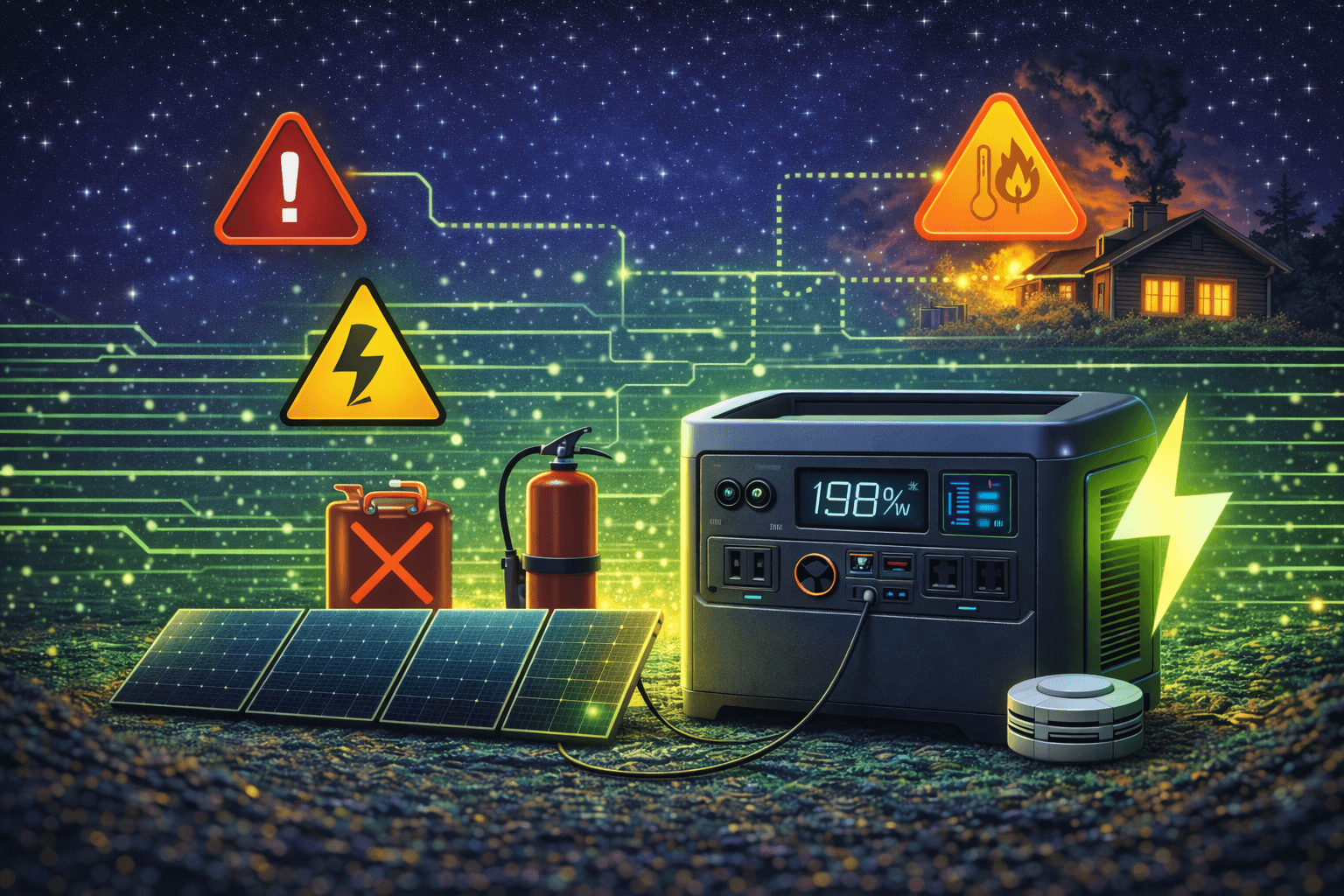
Use non-flammable surfaces (concrete, tile, metal — not wood, carpet, or bedding). Keep 3+ feet of clearance from curtains, upholstered furniture, papers. Make sure there’s a smoke detector nearby and a fire extinguisher accessible. An ABC-rated fire extinguisher covers electrical fires and should be within reach of any charging area.
Documented fires show preventable patterns: charging on a bed (bedding ignited when the unit faulted), charging in a closet (zero ventilation, flammable clothing everywhere), charging next to gasoline storage. Each case was foreseeable and avoidable.
Use the Right Charger
Manufacturer chargers communicate with the BMS, adjusting charge rates based on real-time battery conditions. Generic third-party chargers lack this communication, potentially causing suboptimal charging or forcing the BMS to correct problems it shouldn’t have to handle.
Use manufacturer-supplied chargers exclusively. Inspect cables for fraying or damage before each use. Replace damaged chargers immediately — don’t tape-repair them. Unplug after charging completes.
Solar Charging
Solar charging is generally safer than AC — lower charge rates, outdoor ventilation, less heat. But it requires attention to detail: verify panel voltage matches your unit’s input specifications, ensure correct polarity, and never exceed maximum solar input wattage. Disconnect during lightning storms.
Documented solar errors include reverse polarity connections causing instant BMS failure and series-connected panels exceeding input voltage limits. Follow your unit’s specifications exactly.
Storage Safety
Stored units continue undergoing chemical processes. Unlike active use where you’re watching for warning signs, stored equipment needs the right environment and periodic checks.
Conditions and Charge Level
Maintain 40-80°F storage temperature. Avoid hot attics (summer temps reach 120-140°F), unheated sheds below freezing, and damp environments. Units stored in moderate basement conditions (60-70°F) showed zero issues over 3+ years. Units in hot garages (summer 95-110°F) developed swelling and BMS faults within 18 months.
Store at 50-60% charge. Full charge (100%) stores maximum energy — highest chemical stress. Empty (0-10%) stresses cells differently. The 50-60% sweet spot balances emergency readiness with reduced chemical stress and optimal battery health. Verify charge level quarterly.
Quarterly Inspection
Five-minute checks prevent surprises:
- Inspect for swelling (case bulges indicating internal pressure)
- Check for warmth (dormant units should feel ambient temperature)
- Smell for chemical odors (sweet or acrid)
- Verify charge level hasn’t dropped excessively (2-5% monthly self-discharge is normal; faster suggests a fault)
- Power on briefly to confirm functionality
If you find swelling, unusual heat, or chemical smells during inspection, move the unit outdoors immediately and contact the manufacturer.
Emergency Procedures
Quality equipment with proper use makes serious incidents rare. But knowing what to do — and what not to do — matters if something goes wrong.
Thermal Runaway Response
Thermal runaway is a self-heating chemical reaction that becomes uncontrolled. Extremely rare with certified equipment (0.01% of units), but it requires immediate action.
Warning signs: surface temperatures over 150°F, visible swelling, smoke or vapor, chemical smell, hissing/popping sounds, visible flames.
If thermal runaway develops:
- Indoors: EVACUATE immediately. Don’t delay for personal items.
- Call 911. Report lithium battery fire if applicable.
- If safe and no visible flames yet: move the unit outdoors to concrete or dirt, away from structures and vehicles.
- Do NOT use water on lithium battery fires — water makes thermal runaway worse.
- Do NOT open the case — oxygen feeds the reaction.
- Do NOT move once flames are visible — risk of spreading fire and severe burns.
- Maintain 50+ foot radius — toxic fumes and potential for explosion.
- Let firefighters handle it — they have specialized agents for lithium battery fires.
After the event: the unit is a total loss. Do not attempt salvage. Contact manufacturer for warranty and incident reporting. Document with photos for insurance. Dispose through hazardous waste programs.
Electrical Fire (Non-Battery)
Inverter faults, outlet failures, or wiring problems produce different symptoms than battery events: burning plastic smell from specific ports, sparking from outlets, flames from housing exterior rather than battery vents.
Immediately disconnect all loads, power off the unit, and use an ABC-rated fire extinguisher aimed at the base of flames. If the fire doesn’t extinguish within 5-10 seconds, evacuate and call 911.
Electric Shock
If someone receives a shock: do NOT touch them while they’re in contact with the power source. Disconnect power if safely possible. Check breathing and pulse. Call 911. Even if the person seems fine, seek medical evaluation — delayed cardiac effects are possible.
Safety Checklists
Before First Use
- Verify UL certification with specific standard number
- Inspect for shipping damage
- Read manufacturer safety documentation
- Monitor first charge carefully in a safe location
- Test all outputs before depending on the equipment
Daily Use
- Visual inspection for damage, swelling, or leaks
- 6+ inches clearance on all sides
- Stable placement that won’t shift
- Load within rated capacity
- Temperature check during operation
Every Charge Session
- Moderate temperature location (50-85°F)
- Non-flammable surface
- Smoke detector present
- Manufacturer charger only
- Monitored — don’t leave unattended for extended periods
Quarterly Deep Inspection
- Detailed physical inspection (all surfaces, ports, vents)
- Charge capacity test
- Cooling fan operation check
- Cable and connector inspection
- Firmware update check if available
Child and Pet Safety
Curious kids and animals don’t understand electrical hazards. Treat power stations with the same precautions as space heaters or power tools.
Physical access control: Store where children and pets can’t reach — high shelves, locked cabinets, dedicated equipment rooms, or gated areas. Documented incidents include toddlers pulling cables and toppling units, cats chewing through charging cables, and children inserting objects into live AC outlets.
During active use: Position out of reach, use cable covers to prevent tripping and chewing hazards, never leave charging unattended with children present, and use child-proof outlet covers on unused AC sockets. The outlets are live and dangerous when powered on — identical shock risk to wall outlets.
Pets: Warm-seeking pets block ventilation vents. Cable-chewing creates fire and shock hazards. Use elevated placement, heavy-duty cable protectors, and physical barriers.
Frequently Asked Questions
Are portable power stations safe to use indoors?
Yes — and they’re far safer indoors than generators, which produce carbon monoxide. Battery power stations create zero emissions and no combustion byproducts. Extended indoor testing (48+ hours continuous) documented zero carbon monoxide, zero volatile organic compounds, zero detectable emissions.
Indoor safety requirements are straightforward: normal room ventilation (not sealed closets), stable placement, distance from water sources, moderate temperatures. The indoor safety profile is comparable to running a laptop — both use batteries, both generate modest heat, neither produces air pollution.
For extended backup scenarios, see our home backup guide, or if you’re weighing battery versus gas options, our power stations vs generators comparison covers the tradeoffs in detail.
Can portable power stations explode or catch fire?
With quality certified equipment, incident rates are documented at 0.01-0.001%. Fires with reputable brands trace almost exclusively to extreme abuse — severe physical damage, charging above 120°F, ignoring visible warning signs. Normal-use thermal events are virtually non-existent with certified units.
Budget and uncertified equipment carries 5-10x higher incident risk, with incidents occurring during normal use rather than abuse — a sign of design flaws rather than user error.
For perspective: portable power stations carry lower fire risk than space heaters, clothes dryers (lint buildup), or overloaded extension cords. Comparable risk to laptops with large batteries. The right response isn’t avoiding the technology — it’s buying certified equipment and following basic safety practices.
What should I do if my power station starts smoking?
- Move it outdoors immediately if no flames are visible (non-flammable surface, 20+ feet from structures)
- Call 911 if you see flames or can’t safely move it
- Evacuate if indoors — toxic gases may be present
- Do NOT open, inspect, or attempt repair
- Maintain 50+ foot distance after moving outdoors
Do not use water on lithium fires. Do not move the unit once flames are visible. Do not try to salvage it.
After the event: contact manufacturer for warranty claim and incident reporting. Document with photos. Dispose through hazardous waste. Consider filing a CPSC report if you suspect a manufacturing defect.
Most smoking events in documented cases showed warning signs days or weeks before — swelling, unusual heat, odd smells. Regular inspection catches these early.
Conclusion
Portable power stations are safe consumer products when you buy quality equipment and follow basic practices. The risk hierarchy is clear:
Buy certified equipment from established brands — this eliminates 80%+ of risk by itself. Maintain proper ventilation during operation and charging. Avoid physical damage through stable placement and inspection. Charge and store in moderate temperatures. Inspect quarterly to catch developing issues early.
These five priorities reduce already-low risk to negligible levels.
The safety advantage over alternatives is substantial. Generators require outdoor operation with carbon monoxide risk, fuel storage, and regular maintenance. Power stations deliver equivalent backup power with zero emissions, sophisticated automatic protection, and safe indoor operation. For most applications, they’re the safer choice — provided you select quality equipment and respect basic safety practices.
For equipment recommendations emphasizing safety and reliability, see our complete buyer’s guide. For choosing the right capacity for your needs, use our portable power station buying guide. And for LiFePO4 models — the safest battery chemistry available — we’ve ranked the best options by capacity and value.