Why Emergency Prep Is Different from Home Backup
Home backup assumes the grid comes back within 12–48 hours. Emergency preparedness assumes it doesn’t. Hurricanes, earthquakes, winter storms, and infrastructure failures routinely knock power out for 3–14 days, sometimes longer. That gap between “power returns tomorrow” and “we’re on our own for two weeks” changes every equipment decision you’ll make.
Disasters stress power systems in ways normal outages don’t. Extended duration prevents the “wait it out” approach. Infrastructure damage blocks fuel deliveries, rendering generators useless when roads are impassable. Seasonal timing compounds the problem—hurricanes hit during hot humid weather pushing cooling demands higher, while ice storms arrive during freezing temperatures that cut battery capacity 20–30%. And cascading failures disable multiple systems at once: grid, cell towers, water systems, sometimes all simultaneously.
Your preparedness level dictates investment. Minimal (72-hour) covers basic government recommendations. Standard (7–14 day) handles typical major disasters at accessible cost. Comprehensive (30+ day) suits hurricane coasts, earthquake zones, or households with critical medical dependencies. This guide covers capacity sizing, solar sustainability, redundancy planning, and specific equipment for each level.
Essential Loads: What Actually Matters in a Disaster
Emergency power demands ruthless prioritization. Every watt-hour spent on non-essentials is a watt-hour unavailable when you genuinely need it.
Tier 1 — Non-negotiable survival loads. Medical equipment tops the list. CPAP machines pull 30–90W nightly (240–720Wh per night depending on humidifier settings). Oxygen concentrators are a different animal entirely—a 5-liter unit drawing 350W continuously burns through 8,400Wh daily, exceeding most consumer battery systems by itself. If someone in your household relies on powered medical equipment, that single need shapes your entire system design.
Communication keeps you connected to 911, evacuation orders, and family. Budget 15–20Wh per phone charge with multiple charges daily during extended outages, plus 5–10W for a battery-powered emergency radio. Lighting prevents accidents and supports mental health—strategic LED placement at sleeping areas, bathrooms, and entry points costs 80–300Wh nightly depending on household size. Well-dependent homes face an additional critical load: well pumps pulling 500–1,500W startup and 300–800W running, consuming 300–2,400Wh daily.
Tier 2 — Serious wellbeing loads. Refrigeration prevents nutritional catastrophe during week-long disasters when grocery stores close and supply chains collapse. Typical 15–18 cubic foot refrigerators consume 600–1,200Wh daily; add 400–800Wh for a freezer. Gas furnace blower distribution (300–800W while running, 30–50% duty cycle in winter) keeps heat circulating through the house rather than pooling at the furnace. Summer fans for air circulation run 50–200W each. Device charging for tablets and laptops (200–400Wh daily) supports information access and psychological resilience during extended isolation.
Tier 3 — Comfort loads. Food preparation appliances like microwaves and electric kettles (200–600Wh daily with occasional use), additional lighting, entertainment. Deferrable during the first 72 hours but increasingly valuable in week-plus disasters where morale and normalcy matter.
Calculate your household daily consumption honestly. A minimal 72-hour scenario without medical equipment or well pump runs roughly 200–1,200Wh daily. Add refrigeration, heating distribution, and device charging for standard preparedness and you’re looking at 2,000–3,000Wh daily. Households with oxygen concentrators or ventilators jump to 10,000–20,000Wh daily—a fundamentally different equipment conversation requiring professional-scale systems.
Capacity Sizing for Multi-Day Disasters
Backup power sized for one day assumes grid restoration tomorrow. Disaster preparedness can’t make that assumption. Major hurricanes routinely bring 3–7 days of heavy cloud cover. Winter storms produce 2–5 days of overcast skies. Wildfire smoke cuts solar generation 30–70% for weeks. Your battery has to bridge these solar-deficit periods, or the system fails precisely when you need it most.
Battery autonomy minimums: 72-hour preparedness needs at least 2 days of consumption stored without recharge. Standard 7–14 day preparedness needs 3 days. Comprehensive 30+ day preparedness needs 4–5 days.
The capacity formula: Daily consumption × Days of autonomy ÷ Depth of discharge = Required battery capacity. Using conservative 50% depth of discharge preserves battery health and provides margin for unexpected consumption spikes (doors opened constantly, inefficient usage under stress, equipment issues).
A practical example: family of four consuming 3,000Wh daily with 3-day autonomy at 50% depth of discharge needs 18,000Wh. That seems enormous, but consider the scenario—Day 1 post-storm you run on battery while solar trickle-charges. Day 2 is overcast with heavy rain, solar nearly useless, battery provides everything. Day 3 rain continues, battery still carrying the full load. Day 4 skies clear, solar recovers, sustainable cycle begins. Systems sized for just one day of autonomy fail on Day 2 when solar can’t keep up.
Solar sustainability after initial autonomy depletes: Daily consumption ÷ Conservative peak sun hours (2–3 in winter or cloudy conditions) ÷ 0.75 efficiency = minimum solar wattage. For 3,500Wh daily consumption, that works out to roughly 1,500–2,000W of panels. Size solar for 1.5–2× daily consumption so sunny days generate surplus that banks power for the next cloudy stretch.
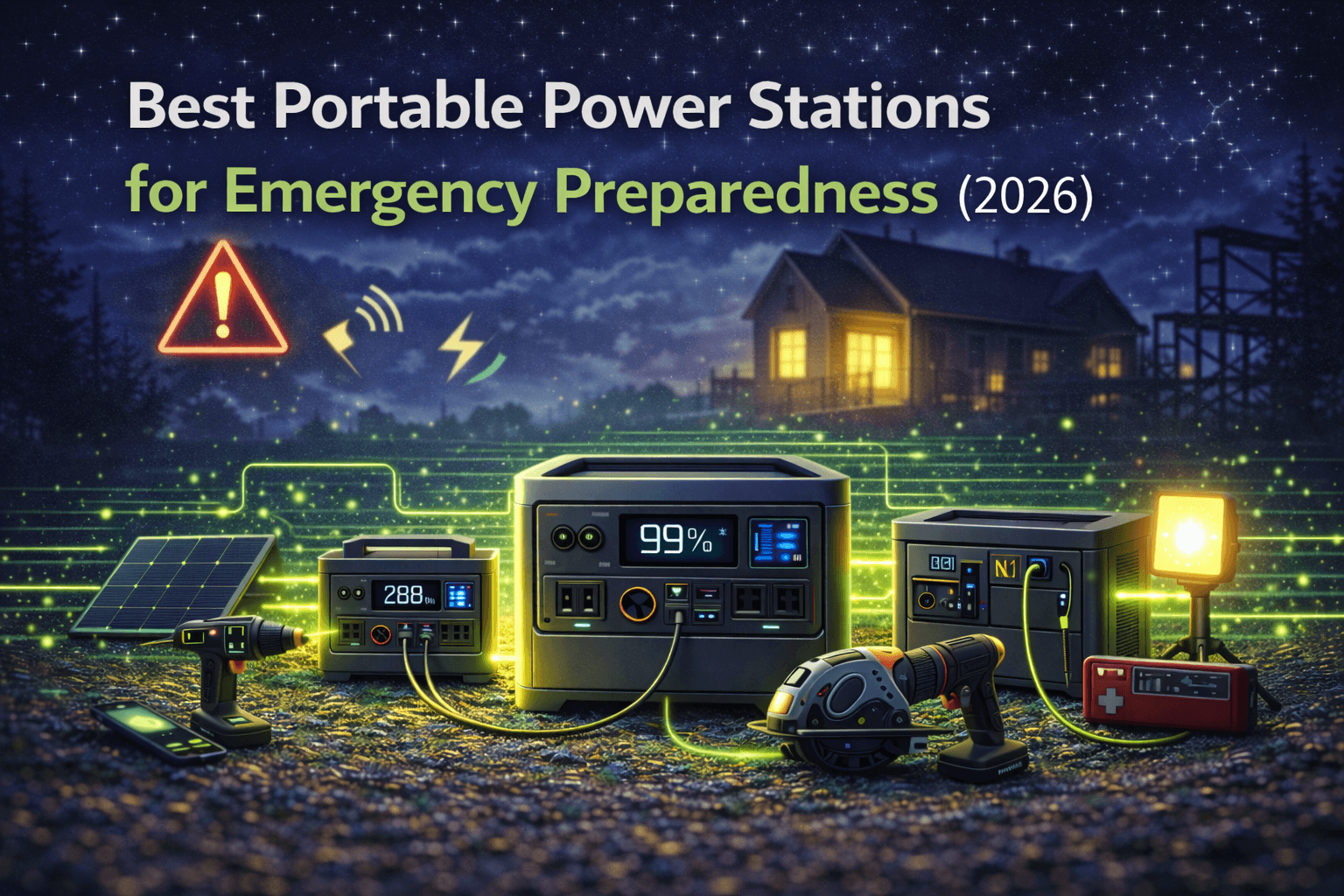
Best Portable Power Stations for Emergency Preparedness
1. EcoFlow Delta Pro System — Best Comprehensive Preparedness
The Delta Pro ecosystem scales to 25kWh across multiple units and expansion batteries, delivering genuine multi-day family autonomy through extended disasters. The 3,600W continuous output (4,500W with X-Boost) runs any essential household load. Dual 1,600W MPPT solar controllers optimize mixed permanent and portable panel arrays. Smart Home Panel integration automates load shedding so critical circuits (medical equipment, refrigerator, well pump) maintain power while convenience loads drop as battery depletes—eliminating manual management during high-stress crisis conditions when mental capacity is impaired.
| Feature | Specification |
|---|---|
| Capacity | 3,600Wh base, expandable to 25kWh |
| AC Output | 3,600W continuous (7,200W surge) |
| Solar Input | 1,600W dual MPPT |
| Battery | LiFePO4, 3,500 cycles to 80% (6,500 to 50%) |
| EPS Switchover | ~30ms |
| Weight | 99 lbs |
At standard 3,500Wh daily emergency consumption, a 10.8kWh configuration (base unit plus two expansion batteries) sustains roughly 3 days before requiring solar recharge—enough to bridge typical hurricane aftermath weather. The modular approach lets you start with the base 3,600Wh unit and add expansion batteries incrementally as budget allows, spreading $10,000–15,000 total system cost across 2–3 years.
The dual MPPT solar capability matters in disaster scenarios where you’re running a mix of fixed roof panels and portable ground-mounted panels at different orientations. Two independent controllers extract maximum power from each array versus single MPPT systems bottlenecking at the weaker array’s performance.
The trade-offs are real: very expensive complete system, professional electrician required for Smart Home Panel installation, stationary setup that can’t evacuate with you, and overkill for basic 72-hour preparedness. But for high-risk locations with serious multi-week preparedness goals, the Delta Pro delivers maximum residential capability short of whole-home professional battery banks.
2. Jackery Explorer 2000 Plus + Solar — Best Value Preparedness
The Explorer 2000 Plus hits the value sweet spot for serious preparedness—2,042Wh base capacity expandable to 12kWh with up to five battery packs (24kWh with two units in parallel), 3,000W continuous output handling any essential load, and 1,400W solar input enabling roughly 2-hour full recharge under good conditions. The 5-year warranty (3 years standard plus 2-year automatic extension from Jackery’s official channels) reflects confidence in long-term reliability.
| Feature | Specification |
|---|---|
| Capacity | 2,042Wh base, expandable to 12kWh (24kWh parallel) |
| AC Output | 3,000W continuous (6,000W surge) |
| Solar Input | 1,400W max |
| Battery | LiFePO4, 4,000 cycles to 70% |
| Warranty | 5 years (3+2 extended) |
| Weight | 61.5 lbs |
At 3,500Wh daily consumption, a 12kWh expanded system provides roughly 3.4 days at full discharge, or about 2 days at conservative 50% depth—adequate for bridging typical storm weather in standard preparedness scenarios. The 4,000-cycle battery ensures the system remains viable for a decade-plus of emergency readiness with regular seasonal testing and storm-season deployment.
Compared to the Delta Pro, you sacrifice maximum capacity (12kWh vs 25kWh), Smart Home Panel integration (manual load management required), and dual MPPT optimization. But at $4,000–5,000 complete versus $10,000–15,000, the Explorer 2000 Plus makes comprehensive preparedness accessible to mainstream households. This covers 70–80% of serious household preparedness needs at a fraction of premium cost. If your needs don’t include week-plus autonomy or critical medical equipment running 24/7, this is likely the right choice.
For a deeper look at how to choose the right portable power station for your specific situation, including capacity calculations and feature priorities, that guide walks through the decision framework step by step.
3. Bluetti AC200P + Solar — Budget Minimal Preparedness
The AC200P represents minimum viable serious preparedness at a budget price point. Its 2,000Wh capacity provides roughly one day of minimal emergency consumption (communication, critical lighting, reduced refrigeration) at full discharge—tight, but functional for 72-hour survival with aggressive conservation and daily solar recharge. The 2,000W output handles most essential loads individually, and 700W solar input with a 600–800W panel array generates enough on sunny days to roughly match minimal daily consumption.
| Feature | Specification |
|---|---|
| Capacity | 2,000Wh |
| AC Output | 2,000W continuous (4,800W surge) |
| Solar Input | 700W max |
| Battery | LiFePO4, 3,500+ cycles to 80% |
| Expandability | Limited (B230/B300 via adapter cable) |
| Warranty | 4 years (2+2 extended) |
| Weight | ~61 lbs |
The realistic scenario: Day 1 post-event operates on battery while solar recharges. Day 2 cloudy skies force battery dependence, depleting reserves to roughly half. Day 3 requires generator supplement or clearing weather for solar recovery. These tight margins are acceptable for minimal preparedness but risky for extended disasters. The AC200P can connect to B230 or B300 expansion batteries via a separately-purchased P090D adapter cable, providing some expandability beyond the base 2,000Wh—though it’s not the seamless native expansion that the Jackery or EcoFlow ecosystems offer.
At $2,500–3,500 complete with solar panels, the AC200P enables preparedness for budget-constrained households. Imperfect capacity, but vastly superior to zero preparedness. Realistic use case: family in a moderate-risk area planning for occasional ice storms with 24–48 hour outages rather than hurricane-zone multi-week scenarios.
Redundancy: Backup for Your Backup
Single-point-of-failure systems collapse when one component breaks during week two of a disaster. Batteries develop internal faults under sustained discharge stress. Solar panels sustain storm damage. Charge controllers fail from voltage fluctuations during grid collapse cascades. Connections corrode in humidity. Research into Hurricane Maria equipment failures in Puerto Rico found 15–25% of solar systems sustained damage or performance degradation, with battery systems overheating in extreme humidity causing thermal shutdowns.
Dual smaller systems beat single large systems for resilience. Two 2,000–3,000Wh units instead of one 4,000–6,000Wh unit costs more total but maintains 50% capability if one fails completely versus total loss. Primary unit handles daily loads while backup remains charged for emergency deployment.
Generator backup for battery charging serves as your backup-for-backup. A portable 2,000–3,500W generator running 2–3 hours weekly recharges batteries from 20% to 80% when solar generation falls short during extended cloud cover. Store 20–40 gallons of stabilized gasoline for weeks of supplemental charging capability.
Manual non-electric alternatives prevent total capability collapse when all electrical systems fail. Gas or camp stove for cooking, hand-crank flashlights and radios, manual water pumping if applicable. These cost almost nothing but prevent catastrophic gaps.
Geographic distribution protects against single-event destruction. Primary unit in the garage, backup in the basement, solar panels in separate storage. A flood or fire that destroys one location doesn’t eliminate your entire system.
For households choosing between the products above, the best portable power stations for home backup guide covers everyday backup scenarios, while this guide focuses specifically on extended disaster resilience.
Emergency Readiness Checklist
Equipment (verify quarterly). Power stations charged to 50–60% storage-optimal state. Solar panels inspected for physical damage with clean, tight connections. Cables organized and labeled. Generator starts easily with current maintenance and fresh stabilized fuel. Backup batteries in flashlights and radios replaced if expired.
Consumption planning. Essential loads documented by tier with daily watt-hour calculations. Load shedding plan prepared specifying which devices reduce or shut off as battery depletes. All household members understand priorities and procedures. Annual 24–48 hour simulation completed to identify failures while stakes are low.
Sustainability. Solar deployment plan practiced including positioning, connection sequence, and peak-hour timing. Generator fuel stored safely (20–40 gallons minimum, stabilized, rotated annually). Manual alternatives tested and verified functional.
Safety. ABC-rated fire extinguisher near power equipment and fuel storage. Carbon monoxide detector operational if generator used in or near enclosed spaces. Emergency contacts documented with family rally point and out-of-area contact person.
Portable Power Station vs. Whole-Home Battery
For serious multi-week preparedness, permanent systems like Tesla Powerwall or Generac PWRcell offer 13–40kWh capacity with seamless automatic switching, higher continuous output, and professional code-compliant installation. The downsides: $20,000–30,000+ installed, weeks of lead time, not portable if evacuation becomes necessary, and large upfront commitment.
Portable power stations cost $2,500–15,000, deploy immediately with no permits or installation, transport if you need to evacuate, and expand incrementally. The trade-offs are smaller capacity, manual connection requirements, and DIY setup without professional optimization.
The practical approach for most households: deploy portable power now for immediate preparedness while saving toward permanent installation later. The portable system protects you during the saving period, then supplements the whole-home battery as additional backup capacity and evacuation insurance after professional installation. For a broader look at the best portable power stations across all use cases, that comprehensive guide covers the full market.
Conclusion
Emergency preparedness with portable power stations delivers genuine multi-week disaster resilience—maintaining medical equipment, food preservation, communication, and climate control through extended grid failures—while remaining accessible to households that can’t justify $20,000+ professional battery banks.
For comprehensive multi-week preparedness in high-risk zones, the EcoFlow Delta Pro system ($10,000–15,000) provides maximum 25kWh expandable capacity with automated load management. For mainstream serious preparedness at accessible cost, the Jackery Explorer 2000 Plus ($4,000–5,000) delivers adequate multi-day capacity with industry-leading longevity. For budget minimal preparedness, the Bluetti AC200P ($2,500–3,500) enables 72-hour survival capability that’s vastly better than none.
Regardless of equipment tier: calculate actual essential loads ruthlessly, size battery for 3–4 days of autonomy, invest adequate solar capacity, practice deployment quarterly, and maintain redundancy. For those deciding between capacity tiers, our capacity guide breaks down the differences. See also our home backup guide for shorter-duration outage planning.
Note: This guide contains affiliate links. If you purchase through our links, we may earn a commission at no extra cost to you. This helps support our in-depth testing and content creation.