Capacity is the spec that matters most when buying a portable power station. It determines how long you can run your gear, how many days you can camp without a recharge, and whether a power outage is an inconvenience or a crisis. Get it wrong, and you’re either stuck with constant recharge anxiety or lugging around (and paying for) capacity you’ll never use.
The problem? Most buyers guess. They pick a number that “sounds right” or default to the biggest unit they can afford. Both approaches waste money.
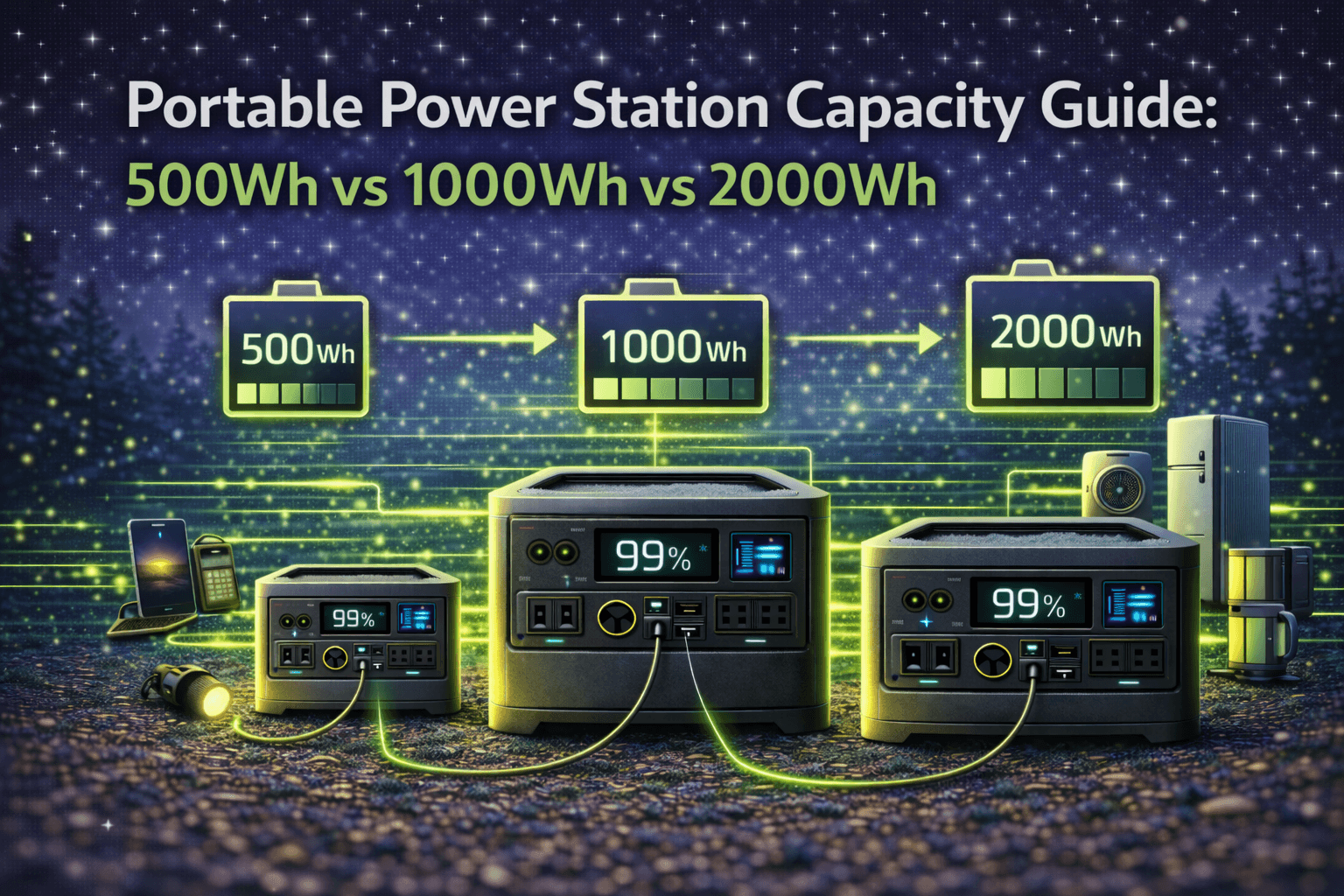
The market breaks into three main decision points: 500Wh for minimalist use, 1000Wh for general-purpose applications, and 2000Wh for extended trips and serious backup. The price jumps between tiers are significant — roughly $200-400 from 500Wh to 1000Wh, and another $500-1000 from 1000Wh to 2000Wh. This guide gives you a concrete framework to figure out exactly which tier fits YOUR actual usage, with real-world runtime calculations, honest cost analysis, and a step-by-step sizing method.
Note: This guide contains affiliate links. If you purchase through our links, we may earn a commission at no extra cost to you.
What Each Capacity Tier Actually Powers (Real Numbers, Not Marketing Claims)
Before we dig in: every runtime estimate below accounts for roughly 15% inverter efficiency loss. Marketing claims assume perfect conditions. Real life doesn’t work that way. Expect 60-75% of whatever the box promises.
500Wh Tier
Representative models: Jackery Explorer 500 (518Wh, 13.3 lbs), Anker 535 (512Wh, 16.5 lbs), Bluetti EB55 (537Wh, 16.5 lbs)
Weekend camping (2 nights, minimalist setup): Phone charging for two people over 3 days (10 charges × 15Wh = 150Wh) + portable fan on summer nights (25W × 6 hours = 150Wh) + LED lantern for two evenings (10W × 8 hours = 80Wh) + camera battery charging (4 batteries × 18Wh = 72Wh). Total: ~452Wh. Fits comfortably with a small margin to spare.
12-hour power outage: WiFi router/modem (25W × 12 hours = 300Wh) + phone charging for a family of four (8 charges × 15Wh = 120Wh) + LED lights in two rooms (20W × 8 hours = 160Wh). Total: ~580Wh. Exceeds capacity — you’ll run dry around hour 9-10 unless you cut some loads.
Tailgating (6 hours): 32-inch TV (50W × 6 hours = 300Wh) + portable speaker (15W × 6 hours = 90Wh) + group phone charging (~80Wh). Total: ~470Wh. Tight but doable. No margin for extras.
The verdict: 500Wh handles weekend minimalist camping with basic electronics, but gets tight for backup scenarios and leaves zero room for spontaneous additions. If you’re running anything beyond phones, lights, and small accessories, you’ll feel the ceiling. For more options in this range, see our best mini portable power stations under 300Wh or our 500Wh roundup.
1000Wh Tier
Representative models: EcoFlow Delta 2 (1024Wh, 27 lbs), Jackery Explorer 1000 Plus (1264Wh, 32 lbs), Bluetti AC180 (1152Wh, 35.3 lbs)
Note on the 1000Wh tier: These models range from 1024Wh to 1264Wh. The Jackery 1000 Plus actually packs 1264Wh and 2000W output — it’s closer to a “1250Wh” unit despite the name. The EcoFlow Delta 2 is the lightest at 27 lbs and offers the best portability-to-capacity ratio.
Weekend camping with electric cooking: Small electric griddle for breakfast (1200W × 30 minutes = 600Wh) + devices, lights, and accessories for the weekend (~350Wh). Total: ~950Wh. Fits within 1000Wh capacity with just enough margin for a true 1024Wh unit. The 1264Wh Jackery 1000 Plus handles this with breathing room.
Home backup (12-18 hours, essentials only): WiFi/modem (25W × 18 hours = 450Wh) + LED lighting (20W × 10 hours = 200Wh) + phone charging (~120Wh) + running a fridge intermittently for 12 hours (150W × 0.4 duty cycle × 12 hours = 720Wh). Total: ~1,490Wh. A 1024Wh unit covers about 12-13 hours before depletion. You’ll need to prioritize — either skip the fridge or accept shorter runtime on other loads.
Extended camping with portable cooler (4 days, 3 nights): A 12V cooler running 40% duty cycle over 72 hours eats ~1,150Wh by itself — already exceeding a 1024Wh unit. Add devices, lighting, and laptop use, and you’re looking at 1,800Wh+. You’ll need daily vehicle recharging or solar panel supplementation to make a 1000Wh unit work for a multi-day trip with a cooler.
The verdict: 1000Wh is the sweet spot for comfortable weekend camping with modest electric cooking, adequate short-term backup (12-18 hours with load management), and professional day work. It falls short for multi-day trips with high-draw devices or extended home backup without recharge access. Check our best 1000Wh portable power stations for detailed model comparisons.
2000Wh Tier
Representative models: Jackery Explorer 2000 Plus (2042Wh, ~61 lbs), EcoFlow Delta 2 Max (2048Wh, ~51 lbs), Bluetti AC200L (2048Wh, ~62 lbs)
Home backup (36-hour outage, refrigerator + essentials): Refrigerator at 40% duty cycle (150W × 0.4 × 36 hours = 2,160Wh) + WiFi/modem (25W × 36 hours = 900Wh) + lighting and devices (~400Wh). Total: ~3,460Wh. A 2000Wh unit powers about 21-24 hours of this load — covering the majority of a typical storm outage. Substantially better than a 1000Wh unit that dies at hour 12.
Multi-day camping with solar (5-7 days): A portable cooler running continuously at 40% duty cycle consumes about 385Wh per day. Add 100Wh/day for devices, lights, and accessories. That’s ~485Wh/day, or ~3,400Wh for a full week. A 2000Wh battery alone gets you 4-5 days. Pair it with a 200-400W solar panel generating 600-1200Wh on a good day, and you reach indefinite operation — the battery bridges cloudy spells while solar handles daily recharge.
Professional photography (full outdoor shoot day, 8 hours): Laptop for tethered shooting and editing (60W × 6 hours = 360Wh) + camera battery charging (12 batteries × 18Wh = 216Wh) + strobe recharging (~200Wh) + devices and accessories (~150Wh). Total: ~926Wh. Only 46% utilization. Massive reserves for unexpected needs — this is where 2000Wh provides stress-free professional operation. See our photographers guide for specific recommendations.
RV boondocking (single night, no hookups): 12V RV fridge at 45W, 45% duty cycle over 24 hours (~486Wh) + water pump intermittent (~150Wh) + LED lights (~100Wh) + devices and laptop (~300Wh). Total without heating: ~1,036Wh. Very comfortable. But add an electric furnace blower for 4 winter hours (400W × 4 = 1,600Wh) and you’re at 2,636Wh — exceeding capacity. For RV use, plan on propane heat with a 2000Wh unit.
The verdict: 2000Wh enables multi-day camping with solar, covers most typical power outages (24-36 hours), provides stress-free professional equipment operation, and supports RV boondocking without heating. Still insufficient for whole-home backup with AC, full-time off-grid living, or extensive RV heating/cooling. For those needs, you’re looking at 3000Wh+ with expansion batteries. Browse our 2000Wh+ roundup for current top picks.
Cost vs. Capacity: Where the Value Actually Is
Here’s something that surprises most buyers: portable power stations don’t offer better per-Wh value at larger sizes. Unlike buying in bulk at Costco, stepping up in capacity costs you roughly the same per watt-hour. The economics are proportional, not exponential.
Current Market Pricing (Quality Brands, Street Prices)
| Capacity Tier | Typical Price Range | Cost per Wh | Notable Models |
|---|---|---|---|
| 500Wh | $250-500 | $0.49-0.95/Wh | Jackery 500 (518Wh), Bluetti EB55 (537Wh), Anker 535 (512Wh) |
| 1000Wh | $450-1,000 | $0.44-0.80/Wh | EcoFlow Delta 2 (1024Wh), Bluetti AC180 (1152Wh), Jackery 1000 Plus (1264Wh) |
| 2000Wh | $1,200-2,000 | $0.59-0.98/Wh | Jackery 2000 Plus (2042Wh), EcoFlow Delta 2 Max (2048Wh), Bluetti AC200L (2048Wh) |
The 1000Wh tier often delivers the best cost-per-Wh ratio, thanks to aggressive pricing competition between EcoFlow, Bluetti, and Jackery. But that doesn’t mean 1000Wh is always the best value for YOU. Value depends on whether you actually use the capacity you’re paying for.
When Upsizing Wastes Money
Weekend camper consuming 400Wh over 2 days: A 500Wh unit handles this at $250-500. Upgrading to 1000Wh means paying $200-500 extra for 500Wh that sits unused every trip — plus carrying an unnecessary 10-15 extra pounds. Your money is better spent on a quality solar panel setup for the rare occasion you need more juice.
Emergency backup for typical 12-hour outages (600Wh consumption): A 1000Wh unit covers this with comfortable margin. Jumping to 2000Wh adds $500-1000 for capacity you’d only tap during extremely rare 24+ hour outages. Unless you live in a hurricane zone or somewhere with genuinely unreliable grid infrastructure, that’s money better spent elsewhere.
When Upsizing Pays for Itself
Regular camper consuming 800-900Wh daily with 3-day trips: A 1000Wh unit means plugging into your car every single day — an operational headache. A 2000Wh unit with a 200-400W solar panel ($300-600 extra) gives you 2+ days of autonomy and potentially indefinite operation with solar. That $700-1,200 total upgrade eliminates daily recharge management for years of trips.
Home backup for 24-48 hour storm outages: A 1000Wh unit dies at hour 12-14, leaving your fridge and communication dark for another day or more. A 2000Wh unit covers 24-30 hours — enough for the vast majority of storm outages. The $500-1,000 upgrade buys real utility: keeping food cold and communication live during an actual emergency. That’s not “nice to have” capacity — it’s the difference between functional and failed backup. For more on this, see our emergency preparedness guide.
The Value Framework
Good value = buying capacity that matches your regular usage + 20-30% safety margin. Poor value = buying excess capacity “just in case” for scenarios you encounter once every few years. The best investment approach: calculate your actual consumption (next section shows you how), match it to the right tier, and put any savings into accessories like solar panels that extend your effective capacity.
Weight and Portability: The Spec Everyone Ignores Until It’s Too Late
Capacity and weight are directly linked. Bigger batteries mean more mass. LiFePO4 cells — now standard in quality units — weigh roughly 11-15 lbs per kWh of capacity. Add the inverter, BMS, housing, and ports, and weight adds up fast.
Typical Weights
500Wh: 13-17 lbs. One-hand carry. Easily relocated around camp. Fits in a tent. Jackery 500 at 13.3 lbs is genuinely portable; the Bluetti EB55 and Anker 535 at 16.5 lbs are slightly heavier but still very manageable.
1000Wh: 27-35 lbs. Two-hand carry required. The EcoFlow Delta 2 at 27 lbs is the most portable in this tier — genuinely reasonable for one person. The Jackery 1000 Plus at 32 lbs and Bluetti AC180 at 35.3 lbs are heavier but still manageable for carrying from car to campsite. You’ll position it once and leave it there.
2000Wh: 50-62 lbs. This is “get help or use a cart” territory. The Jackery 2000 Plus has wheels and a telescoping handle, which makes a real difference. Units in this range live in vehicles or fixed locations. You’re not casually relocating 60 lbs to follow the shade.
How Weight Actually Affects Usage
This matters more than people think. A 15-lb unit gets used constantly — you grab it, move it, bring it along without thinking. A 60-lb unit requires planning and commitment. If you’ll resent moving it or skip bringing it on trips because it’s too heavy, all that capacity is worth exactly zero.
Prioritize portability (under 20 lbs ideal, 30 lbs max): Festival camping, backpacking base camp, frequent relocation, stairs/difficult access, overlanding or expandable systems where you need to move gear often.
Weight doesn’t matter much: Car camping (stays in/near vehicle), home backup (sits in one spot), RV installation, workshop use, construction sites with vehicle access.
The uncomfortable middle ground: Photography location work, mobile service calls, overlanding — you want both capacity AND portability. The 1000Wh tier (27-35 lbs) is typically the best compromise. Not ultralight, but one person can manage it with occasional relocation.
Use Case Recommendations by Capacity
500Wh — Best For:
Weekend minimalist camping with basic electronics (phones, lights, small speaker). Emergency phone and communication backup during outages. Day-long photo shoots returning to a studio nightly. Festival and music event camping (2-3 day device charging). Tailgating with TV and sound (no cooking appliances). Anyone prioritizing ultra-portability over runtime.
Not enough for: Extended camping without recharge, whole-home backup, cooking appliances, daily consumption over 400Wh.
1000Wh — Best For:
Standard weekend camping with conveniences (portable cooler, occasional electric cooking, ample device charging). Short-term home backup (12-18 hours with load management). Single-night RV boondocking without heating (fridge + lights + devices + water pump). Professional mobile work with daily vehicle return. Van life with minimal consumption and solar supplement. Anyone wanting the best balance of weight, capacity, and value.
Not enough for: Multi-day camping without recharge, extended backup (24+ hours with fridge), RV with electric heating/cooling, daily consumption over 900Wh. For a deeper dive into choosing the right unit, see our buying guide.
2000Wh — Best For:
Extended camping (4-7 days) with solar panel supplement. Serious home backup (24-36 hours with refrigerator + essentials). Multi-night RV boondocking (with propane heat, not electric). Professional photography/videography with extensive equipment. Off-grid weekend cabin use with solar supplement. Anyone who needs multi-day autonomy without recharge access.
Not enough for: Whole-home backup with AC (need 3000Wh+), full-time off-grid living (5000Wh+ with robust solar), RV with extended AC/heating use, daily consumption over 1500Wh without strong solar generation.
How to Calculate Your Actual Capacity Need (5-Step Method)
Skip the guesswork. This takes 15-20 minutes and saves you hundreds of dollars in wrong-size purchases.
Step 1: List Every Device You’ll Power
Write down each device with its actual wattage. Check the label on the device, the user manual, or the manufacturer’s spec sheet. Don’t estimate — a laptop drawing 45W vs. 65W makes a real difference over a multi-day trip. Use our runtime calculator if you want to speed this up.
Step 2: Calculate Daily Consumption
For each device: Wattage × Hours of daily use = Wh per day. For cycling loads like refrigerators and coolers, multiply by the duty cycle (typically 0.35-0.45 for coolers, 0.30-0.40 for efficient fridges).
Example calculation: Portable cooler (40W × 0.4 duty × 24 hours = 384Wh) + phones for 2 people (60Wh) + LED lighting (50Wh) + laptop work 6 hours (50W × 6 = 300Wh) + accessories (50Wh) = 844Wh/day.
Step 3: Determine Duration Between Recharges
Weekend camping = 2-3 days. Home backup = your area’s typical outage duration (check historical data — 12 hours? 24? 48?). Overlanding = 3-7 days between towns. RV boondocking = 1-4 nights typically.
Step 4: Apply the Sizing Formula
Required capacity = Daily consumption × Duration × 1.25
The 1.25 multiplier covers inverter inefficiency (~15%) plus a safety margin for cold weather capacity reduction, unexpected loads, and device wattage variance.
Example: 844Wh/day × 3 days × 1.25 = 3,165Wh minimum. This buyer needs a 2000Wh unit paired with solar panels, or an expandable system.
Step 5: Match to Tier and Verify Budget/Weight
| Required Capacity | Recommended Tier |
|---|---|
| 300-650Wh | 500Wh |
| 650-1,500Wh | 1000Wh |
| 1,500-2,500Wh | 2000Wh |
| 2,500Wh+ | 2000Wh + solar, or expandable system |
Budget check: Can you afford the tier your calculation points to? If not, reduce consumption targets (shorter trips, fewer conveniences) or save longer — don’t buy undersized equipment. That leads to the “buy twice” mistake covered below.
Weight check: Can you physically manage the unit you need? If a 60-lb 2000Wh unit is impractical for your situation, consider a 1000Wh unit with aggressive solar supplementation instead.
Critical Reminders
Include ALL devices — people routinely forget the cooler’s continuous draw, overnight lighting, or that hair dryer used for “just 5 minutes” that pulls 1500W. Be honest about usage hours. Measure an actual camping trip if possible. Account for cold weather: LiFePO4 batteries lose 20-30% capacity below freezing. Build in a margin. The unit that’s “just barely enough” will feel inadequate the first time conditions aren’t perfect.
The 1000Wh vs. 2000Wh Decision (The Most Common Dilemma)
This is the question we get asked most. Here’s a straightforward decision framework.
Choose 1000Wh If:
Your daily consumption falls below 700Wh. You have recharge access (vehicle, campground hookups, or solar panels supplement the battery). Portability matters — you need to physically carry the unit. Budget caps at $500-1,000. Your typical use is weekend trips or short-duration backup.
Practical example: Weekend camping at 600Wh/day. A 1024Wh unit gives you 1.5 days before depletion. With even a modest 100W solar panel generating ~300Wh on a sunny day, you comfortably cover a full weekend.
Choose 2000Wh If:
Daily consumption hits 700-1,500Wh. You need multi-day autonomy without recharge (remote camping, multi-day events, overlanding). Home backup is a priority and typical outages last 24+ hours in your area. You’re running professional equipment with high capacity demands. Weight isn’t a constraint (vehicle transport, stationary use).
Practical example: 36-hour storm backup. Fridge (~1,200Wh over 36 hours) + WiFi/modem (~900Wh) + lights and devices (~400Wh) = 2,500Wh total. A 1000Wh unit covers 14-16 hours — half of what’s needed. A 2000Wh unit covers 28-32 hours, keeping food cold and communication live through most outages.
The Decision Zone: 800-1,300Wh Calculated Need
If your calculation lands here, either tier could work with tradeoffs. 1000Wh saves money and weight but requires more active management (solar, vehicle charging, load awareness). 2000Wh costs more and weighs more but eliminates the management burden. Ask yourself: do you want to manage your power, or do you want to forget about your power? If management feels like part of the adventure, 1000Wh works. If you want set-and-forget reliability, pay the premium for 2000Wh.
Can You Start Small and Upgrade Later?
You can, but it’s an expensive strategy. The math is brutal.
Buy a 500Wh unit at $400 → Discover it’s inadequate → Buy a 1000Wh unit at $700. Total spent: $1,100 for 1000Wh of usable capacity, versus $700 buying correctly upfront. That’s a 57% premium for the “stepping up” approach.
The 500Wh unit becomes either a paperweight, a rarely-used backup-to-the-backup, or a loss on the secondary market (expect 40-60% resale value at best).
When Starting Small Makes Sense
Genuinely uncertain users: You’ve never owned a portable power station and aren’t sure you’ll use it regularly. A 500Wh unit tests the concept with minimal investment. If you discover you love camping with power, upgrade later — the experience wasn’t wasted, even if the money partially was.
Evolving needs with a plan: Your current consumption is legitimately under 400Wh/day but you expect that to change (planning van life, adding family members, new hobbies). The 500Wh unit serves now, and the planned upgrade is baked into your timeline and budget.
Intentional secondary role: You’ll always need a small portable unit for day trips, car emergencies, or as a dedicated photography kit, even after buying a larger primary unit.
When Starting Small Fails
Undersized from the start: Your calculation shows 900Wh/day but you buy 500Wh “hoping to make it work.” This is guaranteed regret and guaranteed repurchase.
Budget-driven undersizing: You can’t afford the right 1000Wh unit so you settle for an inadequate 500Wh. Better approach: save for 2-3 more months and buy correctly. The $300-500 you “save” now costs you $700-1,000 total when you inevitably upgrade.
Bottom line: If you’ve done the calculation and know your needs, buy the right size the first time. If you’re genuinely experimenting, start small but go in with eyes open about the potential cost of upgrading later. Never undersized on purpose and hope it works out — that’s the single most expensive buying mistake in this category.
Final Recommendations by Tier
Choose 500Wh when: Daily consumption under 400Wh. Weekend trips only. Ultra-portability is non-negotiable. Budget tops out at $300-500. You’re powering devices, lights, and basics — nothing more. Best for: festival camping, photography day shoots, emergency communication backup.
Choose 1000Wh when: Daily consumption 400-800Wh. Weekend to 3-day trips with recharge access or solar. Best balance of portability, capacity, and value. Budget $450-1,000. You want comfortable camping with a cooler, devices, laptop, and lighting. Best for: standard camping, short-term home backup, professional day work.
Choose 2000Wh when: Daily consumption 800-1,500Wh. Week-long trips or multi-day backup. Stationary or vehicle transport (weight acceptable). Budget $1,200-2,000. Extended autonomy is the priority. Best for: extended camping with solar, serious home backup, multi-night RV boondocking, professional photography/videography.
Do the 20-minute consumption calculation. Match to the right tier. Buy once, correctly. That’s the most cost-effective path to the right portable power station for your needs. For a broader view of the best options across all categories, check our complete buyer’s guide.