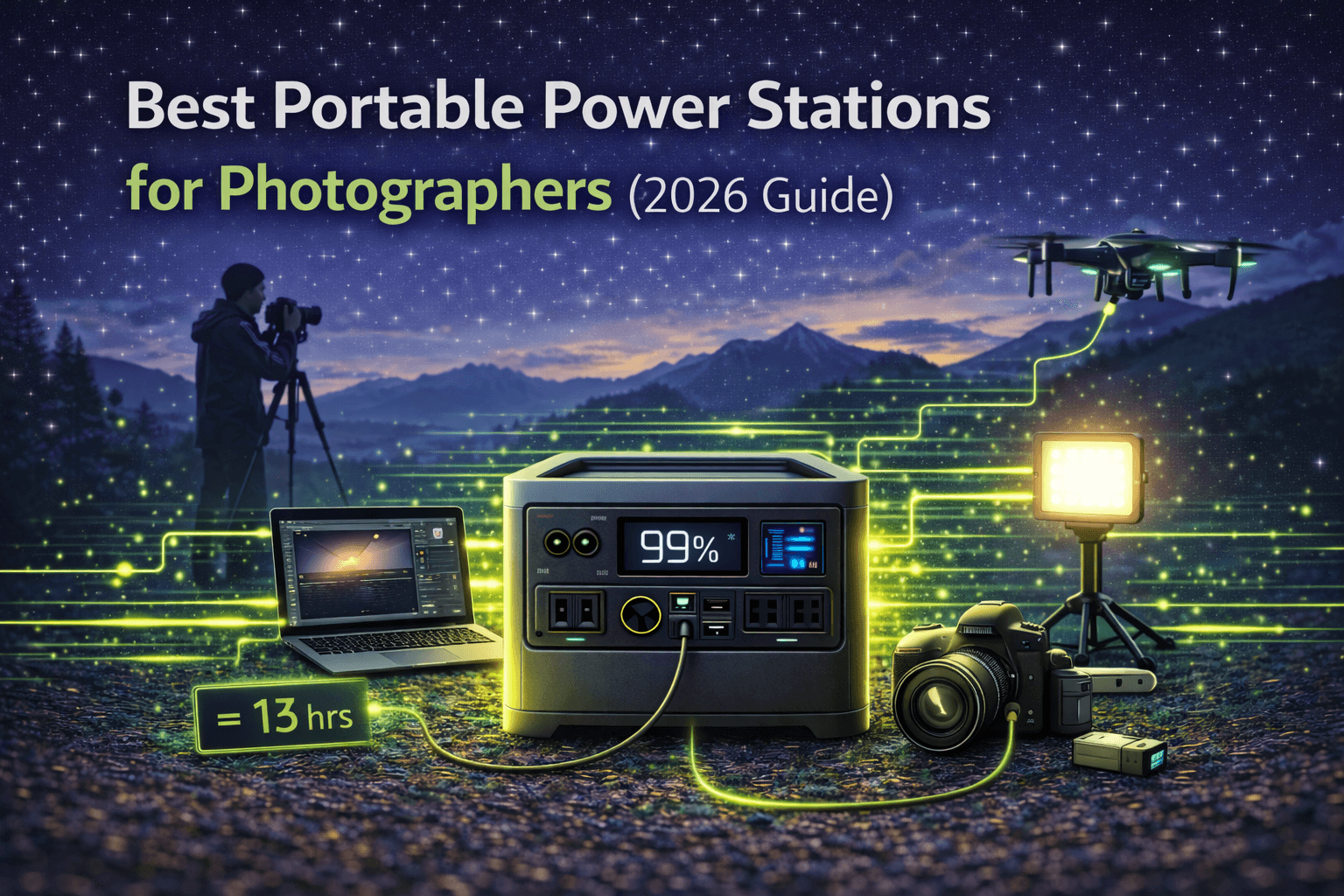
Portable power changed location photography. Before affordable battery stations, shooting on-location meant limited laptop runtime, a bag full of spare camera batteries, and either hauling a noisy generator or accepting daylight-only constraints. Now, a single unit the size of a lunchbox runs your entire mobile workflow — silent operation that won’t disrupt audio or spook subjects, studio lighting anywhere, tethered shooting with immediate client review, and multi-day event coverage without returning to the studio.
Photography power needs differ from typical portable power applications. You don’t need the 2000–3000Wh capacity of an RV setup or the high-output surge of home backup. What you need is abundant USB and DC outputs for simultaneous device charging, moderate AC power for laptops and occasional strobes, extended runtime at modest draw, and absolute reliability. Equipment failures during paid shoots cost money and reputation — this isn’t a camping convenience, it’s professional infrastructure.
The financial case writes itself. Professional photographers bill $150–500+ per hour for location work. A $500–1000 portable power investment opens up remote location bookings, extended coverage hours, and hybrid photo/video services. It pays for itself within a season. This guide covers photography-specific power calculations, essential features for your workflow, specific model recommendations, and real-world shoot planning with complete numbers.
Note: This guide contains affiliate links. If you purchase through our links, we may earn a commission at no extra cost to you. This supports our testing and content creation.
Photography Equipment Power Requirements
Photography equipment consumes far less power than most portable power applications. Understanding your actual draw prevents two expensive mistakes: undersizing (running out mid-wedding) and oversizing (lugging a 60-pound unit you’ll never deplete).
Camera Battery Charging
Modern mirrorless and DSLR batteries hold 10–25Wh per battery. The common models: Sony NP-FZ100 at 16Wh, Canon LP-E6NH at 14Wh, Nikon EN-EL15c at 15Wh, Fujifilm NP-W235 at 16Wh — averaging roughly 15Wh per battery.
For full-day wedding coverage, you’ll cycle through 6–8 batteries. That’s 8 batteries × 16Wh = 128Wh, plus 25% for charging inefficiency = 160Wh total. Even a 240Wh budget unit handles two full recharge cycles comfortably. Camera batteries alone won’t stress any power station.
Laptop Power
This is your biggest single draw. Tethered shooting, on-location editing, immediate client review — plan for 2–6 hours of laptop time depending on your workflow.
Typical photography laptop consumption during editing: MacBook Pro 14” M-series averages 45W, MacBook Pro 16” M-series around 60W, Dell XPS 15 about 50W. Call it 50W average during active editing work.
Six hours of laptop editing × 50W = 300Wh, plus 10% inverter loss = 330Wh daily. Your laptop consumes 2–3× what camera battery charging does. If you’re looking at where your power actually goes, this is it.
Strobe and Flash Charging
Battery-powered strobes (Profoto B10 series, Godox AD600) charge via AC adapter — intermittent high-draw for 30–60 minutes, then idle. A Profoto B10 Plus pulls 65W for about 1.5 hours per full charge = 98Wh. A Godox AD600 Pro draws more at 180W for 2 hours = 360Wh per charge. Most shoots need 1–2 strobe charges daily: 100–400Wh depending on your lighting kit.
Continuous LED Lighting
LED panels for video or portrait work run 30–100W per panel over 2–6 hours. Two 60W panels running 4 hours = 480Wh. This only matters for hybrid photo/video shooters — still photographers using strobes can skip this entirely.
Accessories
Phone charging (40Wh daily), tablet for shot lists and client review (60Wh), external hard drives during backup (20Wh), miscellaneous. Combined: roughly 130Wh daily.
Real-World Power Budgets
Wedding photography (full day, no strobes):
Camera batteries (8×) 160Wh + Laptop (4 hours) 220Wh + Phone/tablet 60Wh + Accessories 50Wh = 490Wh total
Portrait session with strobes (4 hours):
Camera batteries (4×) 80Wh + Laptop (2 hours) 110Wh + Strobe charge (1×) 100Wh + Accessories 40Wh = 330Wh per session
Commercial location with continuous lighting:
Camera batteries (6×) 120Wh + Laptop (6 hours tethered + editing) 330Wh + LED panels (2× 60W, 5 hours) 600Wh + Accessories 80Wh = 1,130Wh daily
The Bottom Line on Sizing
Photography is a low-power application compared to camping with coolers (600–1200Wh daily) or home backup (1500–3000Wh). Most photography work consumes 300–800Wh daily. A 500–1000Wh power station handles 80% of professional photography applications. The exception: hybrid productions with extensive continuous lighting (1000–2000Wh daily) or multi-day events without recharge access.
Output wattage matters less than capacity here. Laptop (60W) + chargers (30W) + accessories (20W) = 110W typical simultaneous load. Even adding a strobe charger: 290W peak. Any power station rated 300W+ handles typical photography loads without breaking a sweat. You’re paying for capacity and portability, not raw output.
Essential Features for Photography
Photography prioritizes different features than camping or emergency backup. Knowing what actually matters for your workflow saves you from overpaying for specs you’ll never use.
USB Port Abundance (Non-Negotiable)
During a wedding shoot, you’re simultaneously charging camera batteries (2–4 on multi-battery chargers), phones, tablets, wireless transmitters, audio recorders, action cameras, and possibly drone batteries. You need ports — lots of them.
Minimum: 4 USB ports total with at least 2 USB-C PD (45W+ for laptop charging). Ideal: 6+ USB ports with high-wattage USB-C so your laptop charges via USB without occupying an AC outlet. Port scarcity forces sequential charging — batteries one-by-one, tablet after batteries, phone last — and destroys efficient workflow. Abundant ports mean everything charges simultaneously and stays ready for the next setup change.
Pure Sine Wave AC Output (Mandatory)
All quality portable power stations deliver pure sine wave power, but verify before buying. Budget units from unknown brands sometimes cut costs with modified sine wave inverters. Modified sine wave risks data corruption on laptops and potential damage to sensitive camera electronics. When you’re running a $3,000 MacBook Pro and a $5,000 camera body, this isn’t the place to gamble.
The 500–1000Wh Sweet Spot
Photography’s modest consumption doesn’t require massive capacity, but location work demands portability. The 500–1000Wh range provides full-day to multi-day capability at a manageable 12–30 pounds. Weight thresholds from field experience: units under 20 pounds carry effortlessly alongside camera gear, 25–30 pounds is noticeable but manageable, and anything over 50 pounds becomes a “base station” requiring vehicle proximity or an assistant. Prioritize sub-30 pounds unless you’re shooting from a fixed location with vehicle access all day.
Pass-Through Charging (Nice for Multi-Day Events)
Wedding weekends, multi-day conferences, extended commercial shoots — pass-through lets you charge overnight from a hotel outlet while simultaneously powering devices, ready each morning at full capacity. Not essential (you can charge overnight with devices unplugged), but it eliminates workflow friction during back-to-back shooting days.
Display Quality
You need to know remaining capacity to plan your day. Will you have enough for evening reception coverage, or should you limit laptop editing and conserve? A clear display showing percentage remaining (or better, Wh remaining with estimated runtime at current draw) helps you make smart decisions under time pressure.
Features You Don’t Need
High output (over 1000W): Photography rarely exceeds 300W loads. A 2000W rating provides zero benefit for most shooting unless you’re also powering space heaters.
Massive capacity (over 1500Wh): A weekend wedding with nightly hotel charging needs 1000–1200Wh maximum. Don’t buy a 3000Wh unit for photography unless you’re regularly shooting multi-day events without any grid access.
Sophisticated apps: Walking to the unit and checking the display takes 10 seconds. Remote monitoring is convenient but not workflow-critical for most photographers.
Buy capacity and features matching your actual photography workflow, not generic “bigger is better” thinking.
Best Portable Power Stations for Photographers
1. Jackery Explorer 1000 Plus — Best Overall for Photography ($899)
The Jackery Explorer 1000 Plus hits the sweet spot for working photographers. At 1264Wh, it covers 2–3 full shooting days without recharge. The port selection — 3 AC outlets, 2 USB-C at 100W each, 2 USB-A — handles realistic multi-device charging. The 32-pound weight is manageable alongside camera gear. And Jackery’s track record for reliability matters when your income depends on equipment performing during paid work.
| Feature | Detail |
|---|---|
| Capacity | 1264Wh |
| AC Output | 2000W continuous (4000W surge) |
| Ports | 3× AC, 2× USB-C 100W, 2× USB-A |
| Weight | 32 lbs |
| Battery | LiFePO4, 4000 cycles to 80% |
| AC Charging | ~1.7 hours |
| Solar Input | Up to 800W |
| Pass-through | Yes |
| Warranty | 5 years (extended) |
| Price | $899 |
Wedding day real-world test: Ceremony through reception (12 hours) — camera batteries (200Wh), laptop editing and backup (400Wh), phone/tablet (80Wh), accessories (60Wh) = 740Wh consumed. Finished at 40% remaining. Comfortable margin for unexpected extended coverage or additional editing.
Multi-day wedding weekend: Friday rehearsal (200Wh) + Saturday wedding (740Wh) + Sunday brunch (150Wh) = 1,090Wh total. The 1264Wh capacity handles it with overnight hotel recharging between days. Without recharge access, you’d need careful load management or an expansion battery.
The 2 USB-C 100W ports are the workflow hero here. MacBook Pro pulling 60W + iPad at 25W = 85W combined USB-C load, handled comfortably without touching the AC outlets. Those stay free for camera battery chargers and strobe charging.
The 2000W output vastly exceeds photography needs — your typical 300W load won’t stress it. But it future-proofs the investment if your work expands into video production with continuous lighting or powered equipment.
The 4000-cycle LiFePO4 battery deserves emphasis. At 50 shoots per year, you’d need 80 years to exhaust cycle life. The battery will outlast your career. Combined with Jackery’s low failure rate and strong warranty support, this is a genuine long-term professional investment — not a disposable purchase.
At 32 pounds, it’s noticeable when carrying but feasible for a photographer already hauling 20–40 pounds of camera gear. Beach shoot test: carried the 1000 Plus plus camera backpack 300 yards from parking — strenuous but doable without an assistant. Heavier alternatives would require a cart.
Why it wins for photography: Optimal capacity-to-weight ratio, enough ports for real multi-device workflow, bulletproof reliability for paid work, and the longest battery lifespan in the industry. For working photographers billing $150–500+ hourly, $899 pays for itself within a dozen shoots through expanded location capability and eliminated rental costs.
Check Price on Jackery
Also on Amazon
2. EcoFlow Delta 2 — Best for Portability and Quick Turnaround ($999)
The EcoFlow Delta 2 targets photographers who value convenience above all — lightest weight in the 1000Wh class at 27 pounds, fastest charging at 80 minutes wall-to-full, the most AC outlets (6×), a genuinely useful app for remote monitoring, and expandability to 3072Wh if needs grow.
| Feature | Detail |
|---|---|
| Capacity | 1024Wh |
| AC Output | 1800W continuous (2700W surge) |
| Ports | 6× AC, 2× USB-C 100W, 4× USB-A (2 standard, 2 fast charge), 2× DC |
| Weight | 27 lbs |
| Battery | LiFePO4, 3000 cycles to 80% |
| AC Charging | ~80 minutes |
| Solar Input | Up to 500W |
| Pass-through | Yes |
| Warranty | 5 years |
| Price | $999 |
The 5-pound weight savings over the Jackery (27 vs. 32 lbs) matters more than the number suggests. Carrying the Delta 2 plus a camera backpack for an extended walk to a location? Noticeably easier. Repeat that load-in five times throughout a wedding day, and the cumulative difference is real.
The 80-minute charging creates workflow options the Jackery can’t match. Saturday wedding depletes the unit; Sunday morning, plug in during your 90-minute prep routine (breakfast, gear organization), and you arrive at the venue fully charged. The Jackery’s 1.7-hour charge wouldn’t finish in that window.
Six AC outlets eliminate power strip hassles entirely: two camera battery chargers, laptop charger, tablet charger, strobe charger when needed, plus one free for a client device as a courtesy — everything plugged in simultaneously.
The EcoFlow app provides legitimately useful remote monitoring: check battery status from your shooting position 200 feet away, monitor consumption during tethered sessions, receive low-battery alerts to plan your final coverage shots.
The trade-off: 1024Wh capacity (240Wh less than Jackery, a 19% reduction) and 3000 cycles vs. 4000. Adequate for single-day shoots, tighter for multi-day coverage without recharge.
The verdict: Worth the $100 premium over Jackery if you prioritize portability, fast turnaround between shoots, and workflow convenience. Choose Jackery for maximum capacity and battery longevity. Choose Delta 2 if 5 fewer pounds and 50 fewer minutes of charging time genuinely improve your day.
3. Anker 535 — Best Budget Entry Point ($499)
The Anker 535 at $499 (frequently discounted to $300–350 during sales) gets beginning professionals into portable power without flagship investment. It delivers 512Wh capacity for a single full shooting day, 500W output covering all photography loads, solid Anker build quality with LiFePO4 chemistry, and a useful 9-port layout.
| Feature | Detail |
|---|---|
| Capacity | 512Wh |
| AC Output | 500W (750W surge) |
| Ports | 4× AC, 3× USB-A, 1× USB-C 60W, 1× car outlet |
| Weight | 16.5 lbs |
| Battery | LiFePO4, 3000+ cycles |
| AC Charging | ~2.5 hours (to 80% via adapter + USB-C) |
| Warranty | 5 years |
| Price | $499 (frequently ~$300–350 on sale) |
The 512Wh capacity handles a single wedding day: camera batteries (160Wh), laptop 3 hours (165Wh), accessories (80Wh) = 405Wh consumed, finishing with roughly 20% reserve. That’s enough for full coverage if you’re disciplined about laptop use — handle essentials on-location, do heavy processing back at the studio.
Multi-day events require daily recharging — weekend weddings need hotel overnight charging between days. At this price point, that’s a reasonable trade-off.
The 16.5-pound weight is the standout advantage. Carried one-handed, zero burden alongside camera gear, perfect for photographers who prioritize mobility. That’s half the weight of the Jackery 1000 Plus.
The 500W output handles all photography loads comfortably: laptop (60W) + camera chargers (40W) + strobe (180W) = 280W peak, well within limits.
One important note: The USB-C port maxes out at 60W, not the 100W you get on the Jackery and EcoFlow. It’ll charge most laptops, but power-hungry 16” MacBook Pros under heavy load may draw faster than the port supplies. For USB-C laptop charging specifically, the flagships have a meaningful advantage.
Who this is for: Beginning professionals who want location power capability now without committing $900+. Photographers with lighter workflows (portrait sessions, shorter events). Anyone who values ultralight portability above multi-day capacity. Upgrade to Jackery or EcoFlow when your business grows to justify the premium.
Photography Workflow Integration
Good equipment is useless with bad workflow. Here’s how to actually integrate portable power into professional shoots.
Pre-Shoot Preparation
Charge fully the night before — eliminate day-of charging stress. Pack the power station in a dedicated bag or case with all cables organized: camera battery chargers, laptop charger, USB cables labeled by device. Position it in your vehicle for easy access (trunk or backseat, not buried under lighting stands). Verify every accessory is present before leaving.
Build a power kit: station + all charging cables + power strip (backup) + short extension cord (venue outlet access) in one dedicated bag. Grab a single bag, and your entire power infrastructure is handled.
During-Shoot Positioning
For portrait sessions, keep the power station at your shooting position — tethered shooting requires laptop proximity. For events like weddings, set up a “base” at a gear table or changing area separate from your active shooting. Camera batteries last 60–90 minutes per charge, so you’ll cycle back to base for battery swaps and equipment charging anyway.
Protect from weather (under tent, tarp, or vehicle if there’s rain risk), secure against tipping (flat surface, sandbag if windy), and keep it accessible for periodic battery status checks.
Vehicle Recharge Strategy
Extended shoots (8+ hours) with tight capacity benefit from midday vehicle recharging. A lunch break or location change gives you 30–60 minutes with a vehicle inverter or AC charging from the car. Wedding photographer example: 45-minute ceremony-to-reception transit, 600W vehicle inverter providing roughly 400Wh of recharge — enough to cover full reception coverage despite morning laptop editing consuming more than anticipated.
Client Service Positioning
Offer phone and tablet charging as a courtesy to your clients during breaks. Position the power station accessible to the bridal party or VIP guests. Mention the capability during consultations — it signals professionalism and preparedness. “Full mobile studio capability — professional lighting and workflow anywhere” isn’t just a tagline, it’s a competitive differentiator.
Post-Shoot Maintenance
Recharge immediately when you return to the studio so it’s ready for the next booking. Store at 50–60% charge for long-term battery health. Run a full discharge/recharge cycle monthly during off-season to maintain battery calibration.
ROI for Professional Photographers
Direct Revenue Opportunities
Remote location premium: Charge $200–500 additional for shoots at beaches, mountains, private properties — places competitors can’t serve without portable power. Three to five premium location bookings annually = $600–2,500 directly attributed to your power investment.
Extended coverage hours: Offer 12–14 hour wedding packages versus the 8–10 hours competitors max out at (limited by battery anxiety, no laptop access). Premium for extended coverage: $300–800 per wedding. Five extended weddings annually = $1,500–4,000 in additional revenue.
Hybrid photo/video services: Add video work requiring continuous lighting, powered entirely by your station. Video add-on packages at $500–1,500 per event. Three hybrid events annually = $1,500–4,500.
Cost Savings
Generator rental avoided: $50–100 per rental × 20 location shoots = $1,000–2,000 annually. Additional camera battery purchases avoided: portable power charges your existing batteries instead of buying 8–10 spares ($600–1,200 saved). Reduced studio rental dependency: shoot on-location with full workflow capability instead of paying for studio space.
Break-Even Math
A $900 Jackery investment pays for itself through any one of these: 2–3 premium location bookings, 1–2 extended wedding packages, 1 hybrid photo/video event, or 9–18 eliminated generator rentals. For an active professional, payback happens within a single busy season.
Frequently Asked Questions
What size portable power station do I need for wedding photography?
It depends on your workflow intensity and whether you have vehicle recharge access.
Conservative workflow (limited laptop use, vehicle nearby): Camera batteries (160Wh) + laptop 2–3 hours (150Wh) + accessories (100Wh) = roughly 400Wh. A 500Wh unit like the Anker 535 handles this with vehicle top-up during ceremony-to-reception transit.
Intensive workflow (extensive tethered shooting, no vehicle recharge): Camera batteries (200Wh) + laptop 6 hours (360Wh) + tablet (80Wh) + strobe charging (100Wh) + accessories (40Wh) = 780Wh. A 1000–1300Wh unit like the Jackery 1000 Plus or EcoFlow Delta 2 covers the full day with 30–40% reserve.
Multi-day wedding weekend: 950–1,450Wh across 3 days. A 1200+ Wh unit with hotel overnight recharging between days. Without recharge access, bring two smaller units or go 2000Wh+.
Practical recommendation for most wedding photographers: 1000–1300Wh provides comprehensive single-day coverage without anxiety. Budget photographers can get by with 500Wh plus vehicle recharging. The best approach: measure your actual consumption during a typical wedding (track laptop hours, count battery charges), then add 30% safety margin.
For a deeper dive into capacity planning and battery chemistry, see our complete buying guide.
Can I use a portable power station to power studio strobes?
Yes — but with an important distinction between strobe types.
Battery-powered strobes (Profoto B10, Godox AD600): These have internal lithium batteries that recharge via AC adapter. Plug the strobe charger into your power station exactly like a wall outlet. A 1000Wh power station provides 7–8 full charges of a Profoto B10 Plus (98Wh per charge at 75% efficiency). Between shooting sessions, plug in for a 45-minute recharge while editing — then you’re ready for 300–500 more flashes.
Plug-in studio strobes (Profoto D2, Godox SK400): Technically possible — they draw 100–500W — but impractical for extended location use. A 400W studio strobe running 4 hours consumes 1,600Wh. You’d drain a large power station in a single session, and you’re adding significant weight between the strobes, stands, and the power station needed to run them.
Better approach for location work: Battery-powered strobes are designed for portability and deliver excellent output without requiring continuous power draw. Use your power station to recharge them between sessions, not to run plug-in studio equipment.
How does this compare to just buying more camera batteries?
It depends on your workflow. If you only charge camera batteries, buying spares is cheaper — 8–10 spare batteries at $60–80 each costs $480–800 with no added weight from a power station.
But the moment you add laptop use, strobe charging, tablet operation, or phone charging into the equation, a power station wins. It consolidates all your power needs into one device versus carrying a bag of batteries and separate chargers for every piece of gear. The workflow efficiency alone — everything charging simultaneously rather than one device at a time — pays for itself in reduced shoot-day friction.