Introduction
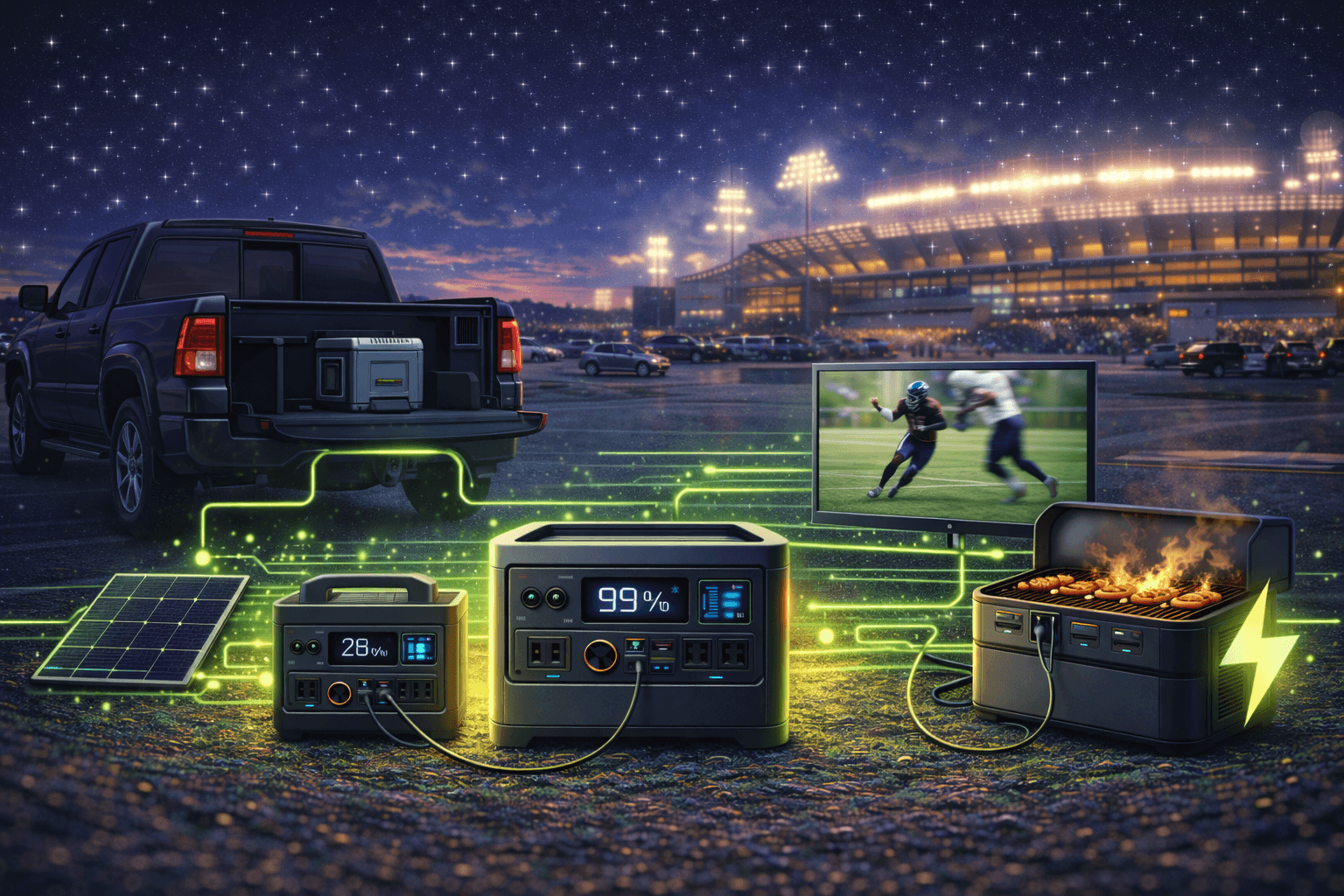
Tailgating is one of the best use cases for a portable power station. You’re outdoors with no wall outlets, running high-draw equipment (TVs, sound systems, cooking appliances) simultaneously, doing it weekly during sports season, and your setup doubles as hospitality — the quality of your power directly affects the party.
Generators used to be the default, but they’re loud, smelly, and need fuel line maintenance. Car battery inverters drain the vehicle battery and create departure anxiety. Modern power stations eliminated those compromises: silent operation that doesn’t kill conversation, enough capacity for 6+ hours of everything running at once, instant-on without pull-starting, and zero emissions so you stay venue-compliant.
Tailgating power needs differ from camping or home backup. Camping stretches modest power over days. Home backup emphasizes reliability during unpredictable outages. Tailgating demands high simultaneous output (TV plus sound plus grill plus blender all at once), moderate duration (4-8 hours of concentrated use), and genuine portability — you’re carrying this 50-100 feet from your vehicle through a parking lot, often weekly.
This guide covers load calculation so you don’t run out mid-fourth-quarter, what features actually matter for parking lot parties, and specific model recommendations from budget to legendary.
Note: This guide contains affiliate links. If you purchase through our links, we may earn a commission at no extra cost to you. This helps support our in-depth testing and content creation.
Calculating Your Tailgating Power Needs
The single most common mistake is undersizing. People calculate for the TV alone, forget about the sound system, lights, device charging, and cooking — then wonder why the unit dies at halftime.
Basic Tailgate (Typical Fan Setup)
Core loads: 55” LED TV (75W), portable speaker (100W), LED string lights (30W), device charging for guests (50W). These entertainment loads run continuously across a 6-hour event: about 1,530Wh total.
Add an electric griddle for pre-game food and halftime snacks — 1,200W for roughly 1 hour of actual cook time — and you’re at 2,730Wh. With a 25% buffer for inverter inefficiency, cold weather, and unexpected loads: roughly 3,400Wh needed.
But most tailgaters cook on propane and use the power station for everything else. In that case, 1,500-2,000Wh covers a solid basic tailgate comfortably.
Impressive Tailgate (Quality Setup)
Bigger TV, better sound (150W), electric grill (1,500W intermittent), blender for drinks (800W for brief bursts), more guest devices, a cooler or mini-fridge. Total consumption across the event pushes toward 5,000Wh. Practically, most people in this tier buy 2,000-3,000Wh capacity and manage cooking strategically — cook early when the battery is full, propane for extended grilling.
Cold Weather Adjustment
This is the one people miss. Battery chemistry at 30°F delivers 70-80% of rated capacity. A unit rated at 2,000Wh becomes effectively 1,400-1,600Wh during winter football. Plan 30% extra capacity for games under 40°F.
The Quick Formula
List every device. Look up its actual wattage. Estimate realistic hours of use (cooking is intermittent, TV is continuous). Multiply watts × hours for each device. Sum everything. Add 25% buffer. That’s your target capacity.
Features That Actually Matter for Tailgating
High Continuous Output (1,500W Minimum)
Your TV plus sound system draws 250W at baseline. Add a 1,500W electric grill and you’re at 1,750W. A unit rated at only 1,000W forces you to choose between entertainment and cooking — not much of a party. Get 1,800W minimum, 2,000W+ preferred.
Portability (Under 50 lbs)
You’re carrying this from your vehicle to the tailgate spot, 50-100+ feet through a parking lot. Every week. The difference between a 27-pound unit and a 50-pound unit accumulates fast over a 20-game NFL season. Under 50 lbs for one-person carry; over that, you need a cart or a buddy.
Multiple AC Outlets (4+ Minimum)
Typical simultaneous connections: TV, sound system, string lights, USB charging station, electric grill, blender. With only 2-3 outlets, you’re constantly juggling plugs and adding power strips that create clutter and failure points. Four outlets is the minimum; six is ideal.
Abundant USB Ports
Modern guests expect to charge their phones. Limited USB (2-3 ports) creates queues and frustrated guests asking to borrow outlets. Six or more ports — including USB-C power delivery — lets 10+ devices charge simultaneously without touching your AC outlets.
Fast Charging (Under 2 Hours)
Weekly use demands quick turnaround. Sunday evening you come home with a dead battery. If it takes 6-8 hours to charge, you need to plan carefully and never forget. If it charges in 80 minutes, you plug it in during dinner and it’s done before bed. Fast charging turns power station ownership from a chore into a grab-and-go routine.
Best Portable Power Stations for Tailgating
1. EcoFlow Delta 2 — Best Overall ($999)
The Delta 2 hits the sweet spot for weekly tailgating: enough capacity for a 6-8 hour impressive setup, powerful output handling simultaneous high-draw loads, light enough to carry one-handed, and fast enough to charge that you never need to think about it.
| Feature | Specification |
|---|---|
| Capacity | 1,024Wh |
| AC Output | 1,800W (2,700W surge, 2,200W X-Boost) |
| Weight | 27 lbs |
| Charging | 0-80% in 50 min, full in 80 min |
| Ports | 4 AC, 2 USB-C (100W), 2 USB-A, DC |
| Battery | LiFePO4, 3,000+ cycles |
| Expandable | To 3,072Wh with extra batteries |
| Warranty | 5 years |
With a 55” TV, quality sound, LED lights, and device charging running all day plus an hour of electric grill cooking, the Delta 2 finished events with 15-20% reserve — comfortable margin for overtime games or spontaneous additions.
The 27-pound weight is genuinely game-changing for weekly use. One-handed carry from vehicle to setup, easy repositioning throughout the event for shade or wind, no physical burden at pack-up. Over a 20-game season, that 5-10 lbs saved versus heavier competitors is the difference between effortless routine and conscious effort.
The 80-minute full charge makes weekly tailgating brainless: plug in Sunday evening, fully charged by bedtime, grab and go next Saturday. No planning, no overnight coordination, no “forgot to charge” disappointment.
X-Boost extends effective output to 2,200W for compatible appliances, handling loads that technically exceed the base 1,800W rating. The EcoFlow app lets you check battery status from across the tailgate without leaving a conversation.
Expandable to 3,072Wh for championship-caliber events by adding an extra battery later — stage your investment as your setup ambitions grow.
Best for: 70-80% of serious weekly tailgaters who want capacity, portability, and charging speed in one refined package.
For the full EcoFlow comparison, see our EcoFlow guide.
2. Jackery Explorer 1000 Plus — Best Value ($899)
More capacity and higher output than the Delta 2 for $100 less. The trade-off is convenience features: heavier, slower charging, fewer outlets. For value-conscious tailgaters who prioritize raw capability per dollar, this is the pick.
| Feature | Specification |
|---|---|
| Capacity | 1,264Wh (23% more than Delta 2) |
| AC Output | 2,000W (4,000W surge) |
| Weight | 32 lbs |
| Charging | Full in ~1.7 hours |
| Ports | 3 AC, 2 USB-C (100W), 2 USB-A |
| Battery | LiFePO4, 4,000 cycles |
| Warranty | 5 years |
That extra 240Wh means the Jackery finished identical test events with 30-35% reserve versus the Delta 2’s 15-20%. The higher 2,000W continuous output (with 4,000W surge) handles simultaneous grill-plus-blender-plus-entertainment loads with more headroom.
The 4,000-cycle battery is the best long-term economics story in this tier. At 20 tailgates per year, the battery mathematically outlasts your tailgating career. Cost per cycle: $0.22 versus $0.33 for the Delta 2.
The honest trade-offs: 32 lbs requires two-hand carrying (noticeable over a season), 1.7-hour charge time is fine but not grab-and-go convenient, and only 3 AC outlets means you may need a power strip for complex setups.
Best for: Committed value-conscious tailgaters who’ll accept heavier weight and slower charging for superior capacity, output, and decade-plus longevity.
Check Price on Jackery
Also on Amazon
See our full Jackery lineup comparison for more options.
3. Bluetti AC180 — Best Budget ($499-599 on Sale)
The entry point for power-station tailgating at aggressive pricing. Delivers enough capacity and output for basic to moderate setups without premium investment.
| Feature | Specification |
|---|---|
| Capacity | 1,152Wh |
| AC Output | 1,800W (2,700W Power Lifting) |
| Weight | 37 lbs |
| Charging | 0-80% in 45 min, full in ~1.3-1.8 hrs |
| Ports | 4 AC, 1 USB-C (100W), 4 USB-A, wireless pad |
| Battery | LiFePO4, 3,500+ cycles |
| Warranty | 5 years |
The 1,152Wh capacity powers basic tailgates (TV, sound, devices, lights) for a full 6-hour event with comfortable margins. Adding heavy electric cooking tightens things — propane for the grill and electric for everything else is the smart play at this capacity.
The wireless charging pad on top is a genuine party trick: guests drop their phones on the surface and they charge. No cables, no asking for outlets, just works. It’s a small thing that consistently impresses.
Bluetooth app control lets you monitor battery status and adjust settings remotely. Charging hits 80% in 45 minutes — competitive with anything in the category.
At 37 lbs, it’s heavier than both the Delta 2 and Jackery despite lower capacity. That’s the main practical downside for weekly carry-in tailgating.
Best for: Casual tailgaters, students, budget-constrained buyers who want solid capability without premium pricing.
Check Price on Bluetti
Also on Amazon
For more Bluetti options, see our Bluetti comparison guide.
4. EcoFlow Delta 2 Max — Best Premium ($1,299)
Double the Delta 2’s capacity for all-day legendary events. When your tailgate involves a 65” TV, professional sound, extended electric cooking, projector systems, and 20+ guests — this is the unit.
| Feature | Specification |
|---|---|
| Capacity | 2,048Wh (expandable to 6,144Wh) |
| AC Output | 2,400W (4,800W surge, 3,400W X-Boost) |
| Weight | 50 lbs |
| Charging | 0-80% in 43 min (AC+Solar), ~1 hr AC only |
| Ports | 6 AC, 2 USB-C (100W), 4 USB-A, DC |
| Battery | LiFePO4, 3,000 cycles |
| Warranty | 5 years |
The 2,048Wh capacity handles enthusiast loads pushing 5,000Wh across an event with margins to spare. The 2,400W continuous output runs more simultaneous appliances and higher-power equipment than anything else here. 4,800W surge handles startup spikes from smokers and induction cooktops.
At 50 lbs, you need a wheeled cart or a partner to carry it. That’s the price of double capacity. Acceptable for vehicle-based tailgating with a cart setup; impractical if you need true grab-and-go portability.
Expandable to 6,144Wh for ultimate multi-TV, multi-cooking-station championship events.
Best for: Premium committed tailgaters hosting legendary all-day events. Justified for serious enthusiasts or season-long VIP hosting.
Buy EcoFlow Delta 2 Max on Amazon
Setup Tips for Game Day
Night before: Charge to 100%. Pre-position in your vehicle where it’s easily accessible — don’t bury it under coolers. Organize all cables in one bag. Test connections at home if it’s your first time.
At the lot: Position the unit centrally to minimize cable runs and trip hazards. Elevate off the ground on a cooler or low table if conditions are wet or muddy. Shade it from direct sun when possible — reduces heat stress and extends runtime.
During the event: Start with entertainment loads only (TV, sound, lights run at 250-350W for hours). Add cooking during high-battery windows — early in the event when you’re at 80%+, not late when you’re at 20%. Check battery status periodically through the app. If running low, reduce loads gracefully (dim lights, lower volume) rather than experiencing a hard shutdown during the fourth quarter.
Weather: Cold games (under 40°F) reduce capacity 20-30% — account for this in planning. Hot games (over 90°F) — shade the unit and ensure ventilation, don’t enclose it where heat builds up. Rain — keep it under the tent or tarp, never operate in standing water, dry ports before connecting.
Post-game: Recharge immediately when you get home. Don’t wait until Saturday morning. Weekly maintenance of “charge after use” creates a reliable grab-and-go routine all season.
Frequently Asked Questions
How long will it run my tailgate TV?
A 55” LED TV draws about 75W. On a 1,000Wh unit at 85% inverter efficiency, that’s roughly 11 hours of TV alone. But you’re not running TV alone — add sound (100W), lights (25W), and device charging (50W) and your total draw is 250W. Now that same 1,000Wh unit lasts about 4.7 hours. Add an hour of electric grill cooking and the math gets tighter still.
Always calculate based on total simultaneous load, not TV alone.
Can I power an electric grill?
Yes, with the right unit. Electric grills draw 1,000-1,500W. You need a power station rated at 1,500W+ continuous to run one safely, and 1,800W+ to run the grill simultaneously with your TV and sound system (total ~1,750W together).
The strategic approach: cook early when the battery is full and tolerant of high draw. Batch-cook quickly rather than leaving the grill on for hours. Or use propane for primary cooking and save electric capacity for entertainment — the hybrid approach gives you the best of both worlds with zero power anxiety.
What’s the best starter unit for budget tailgaters?
The Bluetti AC180 at $499-599 on sale gives you 1,152Wh and 1,800W output — enough for TV, sound, device charging, and lights throughout a full game. Start there, experience your actual power patterns for a season, then upgrade with better information about what you genuinely need versus what you assumed.
For complete equipment selection beyond tailgating, see our buyer’s guide and decision framework.
Conclusion
The right portable power station turns a basic tailgate into a legendary one — silent power for impressive TVs, quality sound, hot food, cold drinks, and a charging station that makes you the parking lot’s most popular host.
Our picks by priority:
- Best overall: EcoFlow Delta 2 ($999) — 1,024Wh, 27 lbs, 80-min charge, the weekly tailgater’s best friend
- Best value: Jackery Explorer 1000 Plus ($899) — 1,264Wh, 2,000W, 4,000 cycles, maximum capability per dollar
- Best budget: Bluetti AC180 ($499-599) — 1,152Wh, wireless charging, solid entry point
- Best premium: EcoFlow Delta 2 Max ($1,299) — 2,048Wh, 2,400W, all-day legendary events
Match capacity to your setup: basic tailgating (TV, sound, devices) needs 1,000-1,500Wh. Add electric cooking and you’re looking at 2,000Wh+. Legendary multi-appliance setups start at 3,000Wh. Most serious tailgaters land in the 1,000-1,500Wh sweet spot with propane handling the grilling.