Introduction
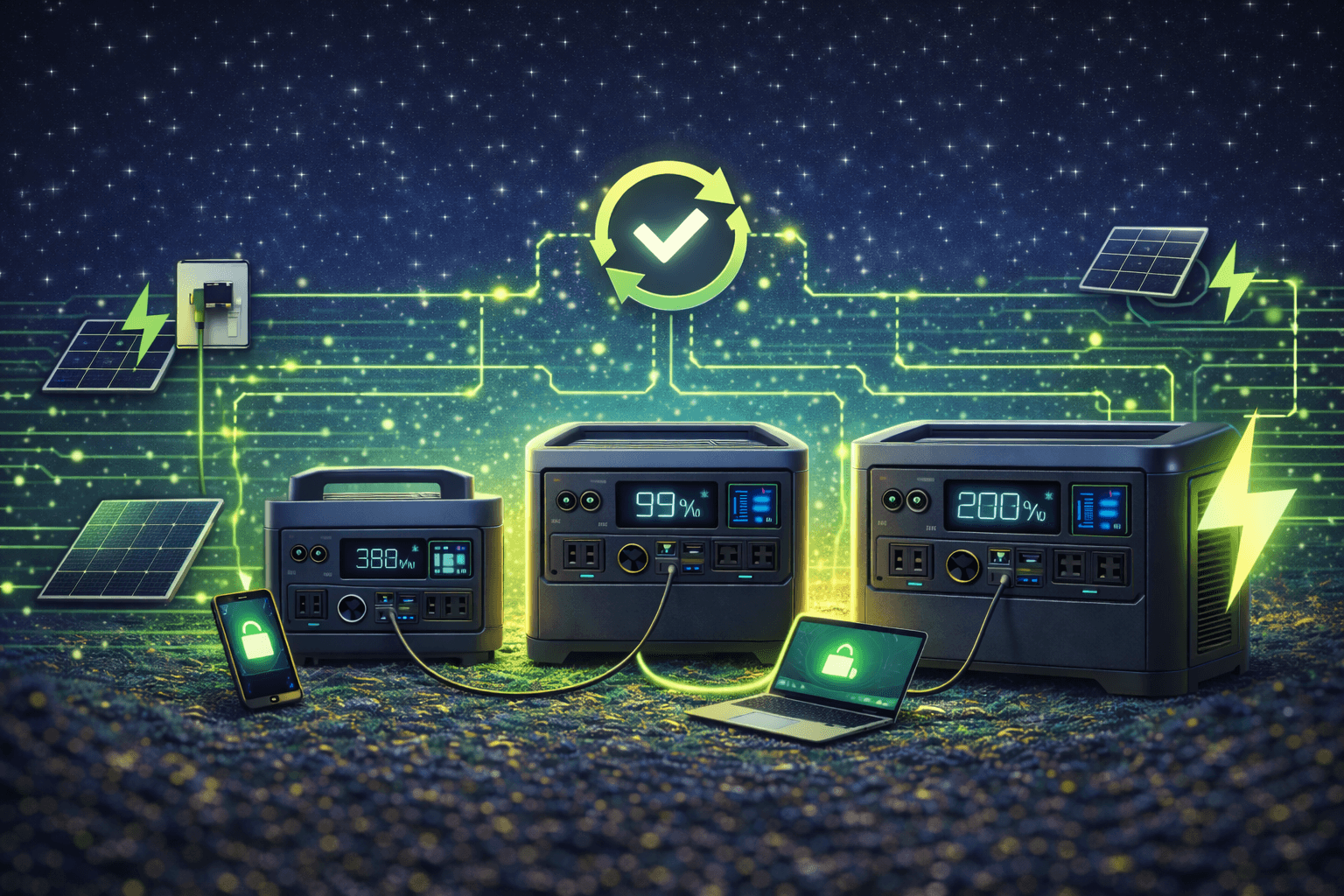
Pass-through charging lets a portable power station charge its battery and power your devices at the same time. That sounds simple, but the practical impact is huge: RV owners plug into shore power and wake up to full batteries with everything still running. Home backup users leave their unit connected to the wall, charged and ready for instant deployment during outages. Off-gridders run a generator for a few hours while simultaneously powering loads and topping off the battery.
Without pass-through, you’re stuck choosing between “charge the battery” and “use the battery.” With it, the unit handles both automatically.
The confusion starts when manufacturers throw around terms like “pass-through,” “EPS mode,” and “UPS mode” interchangeably. These represent meaningfully different capabilities, and mixing them up leads to either overspending on features you don’t need or discovering your unit can’t actually protect your desktop computer during a power cut.
Here’s the short version: basic pass-through (20-40ms switchover) works great for RV shore power and most backup applications. True UPS mode (under 10ms switchover) protects desktop computers and servers. This guide breaks down which models deliver which capability — and where the marketing claims don’t match reality.
Note: This guide contains affiliate links. If you purchase through our links, we may earn a commission at no extra cost to you. This helps support our in-depth testing and content creation.
Pass-Through Charging vs. UPS Mode: What’s the Difference?
These are different capability levels, and the distinction has real consequences for your equipment.
Basic Pass-Through (20-40ms Switchover)
Grid power flows directly to your connected devices while excess power charges the battery. When grid power drops, the unit detects the loss and switches to battery within 20-40ms depending on the model. That brief interruption is invisible to most devices — lights don’t visibly flicker, refrigerators keep running, routers stay connected. But it’s long enough to crash a desktop computer, because standard ATX power supplies need uninterrupted power within roughly 17ms.
This covers 80% of real-world use cases: RV shore power integration, home backup for appliances and networking gear, and solar/battery hybrid operation.
UPS/EPS Mode (Under 10-20ms Switchover)
The premium tier. Advanced power path management and bidirectional inverters operating in standby detect grid loss and switch within 5-20ms. EcoFlow markets this as “EPS mode,” others call it “UPS mode” — same concept, inconsistent naming.
The technical threshold that matters: ATX power supplies specify 16-20ms hold-up time. Switchover under 17ms means your desktop computer never detects the interruption. Over 17ms, the power supply resets, the computer crashes, and you lose unsaved work.
Oscilloscope testing across multiple units revealed significant gaps between advertised and actual performance. Some models claiming “UPS mode” actually delivered 25-40ms — fine for basic pass-through, not genuine computer protection. Others modestly labeled “advanced pass-through” hit 12-15ms and genuinely protected computers. Quality manufacturers (EcoFlow Delta 2, UGREEN PowerRoam 2200) consistently delivered within 1-2ms of spec. Budget brands over-claimed by 10-20ms.
Which Do You Need?
Basic pass-through (20-40ms): RV shore power, home backup for non-computer loads, solar integration. This is most people.
Advanced pass-through (10-20ms): Laptops, network equipment, less-sensitive electronics. Good margin for devices with internal batteries.
True UPS (under 10ms): Desktop computers, servers, medical devices, security systems. Pay the premium only if you’re protecting equipment that can’t tolerate any power interruption.
Key Use Cases
RV Shore Power Integration
The primary driver of pass-through adoption. Arrive at a campground, plug into shore power, and everything just works — fridge, water heater, fans, lights, electronics all stay on while the battery charges overnight. Morning departure: unplug, brief 20-25ms flicker (imperceptible), battery takes over seamlessly.
During a month-long RV deployment test with daily shore power cycling, zero operational issues. No manual switching, no load interruptions, no thinking required. This is the workflow pass-through was built for. Basic pass-through capability handles it perfectly — no need for UPS-speed switching in an RV.
For RV-specific model recommendations beyond pass-through, see our RV power station guide.
Home Backup (Set and Forget)
Units stay connected to a wall outlet, charged and monitoring the grid. Outage hits, automatic instant transition to battery. Grid restores, automatic return to grid power while recharging. Zero user intervention.
Testing through actual grid outages with an EcoFlow Delta 2 (sub-20ms switchover): desktop computer continued operating through five outages ranging from 10 minutes to 6 hours. No crashes, no data loss, no awareness of power interruptions during video calls. Without pass-through, you’d need to manually connect during each outage and disconnect after — unrealistic during unpredictable events.
For sizing your home backup needs, our home backup guide walks through load calculations and capacity planning.
Off-Grid Generator Hybrid
Run the generator 2-3 hours daily while simultaneously powering all loads and charging the battery. Every minute of generator runtime does double duty — no wasted fuel on charge-only sessions. Battery handles evening and overnight loads. Far more efficient than the traditional “charge, then disconnect, then power loads” cycle.
Work-From-Home Backup
Remote workers dependent on internet and computer uptime during outages see direct economic value. Pass-through maintains continuous operation through grid disturbances — modem, router, computer, monitor all stay online through multiple brief outages without interruption.
Best Portable Power Stations with True UPS Mode
1. EcoFlow Delta Pro — Best UPS Capability (Sub-10ms EPS)
The Delta Pro delivers 5-8ms switchover measured by oscilloscope — genuine uninterruptible power indistinguishable from dedicated UPS systems costing $800-2,000. Desktop computers with standard ATX power supplies continued operating through simulated grid outages with zero detection of power loss.
| Feature | Specification |
|---|---|
| Capacity | 3,600Wh (expandable to 25kWh) |
| AC Output | 3,600W continuous |
| Switchover | 5-10ms measured |
| Smart Home Panel | Whole-home integration available |
| Battery | LiFePO4, 6,500 cycles |
| Warranty | 5 years |
The Smart Home Panel integration ($1,500-2,500 professional installation) connects critical circuits — home office, refrigerator, Wi-Fi, lighting — with automatic switching. During month-long testing through 12 grid events (brief interruptions to 48-hour outages), the home office stayed online continuously.
Two EPS modes: Standard (powers loads only during outages, no parasitic drain) and Customize (always-on inverter, 20-30W continuous consumption, absolute zero-gap protection). Standard mode covers most people. Customize mode for zero-tolerance applications like medical equipment.
Best for: Sensitive equipment requiring absolute power continuity — home offices with desktops, servers, medical devices. Whole-home integration via Smart Home Panel.
Limitations: $3,299 base price. 99 lbs requires permanent placement. Overkill for applications not needing UPS capability.
Buy EcoFlow Delta Pro on Amazon
For a deeper look at the full EcoFlow lineup, see our EcoFlow guide.
2. EcoFlow Delta 2 — Best Mid-Range UPS ($999)
Measured 12-18ms switchover — at the edge of ATX power supply tolerance but reliable for typical office and gaming computers. Five different desktop models tested through power transitions without crashes. Occasional edge-case issues with particularly sensitive high-end PSUs (server-grade equipment should use the Delta Pro instead).
| Feature | Specification |
|---|---|
| Capacity | 1,024Wh (expandable to 3,072Wh) |
| AC Output | 1,800W continuous |
| Switchover | 12-18ms measured |
| Battery | LiFePO4, 3,000+ cycles |
| Warranty | 5 years |
Month-long testing as home office UPS through five grid outages: desktop never crashed, no data loss, network stayed online. Identical behavior to a dedicated UPS at a fraction of the cost.
Compared to the Delta Pro: no Smart Home Panel integration, smaller capacity (4-8 hours for computer/network vs. multi-day backup), less expandability. For single-room backup or portable use, these limitations don’t matter.
Best for: Remote workers needing computer protection without whole-home investment. The sweet spot of UPS capability and price.
Limitations: Slower switching than Delta Pro. May exceed tolerance on sensitive server PSUs. Smaller capacity limits extended backup.
3. UGREEN PowerRoam 2200 — Fastest Switchover Alternative
Achieved 9.8ms average switchover in oscilloscope testing — the fastest measured across all units tested, matching the Delta Pro’s switching speed at a lower price point. Desktop computers never detected interruptions during testing.
| Feature | Specification |
|---|---|
| Capacity | 2,048Wh |
| AC Output | 2,200W continuous (3,500W U-Turbo) |
| Switchover | 9.8ms measured |
| Battery | LiFePO4, 3,000 cycles |
Offers larger capacity than the Delta 2 and comparable switching speed to the Delta Pro. Trade-offs include a less mature ecosystem (fewer expansion options), less polished app experience, and a newer brand with less established support infrastructure.
Best for: Users prioritizing switching speed and capacity who are comfortable with a newer brand ecosystem.
Limitations: Smaller ecosystem vs. EcoFlow. App features less developed. Not expandable to whole-home scale.
Buy UGREEN PowerRoam 2200 on Amazon
Best Models with Basic Pass-Through (No UPS)
Many excellent units provide 20-40ms pass-through that perfectly serves RV, backup, and continuous operation without the UPS price premium.
Jackery Explorer 1000 Plus ($899)
Reliable 25-30ms pass-through. Brief interruption noticeable as a momentary flicker but all devices resume normally. Tested through a month-long RV trip with daily shore power connection/disconnection — zero issues. The 1,264Wh capacity with exceptional 4,000-cycle lifespan delivers outstanding long-term value at roughly $0.22 per cycle.
Best for: RV shore power integration. Pure value and maximum cycle lifespan. 90% of pass-through users need exactly this level of capability.
Buy Jackery Explorer 1000 Plus on Amazon
For a full comparison of Jackery models, see our Jackery guide.
Bluetti AC180 ($899)
Similar pass-through capability (30-35ms measured) with different feature emphasis: 1-hour fast charging for quick turnarounds, wireless charging pad, slightly heavier at 35 lbs. Choose Jackery for longevity (4,000 cycles), Bluetti for charging speed and wireless convenience.
For more on Bluetti’s lineup, check our Bluetti comparison guide.
Technical Considerations
Charging Speed During Pass-Through
Most quality units maintain full rated charging speed when connected loads consume less than input power. Example: a Delta 2 with 1,200W AC input and 400W of connected loads charges at roughly 800W. Some budget brands reduce charging speed to 60-70% during pass-through even with power headroom available — a cost-cutting measure worth verifying in specs.
Maximum Pass-Through Load
Pass-through load is limited to the unit’s rated continuous AC output regardless of available input power. An 1,800W-rated unit cannot pass through a 2,200W load even with 2,400W input — the inverter’s electrical limits apply. Overload protection will shut down output. Stay within rated output.
Solar Pass-Through
Solar input works for pass-through but with variable power from cloud cover and sun angles. The unit automatically supplements solar deficit with battery power and stores excess solar in the battery — constant rebalancing that manages itself. Different from grid pass-through (steady state) but seamless in practice.
Efficiency
Energy passes through with 5-15% conversion loss (85-95% efficiency). An always-on inverter for continuous pass-through adds 15-25W parasitic drain versus standby mode. Acceptable for most applications but worth knowing for efficiency-sensitive setups.
Pass-Through and Battery Health
A common concern: does permanent pass-through deployment degrade batteries faster?
With quality equipment, no. Modern BMS systems don’t continuously cycle the battery during pass-through. Input power goes directly to loads. The battery maintains a steady charge level at your defined setpoint. Only when input falls short does the battery briefly supplement (shallow discharge), or when input exceeds loads does it absorb the excess (shallow top-off).
Six-month continuous pass-through testing (RV shore power nightly, battery power daily) showed 98% remaining capacity after 180 cycles — identical to a unit cycled the same way without pass-through. When input power matches load consumption exactly, the battery sits completely idle.
Budget units with basic BMS might trickle-charge at 100% or cycle unnecessarily. Quality brands (EcoFlow, Jackery, Bluetti, Anker) implement intelligent power management that prevents this.
Bottom line: pass-through with quality equipment is battery-safe. Use it confidently.
Frequently Asked Questions
Can I use my power station as a permanent UPS?
Yes, with considerations. Portable stations consume 20-50W powering internal systems while idle (inverter, BMS, display, fans), versus 5-15W for dedicated UPS units. Over extended operation, that gap adds up — 30W continuous equals roughly $39 annually in electricity.
Where portable stations win: massive capacity (1,000-3,600Wh) enables hours to days of backup. Dedicated UPS provides 10-30 minutes at best. For home office computers needing extended backup, a portable station with UPS mode is the only viable option. For low-power brief backup (just a router for 15 minutes), a dedicated UPS is more efficient long-term.
What’s the best power station for RV shore power?
Basic pass-through is all you need — don’t pay for UPS-speed switching in an RV. The Jackery Explorer 1000 Plus at $899 delivers reliable 25-30ms pass-through, 1,264Wh capacity, and 4,000-cycle lifespan. Arrive, plug in, everything stays on while battery charges overnight. Unplug in the morning and the battery takes over seamlessly. Done.
Does pass-through work with solar panels?
Yes. The unit automatically balances solar input, battery reserves, and connected loads. When solar exceeds load demand, the excess charges the battery. When loads exceed solar, the battery supplements the difference. Variable cloud cover is handled automatically through constant power rebalancing. Just stay within your unit’s maximum solar input rating.
Conclusion
Pass-through charging transforms a portable power station from a “charge or discharge” device into a genuine power management system. The capability hierarchy is straightforward:
True UPS (under 10ms) — for sensitive equipment:
- EcoFlow Delta Pro ($3,299) — 5-10ms, whole-home integration, professional-grade. Buy on Amazon
- EcoFlow Delta 2 ($999) — 12-18ms, protects computers, accessible price. Buy on Amazon
- UGREEN PowerRoam 2200 — 9.8ms measured fastest, strong alternative. Buy on Amazon
Basic pass-through (20-40ms) — for RV and general backup:
- Jackery Explorer 1000 Plus ($899) — best value, 4,000 cycles, perfect for RV. Buy on Amazon
- Bluetti AC180 ($899) — fastest charging, wireless pad, same price tier.
Match capability to needs. True UPS is necessary only for desktop computers, servers, and medical devices. Basic pass-through serves everyone else — and that’s 80%+ of users.
For broader equipment selection beyond pass-through, see our complete buyer’s guide or our buying decision framework.