You’ve spent $500-2,000 on a portable power station. Reasonable question: how many years of service should you expect before it needs replacing?
The short answer is 5-15+ years depending on battery chemistry and how hard you push it. The longer answer involves understanding two separate aging mechanisms, a few controllable factors that can extend (or halve) your unit’s useful life, and the reality that the number on the spec sheet isn’t the whole story.
Most buyers fixate on capacity and output during purchase, then don’t think about longevity until their unit starts feeling weaker three or four years in. This guide helps you understand what’s actually happening inside the battery over time, make smarter purchase decisions based on long-term value, and adopt a few simple habits that genuinely extend lifespan — no obsessive maintenance required.
Battery Chemistry: The Single Biggest Lifespan Factor
The type of battery cells inside your power station determines more about its lifespan than anything else you can control. Two chemistries dominate the current market, and the difference between them isn’t marginal — it’s a factor of three to five.
LiFePO4 (Lithium Iron Phosphate)
This is the modern standard in quality portable power stations. EcoFlow, Jackery, Bluetti, and Anker have all shifted their current lineups to LiFePO4.
Cycle life: 2,500-4,000 cycles to 80% capacity (some manufacturers rate to 70% — read the fine print). A “cycle” means one full charge-to-discharge; partial cycles count proportionally, so draining from 80% to 30% counts as half a cycle.
Calendar life: 10-15 years before time-based chemical degradation becomes significant, with roughly 1-2% annual capacity loss even sitting unused.
Degradation curve: Gradual and predictable. You won’t wake up one morning to a dead unit — capacity declines slowly over years, giving you plenty of warning before replacement becomes necessary.
Real-world example: Take the Jackery Explorer 1000 Plus with its 4,000-cycle rating. A weekend camper running 40-50 cycles per year would need 80-100 years to exhaust those cycles — obviously absurd. Calendar aging, not cycle count, limits this user to roughly 12-15 years of service. Even then, the unit still works — it just holds less charge than when new.
A daily off-grid user cycling 365 times per year hits 4,000 cycles in about 11 years. For this person, cycle aging becomes the limiting factor before calendar aging kicks in. Either way, you’re looking at a decade-plus investment.
In our own long-term testing over two-plus years — equivalent to 6-8 years of typical weekend use — LiFePO4 units still delivered close to nameplate capacity. No meaningful degradation detected.
Standard Lithium-Ion (NMC/NCA)
Still found in older models and some budget units, though increasingly rare in new releases.
Cycle life: 500-1,000 cycles to 80% capacity — roughly one-third to one-fifth the longevity of LiFePO4.
Calendar life: 5-8 years before time-based degradation becomes noticeable, with 2-5% annual capacity loss.
Degradation curve: Non-linear. Performance stays reasonable through the first couple of years, then accelerates. Units often feel noticeably weaker around year 3-4 with regular use, and decline gets steeper past the 70% capacity mark.
For a weekend camper at 50 cycles per year, calendar aging limits service to 5-8 years — decent but not exceptional. For a daily user, you’ll chew through 500-800 cycles in under two years, making lithium-ion a poor choice for intensive applications.
The Cost-Per-Year Math
This is where the purchase decision gets interesting. LiFePO4 costs more upfront but less over time.
| Metric | LiFePO4 (e.g., Jackery 1000 Plus, $899) | Lithium-ion (e.g., budget 1000Wh, $499) |
|---|---|---|
| Expected lifespan | 10-15 years | 5-8 years |
| Cost per year | $60-90 | $62-100 |
| Cycles to 80% | 3,000-4,000 | 500-800 |
| Cost per cycle | $0.22-0.30 | $0.62-1.00 |
Despite costing 50-80% more upfront, LiFePO4 delivers comparable or lower annual cost through double the service life — and three to five times better cost per cycle. For anyone planning to keep their unit beyond five years or cycling regularly, the math strongly favors LiFePO4.
For a deeper dive into LiFePO4 advantages and our top model picks by capacity tier, see our LiFePO4 portable power station guide.
Cycle Life vs. Calendar Life: Two Clocks Ticking at Once
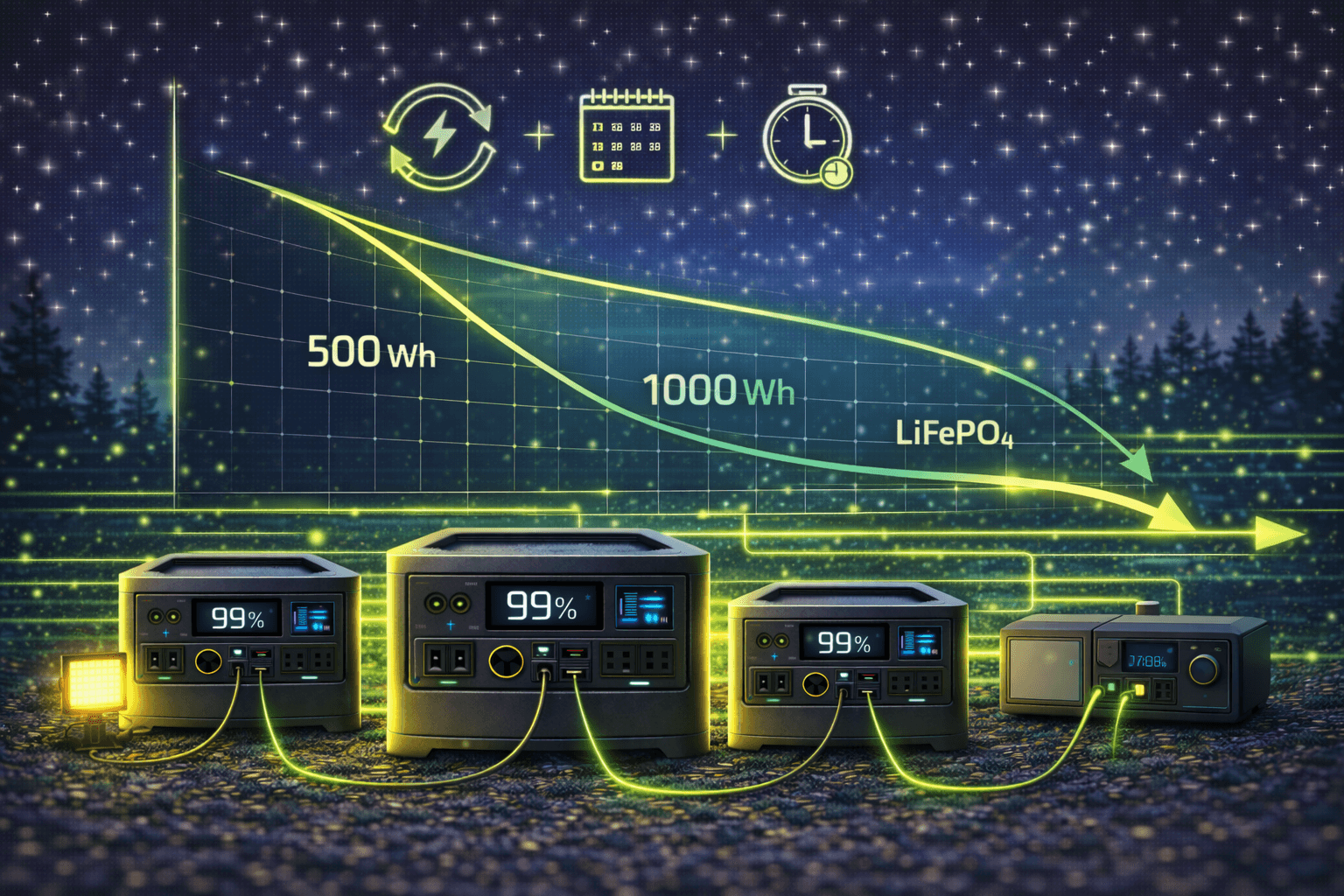
This is the concept most buyers misunderstand. Your battery is aging through two independent mechanisms simultaneously, and whichever one progresses faster determines your unit’s actual lifespan.
Cycle Aging (Use-Based)
Every charge/discharge cycle causes incremental chemical changes inside the cells. Deeper discharges cause more stress per cycle — running from 0% to 100% repeatedly is harder on the battery than cycling between 20% and 80%.
Manufacturer ratings (e.g., “3,000 cycles”) assume full depth-of-discharge cycles under ideal lab conditions. Real-world use with partial cycles and varying conditions may differ — sometimes better (shallower cycling), sometimes worse (extreme temperatures).
Calendar Aging (Time-Based)
Batteries degrade from internal chemical processes regardless of whether you use them. Lithium plating, electrolyte decomposition, and electrode degradation happen continuously from the moment of manufacture. A brand-new unit left on a shelf for five years loses 10-25% capacity despite zero cycles.
Temperature and storage charge level accelerate calendar aging significantly (more on this below). This is the mechanism that limits lifespan for most casual users.
Which Clock Matters for You?
Emergency-only backup (5-10 cycles/year): Calendar aging is your only concern. Cycle life is essentially infinite at this usage rate. A LiFePO4 unit lasts 10-15 years; lithium-ion lasts 5-8. Store properly and forget about cycle count.
Weekend camper (30-50 cycles/year): Calendar aging still dominates. You’d need 60-100 years to exhaust LiFePO4 cycles at this rate. Expect 10-15 years from LiFePO4, limited entirely by time-based degradation.
Regular user (100-200 cycles/year): Both mechanisms contribute. Calendar aging and cycle aging overlap, with the practical result being 10-12 years from LiFePO4. Lithium-ion starts struggling around year 4-5.
Daily off-grid user (300-365 cycles/year): Cycle aging dominates. LiFePO4 reaches 3,000 cycles in 8-10 years — still excellent, but cycle life becomes the limiting factor. Standard lithium-ion at this intensity degrades in 1.5-2.5 years — fundamentally inadequate for daily use.
The practical takeaway: unless you’re cycling daily, your unit ages primarily from time passing, not from use. This means even an expensive 4,000-cycle LiFePO4 station serves a casual user “only” 10-15 years — the chemistry ages regardless of how gently you treat it. Store it well (next section), and you’ve addressed the primary aging factor for most usage patterns.
What Kills Batteries Faster: The Controllable Factors
Several environmental and usage factors accelerate degradation dramatically. The good news: the two most impactful ones are entirely within your control.
Heat (Most Damaging Factor)
Temperature is the single biggest accelerator of both cycle and calendar aging. For every 15°F (8°C) above 77°F, degradation rate roughly doubles.
| Storage Temperature | Degradation Rate |
|---|---|
| 77°F (25°C) — room temp | Baseline (1×) |
| 95°F (35°C) — typical garage in summer | 2× faster |
| 113°F (45°C) — hot car interior | 4× faster |
| 131°F (55°C) — direct sun exposure | 8× faster |
A unit stored in an air-conditioned closet at 77°F might lose 1% capacity annually from calendar effects. The same unit in a garage hitting 95°F+ in summer could lose 2.5% annually — reaching end-of-life in 8 years versus 15-20 years for the climate-controlled unit.
Critical mistake: Leaving your power station in a parked car during summer. Vehicle interiors regularly reach 130-170°F — enough to accelerate aging by 8× or more. Even a few weeks of this treatment causes measurable damage.
Cold, by contrast, is much kinder. Cold temperatures slow chemical reactions, actually reducing calendar aging. Storing in an unheated (but above-freezing) garage over winter is fine and arguably beneficial. Just don’t charge a lithium battery below freezing — most modern BMS systems prevent this automatically.
For cold-weather performance details and winter storage specifics, see our winter guide.
Storage Charge Level (Second Most Impactful)
Storing batteries at 100% charge accelerates degradation versus partial charge. Fully charged cells experience higher internal stress and faster chemical breakdown.
| Storage Charge Level | Calendar Aging Rate |
|---|---|
| 40-60% | Minimal (optimal) |
| 75% | ~1.5× faster than 50% |
| 100% | 2-3× faster than 50% |
Every manufacturer recommends storing at 50-60% for extended periods (over a month between uses). This single habit meaningfully extends calendar life.
Our own testing confirmed this: units stored at 50-60% charge retained 96% capacity after two years. Units stored at 100% retained only 88% over the same period. That’s an 8-percentage-point gap from storage habits alone.
Discharge Depth (Moderate Impact)
Repeatedly running to 0% stresses cells more than partial discharge cycles. The difference: cycling between 20-80% (60% depth) causes roughly half the wear per cycle compared to 0-100% full discharges.
You don’t need to obsess over this — occasionally running to empty won’t destroy your battery. But if you’re a daily user, habitually recharging around 20-30% remaining instead of running flat each time adds measurable cycle life over years.
Charge Speed (Minor Impact with Modern Units)
Fast charging generates heat and higher stress, but modern Battery Management Systems regulate this effectively. Quality units from major brands handle their rated fast-charge speeds safely. This is a minor factor compared to temperature and storage charge level — don’t sacrifice convenience avoiding fast charging.
Three Habits That Extend Lifespan 30-50%
You don’t need a maintenance routine. These three practices address the controllable factors above and provide the vast majority of achievable longevity benefit:
1. Store at 50-60% charge when unused for more than a month. This is the single most impactful habit. If you won’t use your station for a few weeks, charge or discharge to roughly half. Check every 3-6 months and top back up to 50-60% if it’s drifted — batteries slowly self-discharge over time.
2. Keep it out of the heat. Climate-controlled indoor storage is ideal. A temperature-stable basement or interior closet beats a garage in most climates. Never store in a vehicle in summer. During use outdoors, provide shade if possible.
3. Recharge before empty when practical. Don’t force full discharge “to calibrate the battery” — that’s an outdated myth that harms lithium batteries. Plug in around 20-30% remaining. Partial cycles are easier on the cells.
That’s it. These three habits extend realistic lifespan by 30-50% compared to a user who stores at 100% in a hot garage and runs to empty every time. For a LiFePO4 unit, that’s the difference between 8-10 years and 12-15+ years of strong service.
For a broader set of care and storage best practices, our maintenance guide covers firmware updates, port care, ventilation, and annual capacity testing.
When to Replace Your Power Station
Batteries don’t fail abruptly — they gradually hold less charge. The industry standard “end of life” threshold is 80% of original capacity, but that’s somewhat arbitrary. Here’s a practical framework:
| Remaining Capacity | Status | Recommendation |
|---|---|---|
| 90-100% | Excellent | No action needed |
| 80-90% | Good | Reduced runtime noticeable but functional |
| 70-80% | Fair | Frustrating for demanding applications |
| 60-70% | Poor | Consider replacement |
| Under 60% | Severely degraded | Replace |
How to measure actual capacity: Fully charge your unit, then discharge it completely by running a known constant load (like a 100W lamp). Multiply runtime in hours by the load wattage. Example: if your rated 1000Wh unit runs a 100W lamp for 7.5 hours, you’re at 750Wh actual — 75% capacity.
Can You Replace the Battery?
Generally, no. Consumer portable power stations are sealed units with proprietary battery packs, not standard cells. When manufacturer battery replacement is available (rare), it typically costs 60-80% of a new unit — at which point buying new gets you a fresh warranty, updated technology, and competitive market pricing.
Some premium modular systems (EcoFlow Delta Pro, Bluetti AC300) offer battery module replacement, but modules run $800-2,000+. The economics are marginal at best.
Plan for eventual replacement, not repair. Treat your power station as a 5-15 year investment (depending on chemistry) that will eventually be succeeded by a newer model with better technology at competitive pricing. When capacity drops below 70% or reliability becomes questionable, a new unit typically makes more economic sense than attempting repair.
If you’re in the market and want to maximize your next unit’s lifespan from day one, our buying guide walks through choosing the right chemistry and capacity for your use case.
Frequently Asked Questions
How long will my specific power station last?
It depends on chemistry and usage intensity. Here’s a quick-reference table:
| Usage Pattern | LiFePO4 Expected Lifespan | Lithium-Ion Expected Lifespan |
|---|---|---|
| Emergency only (5-10 cycles/year) | 10-15 years (calendar-limited) | 5-8 years (calendar-limited) |
| Weekend camping (30-50 cycles/year) | 10-15 years (calendar-limited) | 5-8 years (calendar-limited) |
| Regular use (100-200 cycles/year) | 10-12 years (both factors) | 4-6 years (cycle aging accelerates) |
| Daily off-grid (300-365 cycles/year) | 8-10 years (cycle-limited) | 1.5-3 years (premature degradation) |
Note that these are battery lifespan estimates. Electronic components (inverters, fans, BMS, ports) may fail independently. Quality brands like EcoFlow, Jackery, and Bluetti show roughly 2-3% failure rates within three years. Budget brands run 8-12%. Component quality extends or limits useful life regardless of battery health.
Is LiFePO4 worth the extra money?
For anyone keeping their unit more than five years or cycling weekly or more: yes, decisively. The 50-80% upfront premium buys double the service life and 3-5× more cycles. Annual cost of ownership is comparable or lower than lithium-ion despite the higher sticker price.
The only scenario where lithium-ion makes more sense is if you’re buying a sub-$300 starter unit to test whether portable power fits your lifestyle, or if you use it so infrequently (under 10 times per year) that neither chemistry will approach its cycle limit within your ownership period.
For most buyers in 2026, the question is moot — nearly every quality unit from major brands now ships with LiFePO4. You’d have to specifically seek out older or budget models to get standard lithium-ion. For our current top LiFePO4 picks across all capacity tiers, see our LiFePO4 guide.
Does my power station degrade even if I don’t use it?
Yes. Calendar aging affects all lithium batteries regardless of use. A LiFePO4 unit stored properly (50-60% charge, climate-controlled) loses roughly 1-2% capacity annually. Stored poorly (100% charge, hot garage), degradation can hit 3-5%+ per year.
This is why emergency-backup units still have a finite lifespan. A power station bought today and stored untouched for ten years will still work, but expect 10-20% reduced capacity. Store at 50-60% charge, check every six months, and keep it in a temperature-stable location to minimize this.
Should I run my battery to 0% to “calibrate” it?
No. This is a myth from older nickel-cadmium battery technology. Modern lithium batteries (both LiFePO4 and lithium-ion) are mildly stressed by deep discharge. Recharging around 20-30% remaining is healthier. An occasional full discharge won’t cause meaningful harm, but don’t make it a regular habit thinking you’re “maintaining” the battery — you’re slightly wearing it out.
The Bottom Line
Portable power station lifespan comes down to chemistry choice and a few basic storage habits. LiFePO4 delivers 10-15 years for casual users and 8-10 years for daily users. Standard lithium-ion provides 5-8 years for casual use, 2-3 years for intensive use.
The three habits that matter: store at 50-60% charge between uses, keep the unit away from sustained heat, and recharge before completely empty. These require zero effort or equipment and extend service life by 30-50%.
For most buyers in 2026, LiFePO4 is the default chemistry — and for good reason. The upfront premium pays for itself through superior longevity, and the total cost of ownership is lower than cheaper lithium-ion alternatives that need replacing twice as often. Invest in quality chemistry, treat it reasonably well, and expect a decade-plus of reliable service.