Your portable power station’s warranty matters more than you think. Two units with identical specs and pricing can deliver completely different ownership experiences depending on whether the manufacturer actually stands behind the product or quietly shifts repair costs onto you.
A 1000Wh station with a 5-year comprehensive warranty behaves like a protected asset. The same station with 90-day coverage is a disposable gadget you’ll replace out of pocket. This guide breaks down warranty duration, coverage scope, claim processes, and customer service quality across every major brand — so you can judge total value, not just surface specs.
Why Warranty Duration Is a Quality Signal
Warranty length tells you how confident a manufacturer is in their own product. Budget brands offering 90-day to 1-year coverage are essentially betting their products will fail — they just want your money before they do. Premium brands backing units for 5+ years are putting real money on the line.
Here’s how the market breaks down:
Budget tier (90 days – 1 year): Unbranded marketplace sellers and ultra-budget imports. Coverage barely confirms the unit arrived working. Battery exclusions are standard, and support is usually a single email address that may or may not respond.
Entry tier (1–2 years): Older-generation models from otherwise reputable brands and budget-focused lines. Adequate for occasional, light use — but you’re carrying most of the risk for anything beyond basic defects.
Standard tier (2–3 years): The mid-market sweet spot. Brands like ALLPOWERS, some Bluetti models, and older Goal Zero units sit here. Many now include battery capacity thresholds (60–70% retention), which is a meaningful upgrade from defects-only coverage.
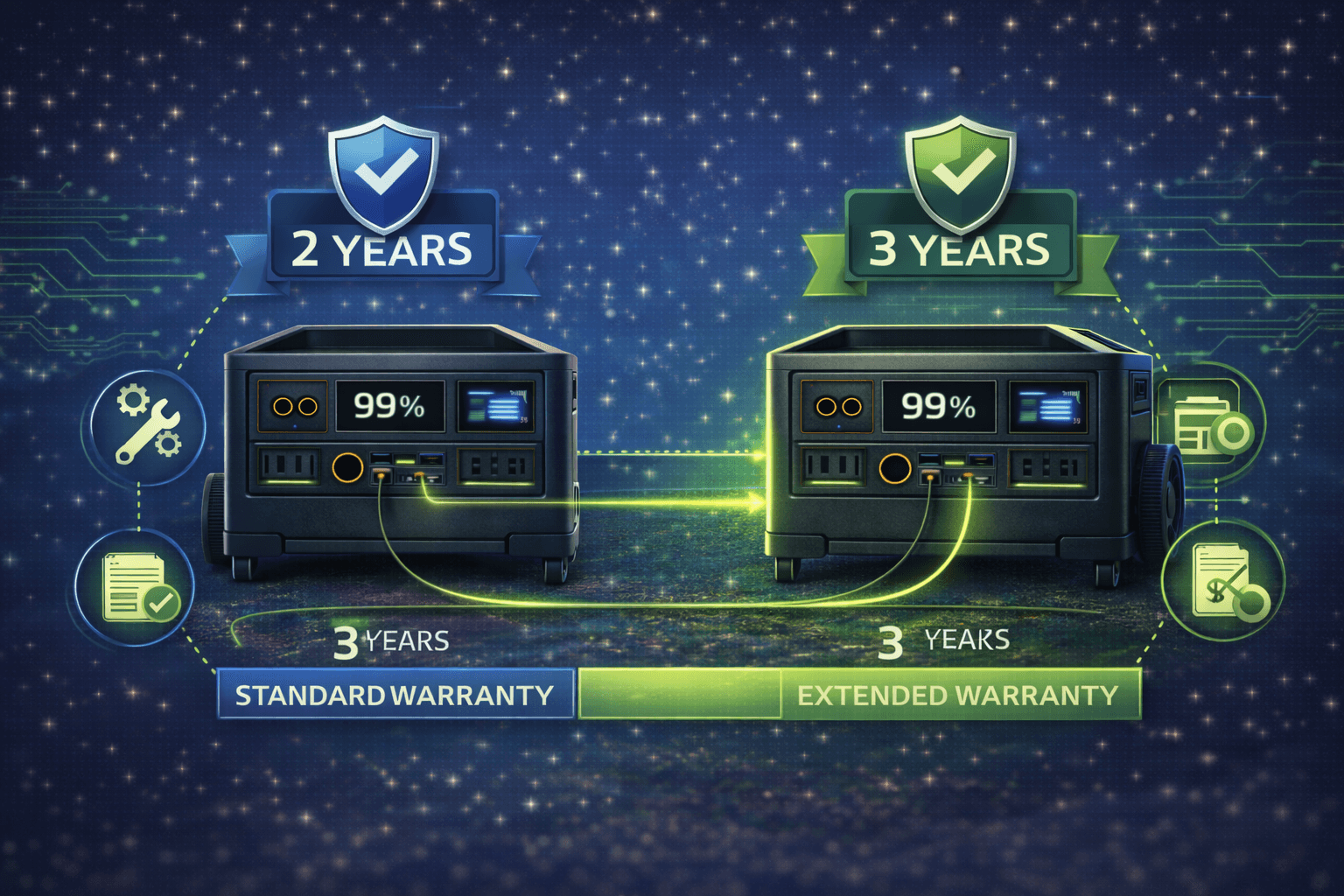
Premium tier (3–5 years): Where serious buyers should focus. EcoFlow’s RIVER 2 and DELTA 2 lines carry 5-year warranties. Jackery’s Explorer Plus and Pro series offer 3+2 year structures (three years standard, two more with registration). Anker SOLIX LiFePO4 stations (F2600, F3800) get 5-year coverage backed by EV-grade battery cells. This tier covers defects, battery degradation, and often includes advance replacement options.
Elite tier (5–6+ years): Bluetti leads here with 72-month warranties on compact LiFePO4 models like the AC60 and AC240, and 60 months on the AC200L. Goal Zero’s Yeti Pro 4000 and its newer LFP-based Yeti 700, 500, and 300 all carry 5-year coverage — a major improvement over the 2-year standard on their older NMC-based Yeti X series.
The pattern is clear: LiFePO4 chemistry gets longer warranties because manufacturers know these batteries last. If a brand offers only 12–18 months on a LiFePO4 unit, that’s a red flag.
Brand-by-Brand Warranty Breakdown
EcoFlow (2–5 years depending on model)
EcoFlow’s current LiFePO4 lineup — RIVER 2, DELTA 2, and DELTA 3 series — carries 5-year warranties when purchased from authorized sellers. Older RIVER and DELTA models (NMC chemistry) sit at 24 months with optional registration-based extensions.
Coverage includes defects in materials and workmanship, with battery protection tied to cycle-life expectations. Claims go through online portals and email, with initial responses typically within 1–3 business days. For higher-end models with confirmed defects, EcoFlow sometimes offers advance replacement — shipping a new unit before you return the faulty one — which cuts downtime from weeks to days.
The catch: EcoFlow doesn’t provide a global warranty. Cross-regional repairs come at additional cost, and some products don’t support cross-regional service at all. Buy from an authorized seller in your country.
Jackery (2–5 years depending on series)
Jackery runs a tiered system. Explorer Plus and Pro series (including the 1000 Plus, 2000 Plus, and all Pro models) get 3+2 years — three standard, plus two more when you register through the official website or Amazon. Older Explorer models (1000, 500, 300 series) get 2+1 years.
Jackery’s support is consistently good. Phone support is available in North America with short hold times, and representatives can typically distinguish between user-side wiring issues and genuine inverter defects without escalation. Replacements ship at Jackery’s expense for confirmed warranty issues.
One important detail: Jackery’s warranty doesn’t cover the battery cell unless you fully charge it within seven days of purchase and at least once every six months afterward. Skip that initial charge, and you could lose battery coverage entirely.
Anker SOLIX (18 months – 5 years)
Anker’s warranty split reveals its transition from consumer electronics to serious power. Legacy PowerHouse models carry 18-month coverage — standard for the phone-charger company Anker used to be. The SOLIX LiFePO4 lineup (F2600, F3800, C-series) gets 5-year warranties, reflecting a 10-year lifespan positioning on EV-grade cells.
Claims flow through Anker’s established online ticket system. For ambiguous battery complaints, they may request app log data and several controlled charge-discharge cycles before approving a claim — reasonable, but expect some back-and-forth.
Bluetti (24–72 months)
Bluetti has the most complex warranty matrix in the industry. Here’s what matters: compact LiFePO4 models like the AC60 and AC240 get 72 months (6 years). The AC200L and similar mid-range LFP units get 60 months (5 years). Older NMC designs (EB55, EB70, EB3A) remain at 24 months. Home backup systems like the AC300 and AC500 get 48 months.
User experiences with Bluetti support are mixed. Some buyers report prompt responses and generous replacements. Others describe slow email-only communication and disputes over what counts as premature battery degradation versus normal aging. Check the exact warranty for your specific model and region before purchasing — don’t assume brand-wide consistency.
Goal Zero (2–5 years)
Goal Zero’s warranty improved significantly with their LiFePO4 transition. The Yeti Pro 4000, Tank Pro 4000, and newer LFP models (Yeti 700, Yeti 500, Yeti 300) all carry 5-year warranties. Older NMC-based Yeti X models (6000X, 3000X, 1500X, 1000X) remain at 2 years. Lead-acid batteries get only 180 days.
Goal Zero’s advantage is longevity and dealer network. They’ve been in the game longer than most competitors, which means better parts availability and a track record of supporting discontinued models for years after the last sale.
What Actually Gets Covered (And What Doesn’t)
Duration means nothing without scope. A 5-year warranty that covers only manufacturing defects while treating all battery degradation as “normal wear” is worth far less than a 3-year warranty with explicit capacity guarantees.
What good coverage includes:
Manufacturing defects in the inverter, BMS, battery, and ports. Premature battery degradation below a published threshold — typically 60–70% of rated capacity for NMC chemistry, 70–80% for LiFePO4 within the warranty period. Prepaid shipping for confirmed warranty repairs. Clear, documented claim procedures.
What premium coverage adds:
Advance replacement for critical-use models. Phone and live chat support. Multi-year protection (4–6+ years) tied to LiFePO4 cycle-life guarantees.
Red flags to watch for:
Battery explicitly excluded or called a “consumable” without defined thresholds. Customer pays shipping both ways on all claims. Original packaging required for returns. Non-transferable warranty — kills resale value.
How to File a Warranty Claim (And Actually Win)
Most claims start online or by email. Every brand wants the same things: proof of purchase, serial number, fault description, and photos or video of the problem. Organized buyers who photograph serial labels at unboxing and save invoices digitally move through this stage in hours. Everyone else spends days tracking down receipts.
After initial submission, expect basic troubleshooting requests — trying different loads, updating firmware, performing a hard reset. For simple issues like tripped protections or app glitches, this might actually fix the problem. For real defects, documenting your troubleshooting attempts speeds approval because it proves the issue persists despite reasonable effort.
Battery degradation claims are harder. Manufacturers draw a line between expected aging and premature failure, and you need data to prove your case. The process: fully charge the station, run a steady known load (a space heater or incandescent lamp bank works well) until auto-shutdown, and measure delivered watt-hours with a plug-in power meter. Run this test 2–3 times and document results with timestamps and photos.
If your 1000Wh LiFePO4 station consistently delivers only 700Wh (70%) within a warranty period that guarantees 80% retention, you’ve got a strong case. If it delivers 850Wh (85%), that’s normal aging — annoying, but not warrantable.
Typical resolution timelines:
Premium brands (EcoFlow, Jackery, Anker): Initial response within 1–2 business days. Decision on repair or replacement within 7–10 days. Total resolution including shipping: 1–3 weeks for straightforward cases.
Mid-tier brands (Bluetti, ALLPOWERS): Initial response within 2–5 business days. Total resolution: 3–6 weeks, often with a return-first policy where you ship the unit back before any replacement is issued.
Budget brands: Unpredictable. Some respond quickly but request endless additional evidence, restarting the clock each time. Others go silent after an initial acknowledgment, forcing you to dispute through the marketplace or your credit card company.
Common denial reasons: Physical damage from drops or liquid. Overloading outputs beyond published ratings. Opening the case or flashing unofficial firmware. Missing proof of purchase, especially on gray-market imports. Buying through unauthorized channels or auction sites. Capacity complaints that still fall above the guaranteed threshold.
Customer Service Quality: The Hidden Differentiator
Written warranty terms are only as good as the people enforcing them. Here’s the practical reality:
Jackery consistently gets the highest marks for support quality. Phone and email support in North America, knowledgeable agents who can diagnose real issues versus user error, and low claim denial rates. If your documentation is solid, expect a smooth process.
EcoFlow offers multi-channel support (phone, email, chat) with generally fast response times. Their product knowledge is strong, and they’re equipped for advance replacements on higher-end models. The main friction point is cross-regional service limitations.
Anker leverages its massive consumer electronics support infrastructure. Responsive and professional, though battery degradation claims may require more data than competitors demand.
Bluetti is the most variable. Some users get excellent service; others report circular email chains and slow resolutions. Recent reviews before purchase are your best indicator of current support quality.
Goal Zero benefits from a long track record and established dealer network. Better parts availability and repair options than newer competitors, with consistent long-term support for older models.
Budget and generic brands typically treat support as a cost center. Single email address, week-long response times, and each reply requests more evidence without advancing the case. A nominal 2-year warranty from an unknown brand is often unenforceable in practice.
Are Extended Warranties Worth It?
Usually not — but with exceptions.
Manufacturer extensions (typically 1–3 extra years for 10–20% of the purchase price) make sense when: the base warranty is short (under 2 years), the product will see heavy daily cycling, or the unit supports mission-critical loads like medical equipment. Paying to extend an 18-month NMC warranty to 3 years for an off-grid cabin used every weekend? That’s reasonable.
Adding paid years on top of an already-strong 5-year LiFePO4 warranty? You’re insuring a narrow, low-probability risk. LiFePO4 batteries commonly retain 70–80% capacity after thousands of cycles, and most non-abusive failures cluster in the first few years — which are already covered.
Third-party plans (Asurion, SquareTrade) operate differently. They often cover accidental damage — drops, spills, surges — which manufacturer warranties explicitly exclude. For units used on boats, construction sites, or during frequent travel, that accidental coverage may be more valuable than extended defect protection.
For most buyers choosing reputable brands with strong standard warranties, the smarter move is self-insuring: set aside the cost of an extension in a maintenance fund and use it if something goes wrong outside warranty. You’ll come out ahead statistically.
Does the Warranty Transfer If You Resell?
Transferability varies widely and directly affects resale value. Jackery explicitly limits warranty to the original consumer purchaser — it does not transfer. Goal Zero takes a similar approach, tying coverage to the original buyer’s records. Bluetti restricts coverage to the country of purchase and requires matching purchaser information.
If you plan to buy used or resell later, read the specific policy. A unit with three years of remaining, transferable coverage is worth materially more than one whose warranty dies at resale. Exchange copies of invoices and confirm serial numbers during any private sale.
One universal exclusion: products purchased through online auction houses are excluded by nearly every major brand. Buying a “new” power station through a third-party auction seller means you likely have zero warranty coverage regardless of what the listing claims.
Bottom Line: Match Warranty to Your Ownership Horizon
Treat warranty coverage as a parallel factor to specs and price. Match duration to how long you plan to own the unit. Insist on explicit battery degradation thresholds — ideally 80% capacity retention for LiFePO4, 60–70% for NMC. Prioritize brands with proven, multi-channel support operations. Don’t duplicate protection you already have with unnecessary extended plans.
For budget models ($200–$500), accept nothing less than 1–2 years covering defects plus defined battery thresholds and responsive email support. For mid-tier stations ($500–$1,500), expect 2–3 years with battery coverage and at least one real-time contact channel. For premium models ($1,500+), demand 3–5 years of comprehensive coverage with advance replacement access.
A slightly more expensive unit with robust 5-year coverage and responsive support delivers better long-term value than a cheaper competitor whose warranty disappears just when you start relying on it. The best portable power station isn’t just powerful — it’s backed by a manufacturer willing to stand behind it for the years you plan to own it.
For related guidance, see our complete buying guide for selecting the right unit, our LiFePO4 guide for understanding battery chemistry advantages, our lifespan guide for maximizing longevity, and our maintenance guide for keeping your investment in top condition.