Introduction
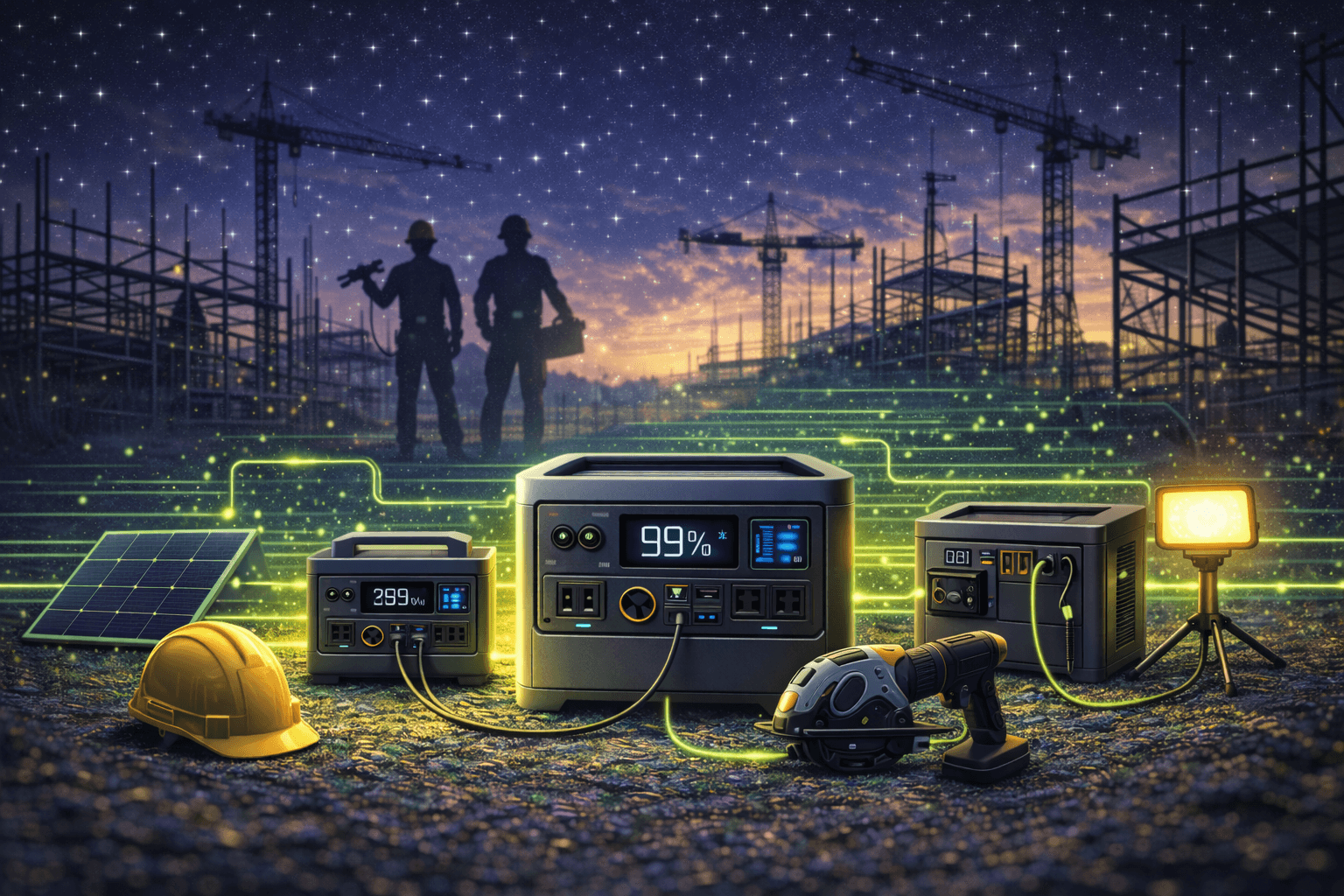
Construction sites are the most demanding application for portable power. Professional tools draw 1,000-2,000W+, workdays run 8-10 hours consuming 3,000-6,000Wh, and the equipment has to survive jobsite dust, vibration, impacts, and weather. This is where consumer products get separated from professional-grade gear, and where realistic assessment matters most — portable power genuinely solves some construction problems while generators remain necessary for others.
The shift from generators to portable power stations makes sense for specific scenarios: noise-ordinance compliance on residential jobs, zero-emission indoor work in occupied buildings, instant-on convenience without fuel management, and increasingly sufficient capacity for real professional use. But framing and concrete work still need generators. The key is matching equipment to the right application.
This guide covers real tool wattages and duty cycles (the data contractors actually need), which construction scenarios suit portable power versus which don’t, durability requirements for jobsite abuse, ROI math showing payback through fuel savings, and professional-grade model recommendations.
Note: This guide contains affiliate links. If you purchase through our links, we may earn a commission at no extra cost to you. This helps support our in-depth testing and content creation.
Construction Tool Power: What You Actually Draw
The most common capacity mistake in construction is calculating based on tool ratings rather than actual duty cycles. A miter saw rated at 2,100W peak doesn’t draw 2,100W for 8 hours straight — it cuts intermittently while you spend most of the day measuring, positioning, and handling material.
Actual Measured Duty Cycles
Miter saw (sliding compound): 2,100W peak startup, 840W average running. In finish carpentry, actual cutting time across a 6-hour day measured at 18.8% — roughly 90 minutes of cuts versus 330 minutes of everything else. Real consumption: 840W × 0.188 = 158W average, totaling about 950Wh for the day. Far less than the spec sheet suggests.
Circular saw: 2,400W peak, 1,200W running. Measured 8.3% duty cycle in finish work (40 minutes actual cutting in an 8-hour day). Real consumption: about 100W average. In production framing, duty cycles climb to 20-30% — a different story entirely.
Table saw: 1,800W running with 40-60% duty cycle in production work. This is one of the higher sustained demands because production table saws process material more continuously. Average draw around 800W.
Reciprocating saw: 1,100W cutting, 20-40% duty depending on application (demolition runs higher). Effective average: roughly 330W.
Impact drivers and drills: 600-900W under load, 10-30% duty cycle. Effective average: about 150W. These are low-demand tools.
Air compressor: 1,200-1,500W building pressure, 0W at cutoff. Duty cycle varies dramatically with air tool usage — 40-70%. Sustained pneumatic work averages 660W and represents substantial demand.
Realistic Daily Consumption by Work Type
Finish carpentry (6-8 hours): Miter saw (950Wh actual), circular saw (280Wh), impact driver (900Wh), work lights (400Wh), cordless tool chargers (200Wh). Total: roughly 2,730Wh. With 25% buffer: about 3,400Wh needed. A 4,000Wh unit covers this with margin.
Service call (4 hours): Reciprocating saw (550Wh), impact driver (750Wh), lights (150Wh), chargers (100Wh). Total: about 1,550Wh. A 1,500-2,000Wh unit handles this comfortably.
Heavy framing (sustained high-draw): Circular saw (1,260Wh), reciprocating saw (2,200Wh), compressor (3,960Wh), impact drivers (1,500Wh), lights (400Wh). Total: 9,300+Wh. This exceeds any portable power station — generator territory.
The insight most contractors miss: finish carpenters consistently overestimate their tool runtime. We documented 8-hour days where the miter saw ran 90 minutes total. The remaining 6+ hours involved measuring, layout, material handling — zero tool power consumed. Understanding your real duty cycles prevents both massive overcalculation and undersizing.
Where Portable Power Works (and Where It Doesn’t)
Ideal: Interior Finish Work
Trim installation, cabinet hanging, flooring, paint work. Modest power draw (miter saw, nailers, lights), noise-sensitive occupied buildings, 3,000-5,000Wh daily consumption. Zero emissions matter when you’re working inside occupied apartments with HVAC running. Silent operation lets you start at 7am without noise complaints and work evenings past quiet hours.
Across six occupied-building remodeling projects, portable power enabled early/late schedules impossible with generators, eliminated tenant complaints about noise and fumes, and gave floor-to-floor portability (27 lbs versus lugging a generator between floors).
Ideal: Service and Repair Work
HVAC, plumbing, and electrical service calls involve brief high-draw tool use (reciprocating saw, impact driver), mobile operation from a service vehicle, and professional appearance at customer locations. Typical service calls consume 800-1,200Wh. With fast-charging units (80 minutes), you can recharge during the drive between afternoon calls — maintaining full-day multi-call productivity without a generator’s setup time, noise, or fuel logistics.
Ideal: Remodeling (Residential, Light Commercial)
Same advantages as finish work — occupied buildings, noise constraints, moderate power. Add professional appearance: clients notice silent power versus generator rumble. First impressions affect repeat business and referrals.
Not Viable: Heavy Production Work
Heavy framing, concrete work, and rough-in electrical/plumbing all demand sustained maximum draw exceeding 9,000Wh daily. Continuous circular saws, sustained compressor operation, concrete saws running for hours — these applications need generators. Portable power stations simply lack the capacity.
The Smart Play: Hybrid Approach
Most contractors don’t need to choose one or the other. Portable power handles 80% of the day (finish tools, lights, chargers, detail work). Generator covers the 20% peak demand (table saw extended use, sustained compressor operation). This captures portable advantages — silent, clean, professional — while the generator handles extremes. You burn far less fuel than running a generator all day.
Jobsite Durability Requirements
Construction abuse exceeds anything recreational use throws at equipment. Dust from cutting and sanding, vibration from work truck transport and nearby hammering, drops from scaffolding, temperature extremes in unheated winter buildings and direct summer sun.
Quality brands (EcoFlow, Jackery, Bluetti) use reinforced impact-resistant housings and corner protection. Drop-testing units 3 feet onto plywood subfloor — simulating standard jobsite handling — quality units showed zero damage and continued operating. Budget units cracked housings, developed internal rattling, and showed intermittent failures.
Dust is the silent killer. Drywall sanding creates extreme particulate environments. Quality units with filtered cooling vents and sealed port covers survived dusty environments without internal contamination after cleaning. Budget units showed dust infiltrating components, fan failures, and erratic behavior within weeks.
LiFePO4 battery chemistry handles temperature extremes better than standard lithium-ion. Winter interior work at 35°F: LiFePO4 units showed 15-20% capacity reduction versus 25-35% for lithium-ion. For cold-weather construction, the chemistry difference is real.
For truck transport over rough roads, quality battery mounting matters. Quality units survived 6+ months of daily jobsite transportation without connection failures. Budget units developed loose internal connections after weeks of truck vibration.
Professional lifespan expectation: budget units last 1-2 years of daily professional use before failures. Quality units deliver 3-5 years of consistent professional use. LiFePO4 chemistry (4,000+ cycles standard) outlasts lithium-ion (3,000 cycles typical).
Best Portable Power Stations for Construction
1. EcoFlow Delta Pro — Best Professional Construction ($2,799)
Maximum capability for professional contractors doing daily jobsite work. The 3,600Wh capacity covers a full 8-hour finish carpentry day, the 3,600W output runs any tool combination simultaneously, and the expandable ecosystem scales to 25kWh for multi-day remote sites.
| Feature | Specification |
|---|---|
| Capacity | 3,600Wh |
| AC Output | 3,600W (7,200W surge, 4,500W X-Boost) |
| Weight | 99 lbs (wheel kit included) |
| Charging | 2.7 hrs AC (1800W), 1.8 hrs (240V) |
| Solar Input | 1,600W dual MPPT |
| AC Outlets | 5 |
| Battery | LiFePO4, 6,500+ cycles |
| Expandable | To 25kWh |
| Warranty | 5 years |
In full-day finish carpentry testing, total consumption ran about 2,730Wh (miter saw + circular saw + impact driver + lights + chargers at real duty cycles). The Delta Pro finished workdays with 15-20% reserve — enough margin for overtime or unexpected loads. We never encountered a tool combination that exceeded its output capacity.
The Smart Home Panel integration creates a professional temporary distribution system for renovation sites: wire the panel to dedicated rooms, give workers local outlets throughout the space instead of running extension cords from a single source. This impresses clients and simplifies power management versus traditional extension cord chaos.
Dual 1,600W MPPT solar input enables multi-day remote jobsite power. Paired with 1,200W of portable solar panels, daily generation (4,000-5,000Wh) exceeded daily consumption — creating sustainable multi-week operation without grid connection or generator.
At 99 lbs, this requires a wheel kit and permanent truck installation. Roll it from truck to jobsite, then stationary for the day. Not something you carry — something you deploy.
Best for: Established contractors with consistent applicable workload (finish carpentry, remodeling) where daily use justifies the investment. ROI through fuel savings, client impressions, and noise-restricted job access.
Buy EcoFlow Delta Pro on Amazon
For the full EcoFlow lineup, see our EcoFlow guide.
2. Jackery Explorer 2000 Plus — Best Value Professional ($1,599)
Professional capability at accessible pricing. The 2,042Wh capacity covers 6-8 hour moderate workdays, the 3,000W output handles any single tool with headroom, and the 4,000-cycle battery ensures decade-plus professional service life.
| Feature | Specification |
|---|---|
| Capacity | 2,042Wh |
| AC Output | 3,000W (6,000W surge) |
| Weight | 61.5 lbs |
| Charging | 2 hrs AC |
| Solar Input | 1,400W (six panels max) |
| Battery | LiFePO4, 4,000 cycles |
| Expandable | To 12kWh with battery packs |
| Warranty | 5 years (3+2 with registration) |
Moderate finish work days (miter saw + circular saw + impact driver + lights + chargers) consumed about 2,280Wh. The 2000 Plus finished with 10-15% reserve — adequate for typical 6-7 hour days, tight for extended 10-hour sessions where you’d want to manage loads.
The 3,000W continuous output (with 6,000W surge) provides comfortable headroom. Table saw (1,800W) plus lights plus chargers runs well under the ceiling — competitors at 2,000W would be stressed by the same combination.
At 200 workdays annually, 4,000 cycles provides 20 years mathematically. The battery outlasts your career. Cost per cycle: $0.40 — genuinely long-term value for professionals.
At 61.5 lbs, it’s a two-person carry from truck to jobsite. Heavier than the Delta 2 but lighter than the Delta Pro. Workable with a helper, challenging solo.
Best for: Contractors with moderate daily power needs (finish work, remodeling, service) who want professional capability without the Delta Pro’s premium. Exceptional long-term value.
Check Price on Jackery
Also on Amazon
See our full Jackery comparison for more options.
3. EcoFlow Delta 2 — Best Mobile Service Power ($999)
Optimized for solo mobile contractors doing service calls. At 27 lbs and 80-minute charging, it’s the grab-and-go unit for HVAC technicians, plumbers, and electricians who need power at multiple customer locations daily.
| Feature | Specification |
|---|---|
| Capacity | 1,024Wh |
| AC Output | 1,800W (2,700W surge, 2,200W X-Boost) |
| Weight | 27 lbs |
| Charging | Full in 80 min |
| Ports | 4 AC, 2 USB-C (100W), 2 USB-A |
| Battery | LiFePO4, 3,000+ cycles |
| Expandable | To 3,072Wh |
| Warranty | 5 years |
The 27-lb weight changes everything for mobile service. Grab it one-handed from the truck, carry it to the customer’s location, reposition as needed. Over weeks of daily service calls, that portability advantage versus 60-99 lb alternatives is enormous.
Typical service calls (reciprocating saw + impact driver + lights + chargers) consume 1,000-1,200Wh. The Delta 2 handles a full 4-6 hour call. For full-day multi-call work, the 80-minute charge creates a unique workflow: deplete during morning calls, recharge during the drive to the afternoon job (from truck inverter), arrive fully charged. Slow-charging competitors can’t replicate this.
The 1,800W output runs any single service tool. Simultaneous multi-tool loads are less common in service work (you’re typically using one tool at a time), making this output adequate for the niche.
Best for: HVAC, plumbing, and electrical service contractors doing mobile work. Solo operators who need lightweight, fast-charging, grab-and-go power for 2-4 hour calls.
ROI: The Numbers That Justify the Investment
Contractors evaluate equipment through payback. Here’s the honest math.
Five-Year Total Cost Comparison
Portable power station: Equipment $1,000-3,500 + electricity $400 (five years at $0.15-0.30/recharge) + maintenance $100 = $1,500-4,000 total.
Equivalent generator: Equipment $500-1,500 + fuel $9,000 (200 workdays × $9/day × 5 years) + maintenance $750 (oil, filters, service) + repairs $400 = $10,650-11,650 total.
The delta: $7,000-9,000 savings over five years for applicable work (finish, remodeling, service). That’s not a marginal improvement — it’s a fundamental cost structure change.
Indirect Value
Client perception is real but hard to quantify. Silent professional equipment versus generator noise affects repeat business and referrals. Compliance value is concrete: many residential sites prohibit generators (noise ordinances, HOA rules, occupied buildings). Portable power lets you take jobs generators can’t access. Productivity gains add up: no fuel runs, instant start, easier communication without generator noise, no repositioning as work moves through the building.
Break-Even Timeline
At $9/day fuel savings, equipment costing $1,000-3,500 breaks even after 111-389 workdays. For contractors working 200+ days annually, payback lands within 1-2 years through fuel savings alone. Everything after that is pure savings.
Frequently Asked Questions
Can portable power fully replace my jobsite generator?
For specific applications — yes. Interior finish work, remodeling, and service calls: six months of exclusive portable power testing completed projects without generator backup. Silent operation, occupied-building access, and professional appearance provided advantages generators can’t match.
For heavy production work — no. Framing, concrete, and rough-in demand 9,000+ Wh daily, exceeding portable capacity. These need generators.
The practical answer for most contractors: portable power handles 80% of your work (finish tools, lights, chargers). Keep the generator for the 20% that demands peak output (sustained compressor operation, production table saw work). Burn a fraction of the fuel you used to.
What daily power consumption should I expect?
The numbers vary dramatically by work type. Finish carpentry runs about 2,700-3,300Wh daily (4,000Wh unit sufficient). Service calls average 1,000-1,500Wh (1,500-2,000Wh unit adequate). Heavy framing hits 9,000+ Wh (exceeds portable capacity).
The critical variable is duty cycle. Your miter saw’s rating says 2,100W, but it actually runs 18% of the day. Your impact driver is rated at 900W but operates 12% of the time. Calculate based on actual cutting/driving time, not the hours you’re on site. The difference between spec-sheet calculation and duty-cycle calculation is typically 60-70% — massive enough to change your capacity needs entirely.
Conclusion
Portable power stations serve professional construction in specific scenarios — interior finish work, remodeling, service calls, and light commercial — where silent operation, zero emissions, and professional appearance provide real advantages over generators.
Our picks by application:
- Best professional construction: EcoFlow Delta Pro ($2,799) — 3,600Wh full-day capacity, 3,600W unlimited tools, expandable to 25kWh, 6,500+ cycle decade-plus reliability
- Best value professional: Jackery Explorer 2000 Plus ($1,599) — 2,042Wh, 3,000W, 4,000 cycles, exceptional long-term value at accessible pricing
- Best mobile service: EcoFlow Delta 2 ($999) — 27 lbs one-hand portable, 80-min charging, perfect for mobile HVAC/plumbing/electrical contractors
For broader equipment selection, see our buyer’s guide and decision framework. For off-grid jobsite setups with solar, see our off-grid power guide. Business users may also qualify for tax deductions.