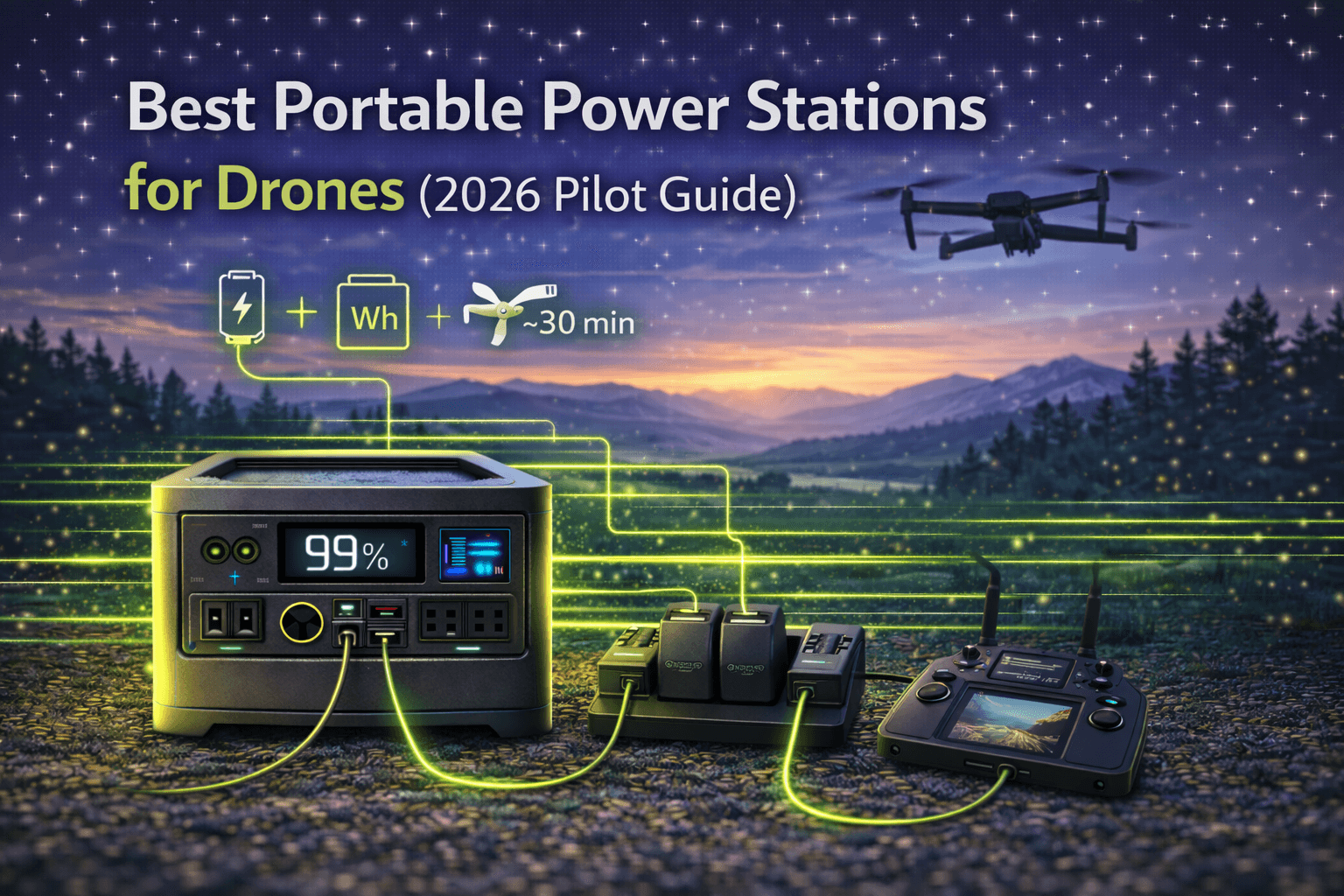
Drone batteries die fast. A professional real estate shoot burns through 4–8 batteries in a session. FPV racers blow through dozens in a single day. And if your only charging option is a 12V car adapter at 60–90 minutes per battery, you’re spending more time waiting than flying.
A portable power station changes the math entirely. Plug in a multi-battery charging hub, charge 4–6 batteries simultaneously via AC, and keep shooting from locations where your vehicle can’t follow — mountain overlooks, remote coastline, wilderness viewpoints.
This guide breaks down exactly how much power you need by pilot type, which models deliver, and how to plan all-day sessions without running dry.
Note: This guide contains affiliate links. If you purchase through our links, we may earn a commission at no extra cost to you.
Drone Battery Charging: Know Your Numbers
Before picking a power station, you need to know how much energy your specific drone batteries actually consume per charge. These numbers drive every decision.
Consumer & Prosumer Drone Battery Specs
DJI Mini series (Mini 3, Mini 3 Pro, Mini 4 Pro) carry batteries in the 2,250–2,788 mAh range (roughly 17–20Wh). Standard chargers pull 29–37W; the DJI 3-battery charging hub draws up to 60W. Expect 25–30Wh consumed per charge after accounting for efficiency losses. Charge time: 64–90 minutes standard, 30–45 minutes on a fast hub.
DJI Mavic 3 series batteries sit around 5,000 mAh (77Wh nominal). The standard charger draws about 65W, and the charging hub operates at roughly 100W. Real consumption per charge lands around 90–100Wh including inverter losses. That’s a meaningful step up from the Mini.
DJI Air 3 batteries pack 4,241 mAh (47.6Wh nominal). Standard charging pulls 65W; fast hubs hit 100W+. Budget 55–65Wh per charge with efficiency factored in. Charge time runs 65–82 minutes standard, under 50 minutes on a fast hub.
Professional drones (DJI Inspire 3, Matrice series) use dual-battery systems pulling 98–130Wh per battery — so 200–260Wh per dual set. Charging power: 100–180W per battery. These are a different category entirely.
FPV racing batteries (4S–6S LiPo packs, 1,300–1,800 mAh) consume 60–120Wh per charge depending on charge rate. Flight times of 3–5 minutes mean you’re burning through batteries at a ridiculous pace.
Session Power Calculations
The formula is simple: (Number of batteries × Wh per charge) + Accessories = Total session consumption.
Casual hobbyist — DJI Mini, 3 batteries, half-day outing:
3 batteries × 28Wh = 84Wh + controller (15Wh) + phone (20Wh) = ~120Wh total
Serious enthusiast — DJI Air 3, 6 batteries, full-day shoot:
6 batteries × 60Wh = 360Wh + controller (25Wh) + phone/tablet (30Wh) + laptop for footage review (150Wh) = ~565Wh total
Professional pilot — DJI Inspire 3, 8 dual-battery sets, all-day commercial:
8 sets × 250Wh = 2,000Wh + controllers/devices (100Wh) + laptop editing (200Wh) + backup gear (150Wh) = ~2,450Wh total
FPV racer — Competitive event, 30 battery charges:
30 × 80Wh = 2,400Wh + goggles/controller (50Wh) + devices (30Wh) = ~2,480Wh total
Multi-Battery Charging Hubs: The Speed Multiplier
This is where power stations earn their keep for drone pilots.
DJI’s official charging hubs look like they charge multiple batteries at once, but most actually charge sequentially — they rotate through batteries one at a time, starting with whichever has the most charge. A DJI Mavic 3 hub draws about 100W and takes roughly 60 minutes per battery. Six batteries = 6 hours of sequential charging. That’s painfully slow.
Aftermarket parallel charging boards change everything. They charge 4–6 batteries truly simultaneously — all at once — pulling 240–400W continuous. Six batteries in 60 minutes instead of 6 hours. But your power station needs to handle that sustained draw. A 500W-output unit won’t cut it for a 4-battery parallel board pulling 300W+ while you’re also running a laptop and charging your controller.
The takeaway: if you’re serious about productivity, you’ll want at least 500W sustained output for parallel charging setups — and closer to 1,000W+ if you’re running a full pilot workspace simultaneously.
Don’t Forget Your Accessories
Drone batteries get all the attention, but accessories add up fast:
- Remote controller: 15–30Wh per charge
- FPV goggles: 25–40Wh
- Phone/tablet for monitoring: 20–40Wh
- Laptop (on-site editing/review): 150–300Wh for 2–4 hours
- Action cameras: 20–30Wh per battery
A professional all-day session easily adds 200–400Wh in accessories alone. Size your power station for the full equipment ecosystem, not just drone batteries.
Capacity Sizing by Pilot Type
Hobbyist Pilots (Casual Weekend Flying)
Profile: 1–2 flights per outing, 2–3 batteries, vehicle usually nearby.
Power needs: 120–300Wh per session.
Recommended capacity: 300–500Wh.
A unit in this range gives you a comfortable margin for a half-day session, weighs under 20 lbs for easy transport, and costs $250–500 — proportional to a recreational investment. You don’t need to overthink it. A mini portable power station in the 250–300Wh range handles most hobbyist needs, though stepping up to 500Wh gives headroom for longer sessions.
Enthusiast / Semi-Pro Pilots
Profile: 3–6 flights per session, 4–8 batteries, may shoot remote locations, occasional paid work.
Power needs: 400–800Wh per session.
Recommended capacity: 1,000–1,500Wh.
This is the sweet spot for most drone photographers and videographers who take their craft seriously. You get full-day shooting capability including laptop editing, enough output for multi-battery hubs, and still reasonable portability at 25–35 lbs. Budget: $800–1,200.
A 1000Wh power station hits the mark for most enthusiasts. If you regularly push 8+ batteries per session or run intensive editing workflows in the field, step up to the 1500Wh range.
Professional Commercial Pilots
Profile: All-day commercial shoots (8–12 hours), 8–16+ batteries, multiple drones, remote locations, on-site editing and client review.
Power needs: 1,500–3,000Wh per session.
Recommended capacity: 2,000–3,000Wh.
Professional work demands professional infrastructure. At this level, weight matters less (50–65 lbs is fine for vehicle-to-location cart transport), and the investment pays for itself quickly when you’re billing $200–1,000+ per shoot. You need enough capacity to never cut a session short because of power, and enough output to run parallel charging boards, laptops, and accessories simultaneously.
Look at the 2000Wh+ category for models that match commercial demands. LiFePO4 chemistry is non-negotiable at this investment level — 4,000-cycle lifespans mean a decade or more of professional use.
FPV Racing Pilots
Profile: Full-day events, 20–40+ battery charges, competitive environment.
Power needs: 2,000–3,000Wh per event day.
Recommended capacity: 2,500–3,500Wh, or dual mid-range units for redundancy.
FPV racing eats power like nothing else. Flight times of 3–5 minutes mean constant battery cycling. Two 1,000–1,500Wh units provide both capacity and redundancy (if one fails mid-event, you’re not done for the day). This setup also lets you dedicate one unit to charging and one to powering accessories.
Best Portable Power Stations for Drone Pilots
1. EcoFlow Delta 2 — Best for Enthusiast Drone Pilots ($999)
The EcoFlow Delta 2 hits the sweet spot for serious drone photographers and semi-pro pilots. At 1,024Wh, it handles 6–8 prosumer drone battery charges plus a full day of accessories — exactly what most enthusiast sessions demand.
What makes it particularly good for drone work: the 80-minute wall recharge. Shoot all day Saturday, plug in during dinner, and you’re at 100% for Sunday’s session. Competitors requiring 4–6 hours of overnight charging can’t match that turnaround.
Specifications:
| Spec | Detail |
|---|---|
| Capacity | 1,024Wh |
| AC Output | 1,800W continuous (2,700W surge with X-Boost) |
| AC Outlets | 6× |
| USB-C | 2× 100W |
| Weight | 27 lbs |
| AC Recharge | 80 minutes (0–100%) |
| Battery | LiFePO4, 3,000+ cycles |
| Expandable | Up to 3,072Wh with extra battery |
Why it works for drone pilots: Four to six AC outlets mean you can run a DJI charging hub, laptop, and still have spare outlets for controller/phone chargers — all simultaneously. The 2× USB-C 100W ports handle fast controller and phone charging without burning AC outlets on low-wattage devices. The EcoFlow app lets you monitor charge status remotely so you can track progress from your flying position instead of walking back to check.
Real-world drone session: DJI Air 3, 6 batteries (360Wh) + laptop editing 3 hours (150Wh) + controller/phone/tablet (80Wh) + action camera (25Wh) = 615Wh total. That leaves roughly 40% capacity remaining — solid margin for unexpected extra flights or extended editing.
Where it falls short: Intensive professional use gets tight. A 10–12 battery commercial session with laptop editing pushes past 900Wh, leaving almost no margin on a 1,024Wh unit. The expansion battery ($799+) extends to 3,072Wh for a professional upgrade path, but that doubles the investment.
The 27 lbs is manageable for one-person carry from vehicle to shooting location, but you’ll feel it on longer hikes. For truly remote locations requiring serious hiking, a lighter unit makes more sense.
Pros:
- 1,024Wh covers full-day enthusiast sessions with margin
- 80-minute AC recharge enables multi-day shoot flexibility
- 6 AC outlets accommodate complete drone pilot workspace
- 100W USB-C ports for fast controller/phone charging
- App monitoring from shooting position
- Expandable to 3,072Wh for growth
Cons:
- Tight for 10+ battery professional sessions
- 27 lbs noticeable on longer carries
- 3,000 cycles vs. 4,000 on some LiFePO4 competitors
2. Anker 535 — Best Budget Drone Power ($279–399)
The Anker 535 earns its spot as the budget pick because it solves a specific problem well: giving hobbyist pilots portable charging capability without a $900+ investment. At 512Wh with LiFePO4 chemistry and 3,000-cycle longevity, it’s built to last a decade — unusual at this price point.
Specifications:
| Spec | Detail |
|---|---|
| Capacity | 512Wh |
| AC Output | 500W continuous |
| AC Outlets | 4× |
| USB-C | 1× 60W PD |
| Weight | ~16.5 lbs |
| AC Recharge | ~2.5 hours (0–80% via adapter + USB-C) |
| Battery | LiFePO4, 3,000+ cycles |
| Warranty | 5 years |
Why it works for hobbyist drone pilots: The ~16.5 lb weight is the real advantage here. This is light enough to carry alongside your drone gear to locations where heavier units stay in the car. A 3-mile hike to a mountain overlook with your DJI Mini, 4 batteries, controller, and this power station? Totally doable.
512Wh powers a solid hobbyist session: 4 DJI Mini batteries (112Wh) + controller (20Wh) + phone (25Wh) = 157Wh consumed. That’s only 30% of capacity — leaving plenty for additional charges or a second outing. Even with a DJI Air 3 and 4 batteries (240Wh + accessories), you’re using under 60% of capacity.
Where it falls short: The 500W output limits you to standard charging hubs — forget parallel boards pulling 300W+ while running other gear. Full-day enthusiast sessions with 6–8 batteries overwhelm the capacity. No app monitoring. And the recharge speed (2.5 hours to 80%) is slow compared to EcoFlow’s 80-minute full charge.
Pros:
- LiFePO4 with 3,000 cycles (decade-long lifespan)
- ~16.5 lbs — lightest recommended option for remote locations
- 5-year warranty (double most competitors)
- $279–399 makes portable drone charging accessible
- 4 AC outlets for basic multi-device setup
Cons:
- 500W output insufficient for parallel charging boards
- 512Wh inadequate for 6+ battery sessions
- Slow recharge vs. modern competitors
- No app monitoring
- 60W USB-C (not 100W)
3. Jackery Explorer 2000 Plus — Best for Professional Drone Work ($1,999)
When you’re billing clients for commercial aerial work, running out of power mid-shoot isn’t an option. The Jackery 2000 Plus delivers 2,042Wh of LiFePO4 capacity with 3,000W output — enough to power parallel charging boards, laptops, lighting equipment, and anything else a professional drone operation demands.
Specifications:
| Spec | Detail |
|---|---|
| Capacity | 2,042Wh |
| AC Output | 3,000W continuous (6,000W surge) |
| AC Outlets | 5× |
| USB-C | 2× (100W + 30W) |
| Weight | 62.3 lbs |
| AC Recharge | ~2 hours |
| Battery | LiFePO4, 4,000 cycles (to 70% capacity) |
| Expandable | Up to 24kWh with battery packs |
| Warranty | 3 + 2 years (5-year total) |
Why it works for professional drone pilots: 2,042Wh powers serious all-day commercial shoots. Eight DJI Mavic 3 batteries (800Wh) + laptop editing 4 hours (200Wh) + controller/devices (100Wh) = 1,100Wh consumed — just 54% of capacity. That leaves massive headroom for additional flights, extended editing, or unexpected client requests.
The 3,000W output means you’ll never hit power limits with drone charging equipment. Run multiple charging hubs, a parallel board, a laptop, and device chargers simultaneously without thinking twice. The 4,000-cycle LiFePO4 battery justifies the investment math: 100 commercial shoot days per year = 40+ years of mathematical life. Realistically, this unit will outlast your drone career.
Expandability to 24kWh (with additional battery packs) provides a growth path for multi-drone teams or production operations.
Where it falls short: At 62.3 lbs, this lives in your vehicle or on a cart — nobody’s hiking with it. The 2-hour recharge is adequate but not as fast as some competitors. And at $1,999, it’s a serious investment that only makes sense for pilots generating revenue from their drone work.
For commercial shoots requiring the full 2,400+ Wh, you may need to supplement with vehicle alternator charging during transit between locations. Or add a Jackery expansion battery to eliminate any capacity anxiety entirely.
Pros:
- 2,042Wh handles all-day professional sessions
- 4,000 LiFePO4 cycles (decade+ professional lifespan)
- 3,000W output — zero limitations on charging equipment
- Expandable to 24kWh for production teams
- Proven Jackery reliability for commercial dependability
- Smart app control via Wi-Fi/Bluetooth
Cons:
- 62.3 lbs requires vehicle transport
- $1,999 — justified only for revenue-generating pilots
- 2-hour recharge adequate but not class-leading
- Large footprint needs dedicated vehicle space
Check Price on Jackery
Also on Amazon
Remote Location Drone Operations
Remote shoots are where portable power earns its keep. Here’s how to handle specific environments.
Mountain & Wilderness Locations
Every pound matters when you’re hiking miles with drone gear. The strategy: calculate your exact session needs (3–4 battery charges + accessories), grab the lightest unit that covers it, and accept minimal margin.
The Anker 535 at ~16.5 lbs is ideal for this scenario. Combined with a DJI Air 3, 4 batteries, and a controller, your total pack weight stays around 28 lbs — manageable for a solo hiker pushing 2–3 miles with elevation gain. That setup gives you 90+ minutes of total flight time from a location you couldn’t reach with a 60 lb power station.
For a deeper dive on power station sizing for outdoor activities, our capacity guide breaks down the tradeoffs between capacity and portability.
Coastal & Marine Environments
Salt spray kills electronics. Carry your power station in a waterproof dry bag, charge batteries under a tarp or windbreak, and wipe down all connections after each session. Store in a dry environment overnight — corrosion on charging ports is a real risk even with brief exposure.
Extreme Heat
Desert and summer conditions reduce battery capacity by 15–25% and decrease charging efficiency. Keep your power station shaded — under a vehicle, inside a tent, beneath a sunshade — and never leave it in direct sun. Plan for reduced effective capacity and longer charge times. Our maintenance guide covers temperature management in detail.
Cold Weather
Freezing temperatures cut usable capacity by 20–30%. Insulate your power station (wrap in a sleeping bag or insulated bag), pre-warm it in your vehicle before use, and budget conservatively. If your calculations say you need 800Wh, bring 1,000Wh+ worth of capacity. The winter guide goes deeper on cold-weather battery performance.
The Charge-While-Flying Workflow
This is the productivity multiplier that justifies portable power for any serious pilot.
Without portable power: Fly battery 1 (25 min), fly battery 2 (25 min), drive back to vehicle, charge both batteries (90 min sequential), repeat. That’s 50 minutes of flying for every 90 minutes of waiting — roughly 35% productive time.
With portable power: Fly battery 1, swap to battery 2, immediately start charging battery 1. Fly battery 2, swap to battery 3, start charging battery 2. You maintain a continuous rotation — always 1–2 batteries charging while you fly. Productive time approaches 100%.
For a real estate photographer shooting 10 properties in a day, this workflow difference means finishing 2–3 hours earlier — or fitting in 2–3 additional properties. At $200–500 per property, the power station pays for itself within a few sessions.
Pair a DJI multi-battery hub with a portable power station: charge 3 batteries while flying the 4th. You’ll always have charged batteries waiting, enabling continuous operation until you’ve cycled every battery multiple times.
Frequently Asked Questions
How many drone batteries can a 1,000Wh power station charge?
It depends on your drone, but here’s the practical math:
- DJI Mini 3/4 Pro (~28Wh per charge): approximately 30 charges theoretically, ~20 realistic accounting for accessories
- DJI Mavic 3 (~100Wh per charge with losses): approximately 8–9 full charges
- DJI Air 3 (~60Wh per charge): approximately 13–14 full charges
- DJI Inspire 3 dual-set (~250Wh): approximately 3–4 sets
In a real session, you’re also charging your controller, phone, tablet, and possibly a laptop — which pulls 100–350Wh depending on your setup. A realistic full-session estimate for a 1,000Wh power station with a Mavic 3: 6 drone batteries + controller + phone + 2 hours of laptop editing = about 700Wh consumed, leaving 30% for contingency.
For detailed runtime calculations across all devices, see our runtime calculator guide.
Can I use solar panels to extend my drone charging?
Yes, and for extended multi-day shoots it’s worth considering. A 200W portable solar panel adds 100–140Wh per hour in decent sun conditions — enough to offset controller and phone charging, or add 1–2 extra drone battery charges over a full day. It won’t replace AC charging speed, but it extends your total capacity meaningfully.
Check our solar panel setup guide for panel sizing recommendations that pair with the power stations listed here.
Is the DJI Power 1000/2000 worth considering?
DJI’s own power stations (Power 1000 at 1,024Wh and Power 2000 at 2,048Wh) are solid performers with competitive specs. The Power 2000 is notably light at 48.5 lbs for its capacity. The main limitation is proprietary SDC connectors for solar and DC — you’ll need adapters for standard solar panels. If you’re exclusively in the DJI ecosystem and don’t mind the connector limitation, they’re worth a look. But for versatility across brands and use cases, the picks above offer broader compatibility.
Our Verdict
Hobbyist pilots: The Anker 535 ($279–399) gives you LiFePO4 longevity, genuine portability at ~16.5 lbs, and enough capacity for 3–4 battery sessions. The most affordable way to add field charging capability.
Enthusiast and semi-pro pilots: The EcoFlow Delta 2 ($999) is the clear pick — 1,024Wh covers full-day shooting with margin, 80-minute recharge enables multi-day flexibility, and expansion to 3,072Wh provides a pro upgrade path.
Professional commercial pilots: The Jackery 2000 Plus ($1,999) delivers the capacity, output, and reliability that commercial work demands. 4,000-cycle LiFePO4, 3,000W output, and expansion to 24kWh. It’s a serious tool for serious professionals.
For a broader view of how these units compare across all use cases, our complete buyer’s guide and how to choose guide cover the full landscape.