This page contains affiliate links. If you buy through our links, we may earn a small commission — at no extra cost to you. This helps us keep the research free.
Jackery vs EcoFlow: Which Portable Power Station Brand Wins in 2026?
Ask anyone seriously shopping for a portable power station in 2026 and the Jackery vs EcoFlow question comes up within the first five minutes. These two brands have each other in a headlock at every price point — entry-level, mid-range, and flagship — and the amount of conflicting information online makes an already confusing purchase even harder. The core difference in one sentence: Jackery is outdoor-first simplicity done well; EcoFlow is a tech-forward ecosystem that reaches into your smart home. Neither answer is wrong. They're just right for different people.
We've tracked both brands through multiple product generations, dug into real-world charge times, app store reviews, warranty policies, and Amazon pricing trends to settle this comparison once and for all. By the end of this article you'll know exactly which brand — and which specific model — deserves your money based on how you actually plan to use it. Whether you're a weekend camper, a full-time RVer, or someone building a home backup system, we'll give you a straight answer.
Jackery vs EcoFlow: Brand Overview at a Glance
| Jackery | EcoFlow | |
|---|---|---|
| Founded | 2012 | 2017 |
| HQ | San Jose, California | Shenzhen, China |
| Battery Chemistry | LiFePO4 (full lineup) | LiFePO4 (full lineup) |
| Flagship Model (2026) | Explorer 2000 Plus | DELTA Pro Ultra X |
| Price Range | ~$150 – $2,000+ | ~$150 – $5,000+ |
| Warranty | 3 yrs (5 yrs with registration) | 5 yrs standard |
| App | Jackery App (basic monitoring) | EcoFlow App (full ecosystem control) |
| Solar Ecosystem | Proprietary 8mm DC connectors | Standard XT60, open compatibility |
Our best Jackery portable power stations guide covers their full lineup in depth, and our best EcoFlow portable power stations guide does the same on the EcoFlow side.
Round 1 — Price & Value
At the entry level, EcoFlow is the better deal, and it isn't close. The RIVER 2 (256 Wh, 300W AC output, LiFePO4) sells for $168 direct and regularly dips under $160 on Amazon. Jackery's comparable Explorer 300 Plus (288 Wh, 300W, LiFePO4) carries a $299 MSRP with a street price around $200–$240. Both are capable entry-level units, but EcoFlow delivers similar capacity with faster charging at a meaningful price advantage.
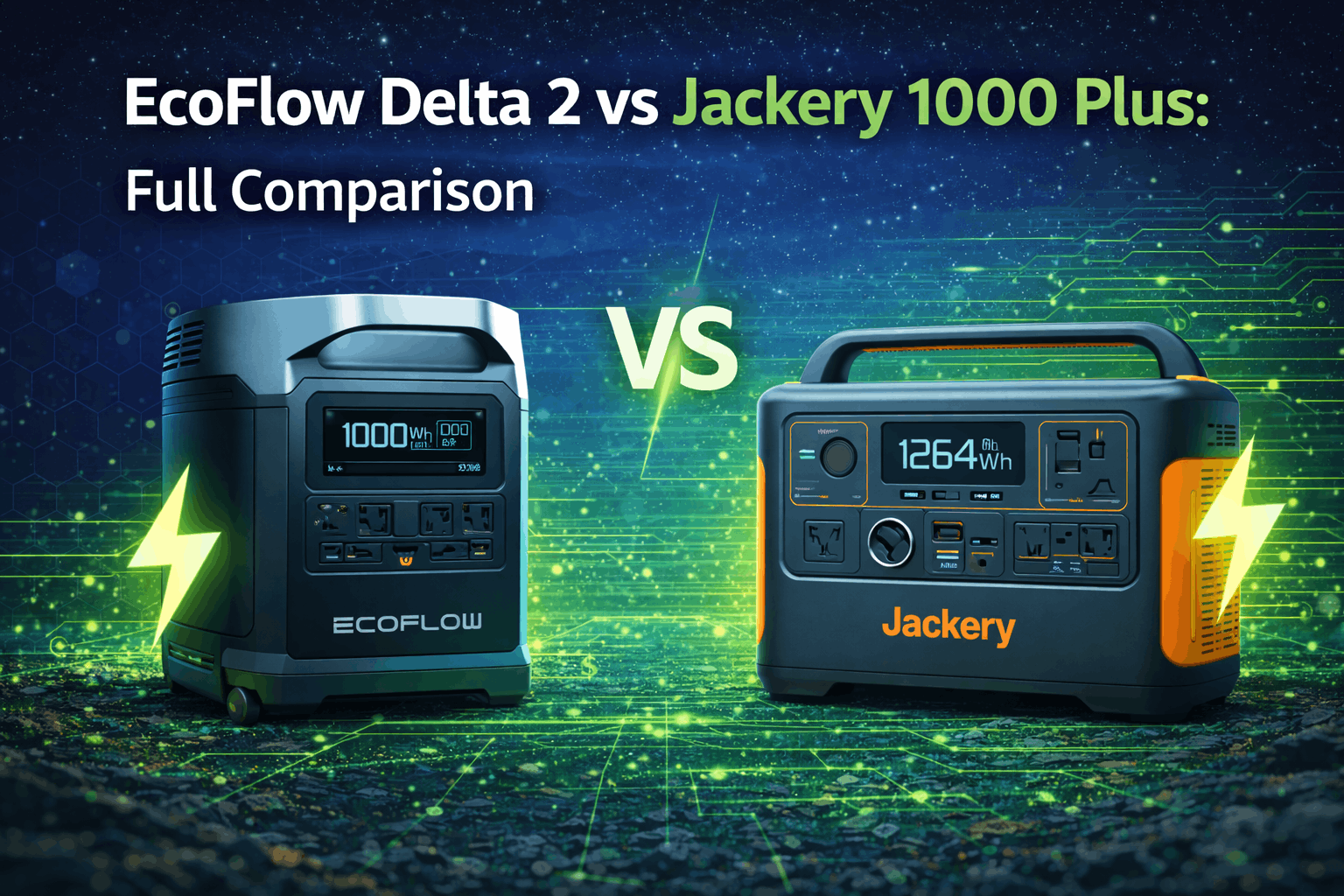
In the mid-range 1 kWh class — the most popular segment — both brands have converged aggressively. The Jackery Explorer 1000 v2 and the EcoFlow Delta 2 currently both sit at approximately $429 on Amazon as of February 2026, down from MSRPs of $799 and $1,049 respectively. That's a dramatic price compression — and it makes the 1 kWh decision almost entirely about specs and features rather than budget. We break that matchup down in detail in our EcoFlow Delta 2 vs Jackery 1000 Plus head-to-head. For anyone comparing units in this class, our best 1000Wh portable power stations guide covers the full field.
At the flagship tier, EcoFlow opens up a substantial price gap. The EcoFlow Delta 2 Max (2,048 Wh) currently sells for around $849 on Amazon. The Jackery Explorer 2000 Plus (2,042 Wh) runs $1,299–$1,599 depending on the day. For almost identical raw capacity, EcoFlow is delivering the 2 kWh class at $400–$700 less. The Explorer 2000 Plus punches back with 3,000W of sustained AC output versus the Delta 2 Max's 2,400W, but for buyers who don't need to run large power tools, that gap doesn't justify the premium. There's more context in our best 2000Wh portable power stations comparison if you're weighing the full 2 kWh field. Round 1 winner: EcoFlow — better entry-level pricing, and a dramatic advantage in the flagship tier.
Round 2 — Charging Speed
EcoFlow built its reputation on fast charging with X-Stream technology, which pulls up to 1,200W from a standard wall outlet via an integrated AC-to-DC converter. The DELTA 2 charges from 0–80% in approximately 50 minutes and reaches 100% in roughly 80 minutes. That's fast by any standard, and — critically — it's the default behavior. Plug in the Delta 2 and it charges at maximum speed without any setup required.
Jackery's response is ChargeShield 2.0, which uses a GaN bidirectional inverter with AI-assisted variable-speed charging across three selectable modes. In "Emergency Super Charge" mode, the Explorer 1000 v2 matches EcoFlow's pace at roughly 60 minutes to a full charge. The problem is that this mode must be manually activated through the Jackery app before each session. The default mode ("Fast Charge") takes approximately 1.7 hours, and a "Quiet Overnight" mode drops the fan speed and charging rate for noise-sensitive environments. That quiet mode is genuinely useful — under 30 dB means you can charge in a bedroom without waking anyone. The Delta 2 fans run audibly at full charging speed, something PCWorld specifically flagged in their review.
In daily use, the difference comes down to convenience. EcoFlow's approach assumes you always want speed and lets you throttle back if needed. Jackery defaults to a gentler charge and makes you opt into speed. Both brands' engineers and multiple independent reviewers recommend using slower charge modes for regular use since sustained fast charging generates heat that accelerates battery aging — even in thermally stable LFP cells. For emergency top-ups, EcoFlow's automatic fast charging is the more practical default. Round 2 winner: EcoFlow — faster by default, no setup required.
Round 3 — Battery Life & Longevity
Both brands have fully committed to LiFePO4 (lithium iron phosphate) chemistry across their current lineups, which is the most significant positive development in the portable power space over the last two years. LFP cells handle heat better, resist thermal runaway more effectively, and last far longer than the NMC chemistry that dominated earlier products. Our best LiFePO4 portable power stations guide covers why this chemistry shift matters in depth.
The cycle life numbers look different on paper than they are in practice. Jackery rates its current LFP units at 4,000 cycles while EcoFlow rates the DELTA 2 at 3,000+ cycles — but Jackery measures to 70% remaining capacity while EcoFlow measures to 80%. These are not equivalent benchmarks. A battery at 70% capacity is noticeably degraded; at 80% it still performs well for most applications. Adjusted for an apples-to-apples comparison at 80% capacity retention, the two brands likely land in a similar range. Neither should meaningfully degrade for a decade of moderate home or camping use.
Where Jackery earns points is long-term cost of ownership transparency. Their warranty registration process explicitly communicates the 5-year coverage terms at purchase, and their customer support reputation is strong — Amazon reviews for Jackery hardware average 4.7 stars across tens of thousands of ratings, with specific praise for warranty claim handling. EcoFlow's support reputation is more mixed; their policy is technically generous (5 years standard, no registration required), but user reports on forums like the DIY Solar Forum describe inconsistent service experiences, particularly around warranty claims involving solar input damage. Round 3: Tie — comparable LFP chemistry, similar longevity when specs are normalized; Jackery edges ahead on customer service execution.
Round 4 — App, Ecosystem & Expandability
The EcoFlow app is where the brand pulls decisively ahead. Rated 4.3/5 on Google Play across 15,000+ ratings and 4.5/5 on iOS, the app delivers real-time per-port power monitoring, hourly energy dashboards, Time-of-Use charging schedules, charge/discharge limit controls, X-Boost appliance compatibility settings, and over-the-air firmware updates via both Wi-Fi and Bluetooth. EcoFlow integrates natively with Amazon Alexa, partnered with Homey by LG at CES 2026 for whole-home energy management, and has an active Home Assistant community plugin. The company listed 15+ smart-home brand partnerships in its CES 2026 ecosystem announcements.
Jackery's app situation is a genuine weak point. The Jackery app rates 2.4/5 on Google Play (321 reviews) and roughly 2.5/5 on iOS. User complaints center on unreliable remote connectivity, display data that doesn't match the physical unit, and the confusing decision to split portable station control ("Jackery") and home energy management ("Jackery Home") into two separate apps. Jackery has no verified integration with Alexa, Google Home, or HomeKit. The only documented smart-home partnership is a European pilot with everHome for the HomePower Ultra line. For anyone planning to use their power station as part of a larger home backup setup, the software gap is significant — our best portable power stations for home backup guide goes deeper on what to look for in that use case.
On expandability, both brands offer real growth paths. EcoFlow's DELTA 2 can expand to 3,072 Wh; the DELTA 2 Max scales to 6,144 Wh; and the DELTA Pro Ultra X reaches 180 kWh in a whole-home configuration. Jackery's Explorer 2000 Plus scales to 12 kWh standard or 24 kWh in parallel, and the Explorer 5000 Plus reaches 60 kWh. EcoFlow's solar connector advantage reinforces this round — standard XT60 connectors accept virtually any third-party panel, while Jackery's proprietary 8mm DC connectors effectively require Jackery's SolarSaga panels unless you purchase an aftermarket adapter. Round 4 winner: EcoFlow — superior app, active smart home integrations, and open solar compatibility.
Round 5 — Portability & Build Quality
Jackery has always understood that a power station needs to move, and the Explorer 1000 v2 reflects that. At 23.8 lbs it's 3.2 pounds lighter than the EcoFlow Delta 2 (~27 lbs) — a real difference when you're loading and unloading gear repeatedly across a weekend trip. The handle ergonomics are comfortable for one-handed carry at this weight class, and the display is clear and readable in direct sunlight, showing watts in/out, state of charge, and estimated run/charge time without needing the app. The Explorer 2000 Plus is heavy at 61.5 lbs, but that's partly a function of the cell chemistry and expansion hardware rather than design inefficiency.
EcoFlow's DELTA 2 Max at ~50 lbs is meaningfully lighter than Jackery's equivalent 2 kWh unit — a 11.5-lb difference that matters for a unit you might load into an RV storage bay or carry to a tailgate. EcoFlow's displays are clean and well-designed, though they provide slightly less at-a-glance information than Jackery's interface without opening the app. Both brands use robust, textured plastic housings that hold up well to outdoor use. Neither feels flimsy. Build quality across both lineups has matured significantly from early generations. Round 5 winner: Jackery in the 1 kWh class (lighter, better standalone display); EcoFlow at the 2 kWh tier (lighter for equivalent capacity).
Head-to-Head: Which Model Should You Actually Buy?
| Use Case | Best Jackery Model | Best EcoFlow Model | Price Difference | Our Pick |
|---|---|---|---|---|
| Casual camping | Explorer 1000 v2 | Delta 2 | ~$0 (both ~$429) | Jackery (lighter, longer cycle life rating) |
| Weekend off-grid | Explorer 1000 v2 | Delta 2 | ~$0 (both ~$429) | EcoFlow (expandable, more ports, open solar) |
| Home backup | Explorer 2000 Plus | Delta 2 Max | ~$450–$750 (Jackery costs more) | EcoFlow (smart home integration, lower price) |
| RV use | Explorer 2000 Plus | Delta 2 Max | ~$450–$750 (Jackery costs more) | EcoFlow (lighter, open solar, app control) |
| Budget buyer | Explorer 300 Plus | RIVER 2 | ~$50–$80 (EcoFlow cheaper) | EcoFlow (faster charging, better value) |
| Power user / tools | Explorer 2000 Plus | Delta 2 Max | ~$450–$750 (Jackery costs more) | Jackery (3,000W sustained output vs 2,400W) |
For specific camping and RV use cases, see our best portable power stations for camping and best portable power stations for RV guides.
Final Verdict
EcoFlow wins this comparison for most buyers in 2026. The app is better, the smart home ecosystem is real and expanding, charging is faster by default, the solar connector standard is open, and the real-world prices on 2 kWh-class units are dramatically lower than Jackery's equivalent hardware. If you're a camper who also wants to use your power station as part of a home backup plan — or if you own any non-Jackery solar panels — EcoFlow is the clear choice. The DELTA 2 at $429 is one of the best portable power station values currently on the market.
Jackery wins for the buyer who prizes simplicity, portability, or raw sustained AC output. The Explorer 1000 v2 is the lightest unit in its class, works flawlessly without ever opening an app, and the brand's customer service reputation is the best in the segment. If you need to run a power tool drawing 2,500–3,000W continuously — a circular saw, a space heater, a well pump — the Explorer 2000 Plus's sustained output is the right tool. Jackery's quiet overnight charging mode is also a genuine differentiator for van lifers and anyone charging indoors.
The bottom line by buyer profile: get the EcoFlow Delta 2 if you want the most capable, expandable 1 kWh unit for the money. Get the Jackery Explorer 1000 v2 if weight is a priority and you don't need expandability. At the 2 kWh tier, the EcoFlow Delta 2 Max is the better buy for almost everyone except power-tool users and off-grid builders who need maximum solar input and sustained 3,000W output.
FAQ
Q: Is Jackery or EcoFlow better for camping?
A: For casual car camping where you're keeping phones charged, running a light, and powering a small cooler, the Jackery Explorer 1000 v2 and the EcoFlow Delta 2 are essentially tied on price at ~$429. Jackery has the edge in portability at 23.8 lbs versus 27 lbs. For more serious off-grid camping where you want expandability and solar from third-party panels, EcoFlow is the stronger system. Both are proven, reliable camping companions.
Q: Which brand has the better warranty?
A: Both now offer 5-year coverage, but EcoFlow provides it automatically on eligible products without registration. Jackery offers 3 years standard and requires free product registration to unlock 5 years. EcoFlow's policy is slightly more consumer-friendly on paper. That said, Jackery's warranty claim execution and customer service reputation score higher in user reviews — multiple review aggregators note Jackery's support as notably friendly and efficient, while EcoFlow draws more mixed feedback on claims handling.
Q: Is EcoFlow worth the extra cost over Jackery?
A: In the 1 kWh class, there is no longer a meaningful price gap — both the Delta 2 and Explorer 1000 v2 sell for around $429. The question becomes about features, not cost. EcoFlow wins on ports (15 vs 7), expandability, solar compatibility, and app quality. At the 2 kWh tier, EcoFlow is actually significantly cheaper than Jackery's equivalent hardware, making the "extra cost" premise outdated for that segment.
Q: Which charges faster — Jackery or EcoFlow?
A: EcoFlow is faster by default. The Delta 2 charges from 0–80% in approximately 50 minutes via X-Stream without any setup. The Jackery Explorer 1000 v2 can match that speed (~60 minutes) in Emergency Super Charge mode, but that mode must be manually activated in the Jackery app before each charging session. For everyday convenience, EcoFlow's plug-in-and-go fast charging wins. Jackery does offer a quieter slow-charge mode that EcoFlow lacks, which is useful for overnight indoor charging.