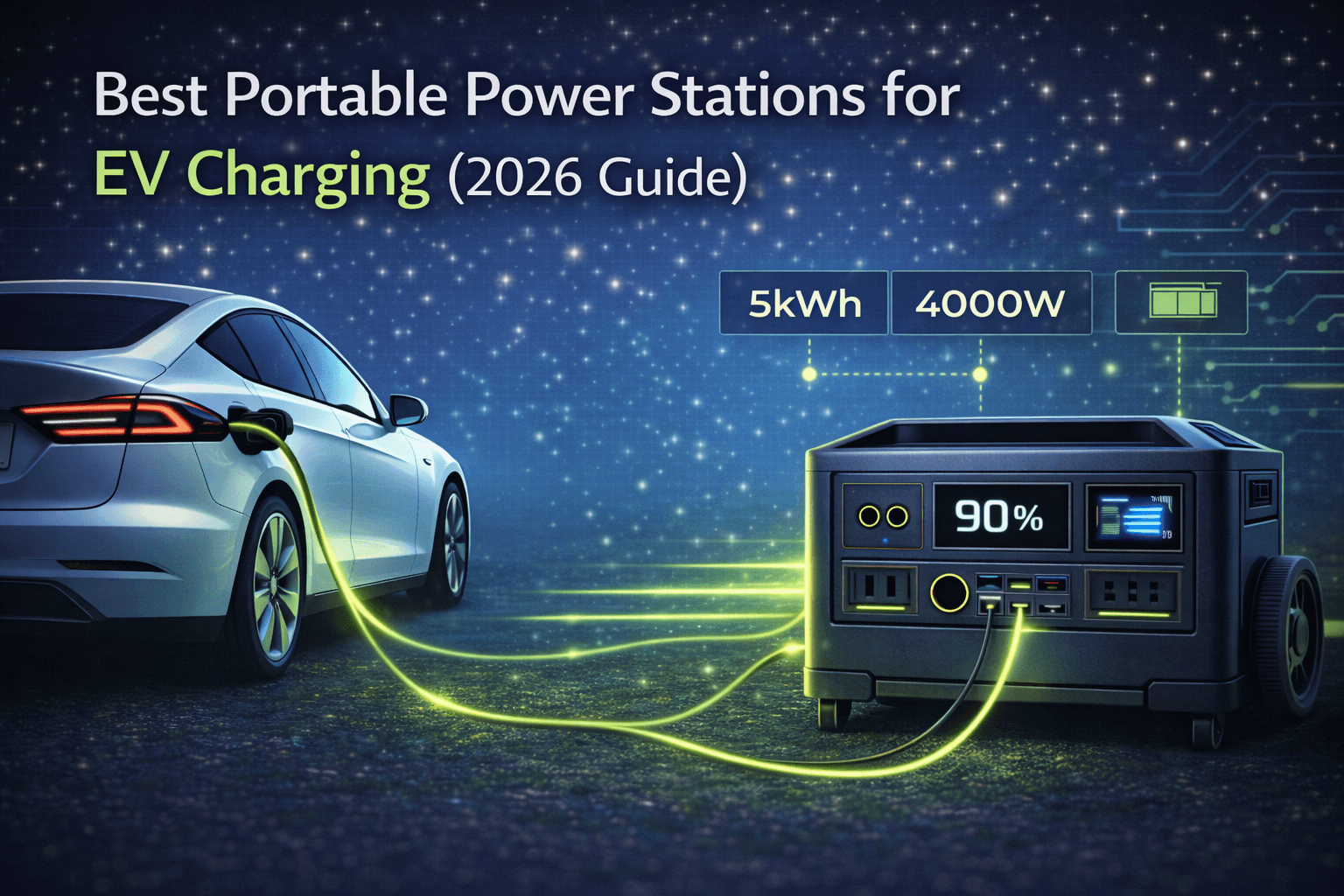
Portable power stations can charge an electric vehicle. But before you get excited, let’s be blunt: even the largest consumer-grade units will add somewhere between 3 and 12 miles of range. That’s it.
This isn’t a replacement for your home Level 2 charger, a DC fast charger, or any part of the permanent charging ecosystem. A portable power station is an emergency tool — a way to avoid a $300+ tow truck call when you misjudge the distance to the next charger by a handful of miles.
The physics are simple. A 2000Wh station, after accounting for inverter and onboard charger losses, delivers roughly 1,600–1,700Wh to your EV’s battery. Most vehicles consume 250–400Wh per mile. Do the math, and you’re looking at 4–7 miles of added range. A top-end 3600Wh unit might push that to 8–12 miles under ideal conditions.
The economics reinforce the same message. Electricity passes through the station’s inverter, then into the car’s onboard charger, losing 15–25% of its energy along the way. Factor in the purchase price of a capable unit, and the cost per mile of portable EV charging is many times higher than plugging in at home — often more expensive per mile than gasoline.
Despite those limitations, there are real scenarios where a portable station earns its keep. Rural driving with sparse charging infrastructure. Overlanding trips near the edge of your comfort zone. The peace of mind that comes from knowing a few extra miles sit in the trunk if everything goes sideways. This guide covers realistic expectations, the equipment you actually need, and the specific models worth considering if emergency EV charging is part of your use case.
Note: This guide contains affiliate links. If you purchase through our links, we may earn a commission at no extra cost to you. This helps support our testing and content creation.
How Many Miles Can You Actually Add? Realistic Range Calculations
The starting point is your vehicle’s efficiency, measured in watt-hours per mile (Wh/mile). This number tells you exactly how far a given chunk of stored energy moves the car.
Typical EV efficiency by category:
- Efficient sedans (Tesla Model 3, Hyundai Ioniq 6, Chevrolet Bolt): 250–280 Wh/mile
- Mid-size crossovers (Tesla Model Y, VW ID.4, Ford Mustang Mach-E): 300–350 Wh/mile
- Large trucks and SUVs (Ford F-150 Lightning, Rivian R1T/R1S, GMC Hummer EV): 350–450+ Wh/mile
These numbers shift significantly with conditions. Cold weather increases consumption by 20–40% because the battery needs heating and cabin climate control draws substantial power. Highway speeds above 65–70 mph amplify aerodynamic drag. Hilly terrain, headwinds, and aggressive driving all push Wh/mile higher.
The formula is straightforward:
Added miles ≈ (Station capacity × overall efficiency) ÷ vehicle Wh/mile
Overall efficiency accounts for the inverter’s DC-to-AC conversion, the car’s onboard AC-to-DC conversion, and cable losses. A realistic real-world figure is 80–85%. So a 2000Wh station delivers roughly 1,600–1,700Wh to the EV battery.
Here’s what that looks like in practice, assuming ~82% round-trip efficiency:
| Station Capacity | Efficient EV (260 Wh/mi) | Average EV (330 Wh/mi) | Truck/SUV (400 Wh/mi) |
|---|---|---|---|
| 1000Wh | ~3 miles | ~2.5 miles | ~2 miles |
| 2000Wh | ~6 miles | ~5 miles | ~4 miles |
| 3600Wh | ~11 miles | ~9 miles | ~7 miles |
Cold weather shrinks these numbers further. A VW ID.4 that normally pulls 320 Wh/mile might jump to 450 Wh/mile in freezing conditions. That same 2000Wh station that adds 5 miles in summer now delivers closer to 3.5 miles.
Stations under 1000Wh are generally not worth the effort for EV charging. After losses, a 500Wh unit delivers maybe 400Wh to the battery — roughly 1–1.5 miles for most vehicles. That barely justifies the time it takes to set up.
Some enthusiasts experiment with stacking multiple large stations for 7–10kWh of total capacity. The math scales, but the practical downsides grow fast: 200–300+ pounds of combined weight, five-figure hardware costs, and serious complexity. At that point, buying an EV with a larger pack or investing in better route planning makes far more sense. For a deeper understanding of how capacity translates to real-world runtime, our portable power station capacity guide breaks down the differences between 500Wh, 1000Wh, and 2000Wh units in detail.
The realistic takeaway: portable EV charging adds single-digit miles in most scenarios. That can be the difference between driving to a charger and waiting for a tow truck, but it can’t turn a depleted pack into a fresh one.
How Portable EV Charging Actually Works
Connecting a portable power station to an EV means using the car’s Level 1 (120V) charging cable — the portable EVSE that ships with every modern EV. You plug the EVSE into the station’s AC outlet, connect the other end to the car’s charge port, and the car begins drawing power just as it would from a household wall socket.
Level 1 charging specs:
- Voltage: 120V AC
- Current draw: 12–16A (approximately 1.4–1.9kW)
- Charging rate: roughly 3–5 miles of range added per hour
- Station requirement: 1500W+ continuous AC output with pure sine wave inverter
The process is simple. Park the car, turn it off, plug in the Level 1 EVSE to the station’s AC outlet, insert the connector into the charge port, and wait. The station’s display will show a sustained 1.4–1.9kW draw, and the car’s dashboard will confirm charging has started.
How long does charging last? That depends entirely on the station’s capacity. A 2000Wh unit running a 1.4kW Level 1 load lasts roughly:
(2000Wh × 0.82 efficiency) ÷ 1400W ≈ 1.2 hours of charging
At Level 1’s typical rate of 3–5 miles per hour, that translates to approximately 4–6 miles before the station is depleted.
Why Level 2 (240V) doesn’t work here: Level 2 charging requires a 240V power source. Some high-end stations can technically output 240V through specific configurations, but the limited watt-hour reservoir still caps added range at low double digits — and the setup complexity introduces safety concerns that aren’t worth it for emergency use. Stick with Level 1.
Efficiency chain breakdown:
Every step in the charging process loses energy. The station’s inverter converts stored DC to AC (90–95% efficient). The car’s onboard charger converts AC back to DC (88–93% efficient). Cable resistance adds minor additional losses. Combined, you’re looking at 75–85% of the station’s stored energy actually reaching the drive battery. Quality inverters with pure sine wave output and modern onboard chargers sit at the upper end of that range.
Solar-charging hybrid approach: If you’re stationary at a campsite, you can use solar panels to refill a portable station, then use that station to trickle-charge the EV. An 800W solar array producing roughly 3kWh of usable energy over a full day of good sun might add 8–10 miles to an efficient EV. That can support short daily excursions from a base camp, but it won’t sustain typical road-trip driving. Our solar panel setup and sizing guide covers the practical details of pairing panels with stations.
Best Portable Power Stations for EV Charging
1. EcoFlow Delta Pro — Best Maximum Emergency Range
Price: ~$1,599–2,799 (prices fluctuate significantly; check current deals)
The Delta Pro remains one of the few portable power stations with enough raw capacity to make EV emergency charging genuinely meaningful. At 3600Wh with a 3600W pure sine wave inverter, it handles a 16A Level 1 EVSE without breaking a sweat while leaving headroom for accessory loads.
Key specs (verified):
- Capacity: 3600Wh LFP battery
- AC output: 3600W continuous (up to 4500W with X-Boost)
- Battery life: 6,500 cycles to 50% capacity, 3,500 cycles to 80%
- Weight: 99 lbs
- Charging: ~1.8 hours via AC wall outlet; up to 1,600W solar input
- Expandable: Up to 25kWh with extra batteries
- Ports: 5 AC outlets, 2 USB-C (100W), 4 USB-A, DC outputs, Anderson port
Using our efficiency assumptions (~82%), the Delta Pro delivers approximately 2,950Wh to the EV battery. In an efficient sedan at 260 Wh/mile, that’s about 11 miles. In a 330 Wh/mile crossover, closer to 9 miles. In a heavy truck at 400 Wh/mile, roughly 7 miles.
Where it shines for EV use: A driver running low in a Tesla Model 3 can deploy the Delta Pro, run Level 1 charging for roughly two hours, and gain enough range to reach the nearest fast charger instead of calling roadside assistance. For overlanders using an EV, it provides a meaningful safety buffer for daily excursions from a base camp.
The catch: At 99 pounds, you’re not casually tossing this in a trunk. It has wheels and an extendable handle, but it’s semi-permanent equipment. And the cost only makes financial sense if you use it for other purposes too — home backup, off-grid work, or powering a camp setup. As a dedicated EV emergency tool, the economics don’t pencil out.
The Delta Pro has been the flagship of EcoFlow’s portable lineup for years, and while newer models like the Delta Pro 3 (4096Wh, 4000W) have arrived, the original Delta Pro frequently hits deep discounts that make it the better value for most buyers. For a full breakdown of EcoFlow’s current lineup, see our EcoFlow portable power stations guide.
2. Jackery Explorer 2000 Plus — Best Mid-Capacity EV Backup
Price: ~$1,999
For drivers who want meaningful emergency range without the Delta Pro’s size and price tag, the Explorer 2000 Plus hits a practical sweet spot. Its 2042Wh LiFePO4 battery and 3000W pure sine wave inverter comfortably run a Level 1 EVSE while delivering roughly half to two-thirds of the range boost the Delta Pro provides.
Key specs (verified):
- Capacity: 2042Wh LiFePO4
- AC output: 3000W continuous (6000W surge)
- Battery life: 4,000 cycles to 70% capacity
- Weight: 60 lbs
- Charging: ~2 hours via AC wall outlet; up to 1,400W solar input (6× SolarSaga 200W panels)
- Expandable: Up to 12kWh with battery packs (24kWh with two units in parallel)
- Ports: 3 AC outlets, 2 USB-C (100W), 2 USB-A, car socket
At ~82% efficiency, roughly 1,675Wh reaches the EV battery. In an efficient sedan at 260 Wh/mile, that’s about 6.5 miles. In a 330 Wh/mile crossover, approximately 5 miles. In a truck at 400 Wh/mile, closer to 4 miles.
Why it works well as a dual-purpose unit: The Explorer 2000 Plus lives comfortably in a garage as both emergency home backup and a mobile EV lifeline. Jackery’s 4,000-cycle LiFePO4 battery — the highest cycle rating in the mainstream portable market — means this unit will outlast most EVs it’s paired with. The cost per cycle ($1,999 ÷ 4,000 = $0.50) is excellent for the 2000Wh+ tier.
At 60 pounds, it’s still heavy but significantly more manageable than the Delta Pro’s 99 pounds. One person can move it without help, which matters when you’re deploying it roadside. For a deeper look at Jackery’s full lineup and how the 2000 Plus compares to their other models, check our Jackery portable power stations guide.
Check Price on Jackery
Also on Amazon
3. 2000–2500Wh Class Stations — Best Portable Compromise
A growing category of stations in the 2000–2500Wh range splits the difference between the heavyweight Delta Pro and mid-capacity units around 1000–1500Wh. These models typically weigh 40–60 pounds, feature 2000–2400W inverters, and deliver enough capacity to add 5–8 miles to most EVs under good conditions.
What to look for in this class:
- Capacity: 2000–2500Wh
- AC output: 2000W+ continuous with pure sine wave (mandatory for EV charging)
- Weight: 40–60 lbs (manageable for one person)
- Battery chemistry: LiFePO4 preferred for longevity
- Expected EV range boost: 4–8 miles depending on vehicle efficiency
Notable options in this class include the EcoFlow Delta 2 Max (2048Wh, 2400W output, ~50 lbs), the Bluetti AC200P (2000Wh, 2000W output, ~61 lbs), and several Anker SOLIX models. Exact models and pricing shift frequently, but the pattern is consistent: roughly 2000Wh of usable energy and an inverter capable of sustained 1.4–1.9kW Level 1 EVSE loads.
These mid-large stations are often the most defensible purchase because they fill multiple roles well. They serve as capable camping power sources, partial home backup, and occasional EV safety nets. The portability advantage matters for actual deployment — a 45-pound unit is something one person can carry from a garage to a trunk and from a trunk to the roadside. A 99-pound unit may never leave its storage spot.
For detailed comparisons in this capacity range, our best 2000Wh+ portable power stations guide breaks down the top options.
When Portable EV Charging Makes Sense (and When It Doesn’t)
Scenarios Where It’s Worth It
True emergency range extension. You misjudge the distance to a charger in a rural area and pull over with 0% displayed and no remaining buffer. Without a station, the options are roadside assistance (often hours of waiting, hundreds of dollars) or a tow truck. With a large station in the trunk, you connect the Level 1 cable, wait an hour or two, and gain enough miles to reach the nearest charger under your own power. This single scenario can pay for the station in one use.
Remote camping and overlanding near the edge of infrastructure. You’re base-camping 10–20 miles from the nearest Level 2 or DC fast charger, using the car sparingly for short excursions. A portable station — especially paired with solar panels — can top up a handful of miles each day, enabling exploration of a small region without range anxiety dictating your plans. For overlanding-specific guidance, our overlanding power station guide covers this use case in depth.
Peace of mind for range-anxious drivers. Some newer EV owners worry about range in a way that limits their enjoyment of the vehicle. Knowing that 5–10 extra miles sit in the trunk can encourage more confident route choices, even if the station rarely gets used. Whether that psychological benefit justifies the cost is personal, but it’s a legitimate consideration.
Indirect range protection. Instead of drawing down the EV’s main battery to power camp gear through the vehicle’s outlets, a portable station shoulders those accessory loads. This preserves more of the main pack for driving — effectively extending range without ever plugging the station into the car.
Scenarios Where It’s a Bad Idea
Routine commuting or road-trip charging. The time, complexity, and cost per mile are all dramatically worse than plugging in at home, work, or public networks. Level 1 charging from a portable station adds 3–5 miles per hour. Your home charger or a public DCFC adds 25–250+ miles per hour. There’s no comparison.
Replacing infrastructure with hardware. If you regularly need more range than your EV provides, the answer is a vehicle with a larger battery, a home Level 2 charger, or better route planning — not stacking portable power stations in the trunk.
Budget-constrained buyers looking for primary charging. A $1,600–2,800 station that adds single-digit miles is a terrible value proposition as a primary charging method. That money is better spent on a Level 2 home charger installation ($500–1,500 including electrician), which adds 25–30+ miles per hour and pays for itself within months.
What About Smaller Stations for EV Charging?
You might wonder whether a 500Wh or 1000Wh station could work in a pinch. Technically, yes — any station with a pure sine wave inverter rated at 1500W+ can run a Level 1 EVSE. But the practical value drops off sharply below 1500Wh.
A 1000Wh station delivers roughly 820Wh to the EV battery after losses. For an average crossover at 330 Wh/mile, that’s about 2.5 miles. It might get you off a highway shoulder to a safer location, but probably not to the next charger.
Below 1000Wh, the math stops making sense entirely. A 500Wh unit adds roughly 1–1.5 miles — barely enough to notice and not worth the 20–30 minutes of setup and charging time.
If EV emergency charging is a meaningful part of your buying decision, start at 2000Wh minimum. The best 1500Wh and best 1000Wh guides cover these capacity ranges for their stronger use cases — camping, home backup, and off-grid work — where they genuinely excel.
Essential Equipment Checklist
Before relying on a portable station for EV emergency charging, make sure you have:
- Your EV’s Level 1 EVSE — the portable charge cord that came with the car. Many drivers leave this at home. If EV charging is part of why you’re carrying a station, the EVSE belongs in the trunk permanently.
- A station with pure sine wave output rated at 1500W+ continuous. Modified sine wave inverters can damage the EVSE’s electronics or prevent the car from recognizing a valid power source. Every station recommended in this guide uses pure sine wave output. Our pure sine wave guide explains why this matters.
- A fully charged station. This sounds obvious, but portable power is useless if you let it sit at 20% for months. LiFePO4 chemistry holds charge well in storage, but check levels before any trip where EV range might be tight. Our maintenance guide covers storage best practices.
- Realistic expectations. Know your vehicle’s Wh/mile rating, estimate the conditions you’ll face, and run the math before counting on specific mileage gains. The formula at the top of this guide gives you what you need.
Frequently Asked Questions
Can I realistically charge my EV with a portable power station?
Yes, but “realistically” means gaining 3–12 miles of range depending on station size and vehicle efficiency. That’s enough to rescue yourself from a stranded situation — reaching a proper charger when you’d otherwise need a tow — but nowhere close to supporting daily driving. Think of it as an emergency tool, not a charging solution.
How long does it take to charge an EV from a portable station?
At Level 1 rates (1.4–1.9kW), you’re adding 3–5 miles per hour of charging. A 2000Wh station runs for roughly 1–1.5 hours before it’s depleted. A 3600Wh station lasts about 2–2.5 hours. The station runs out long before the car is “full” — you’re just adding a small buffer, not doing a meaningful charge.
Does the station’s inverter type matter for EV charging?
Absolutely. You need pure sine wave output. Modified sine wave inverters can prevent the EVSE from initiating a charge session or, worse, damage its electronics. Every station listed in this guide uses pure sine wave, but verify this spec if you’re considering other models.
Can I use Level 2 (240V) charging from a portable station?
In most practical scenarios, no. Level 2 requires 240V output, which very few portable stations provide natively. Some can be configured for 240V output through dual-unit setups, but the limited total energy stored still caps range gains at roughly the same levels — and the complexity and safety concerns aren’t worth the marginal benefit for emergency use.
Is it cheaper to just call a tow truck?
Often, yes — for a single incident. A single roadside assistance call or tow typically costs $150–400 depending on distance. But if you’re someone who regularly pushes range boundaries in rural areas, the station pays for itself after 2–3 avoided tow calls. And the station serves many other purposes — home backup, camping, off-grid work — where a tow truck is useless.
What about using the EV’s V2L (vehicle-to-load) instead?
V2L goes the opposite direction — the car powers external devices. It doesn’t help charge the car itself. But if you have V2L capability, a portable station can serve a different role: powering your camp equipment instead of drawing from the EV battery, effectively preserving more range for driving.
Final Verdict
Portable power stations occupy a narrow but real niche in the EV ecosystem. They’re powerful enough to bail you out of a bad situation but nowhere near capable enough to function as regular chargers. The value proposition hinges entirely on how you frame the purchase.
If you’re buying a station solely for EV charging, the economics rarely make sense. But if you’re buying one for camping, home backup, off-grid living, or professional use — and emergency EV charging is a valuable secondary benefit — the calculus changes.
For maximum emergency range, the EcoFlow Delta Pro (3600Wh) delivers the most miles from a single unit. For a more portable and cost-effective option that still provides meaningful emergency range, the Jackery Explorer 2000 Plus (2042Wh) balances capacity, weight, and long-term durability exceptionally well. And the growing category of 2000–2500Wh stations offers increasingly compelling options for buyers who see EV rescue as one of several use cases.
The key is keeping expectations calibrated: not magic bullets for range, but versatile tools that happen to offer high-value insurance against the worst-case EV scenario.