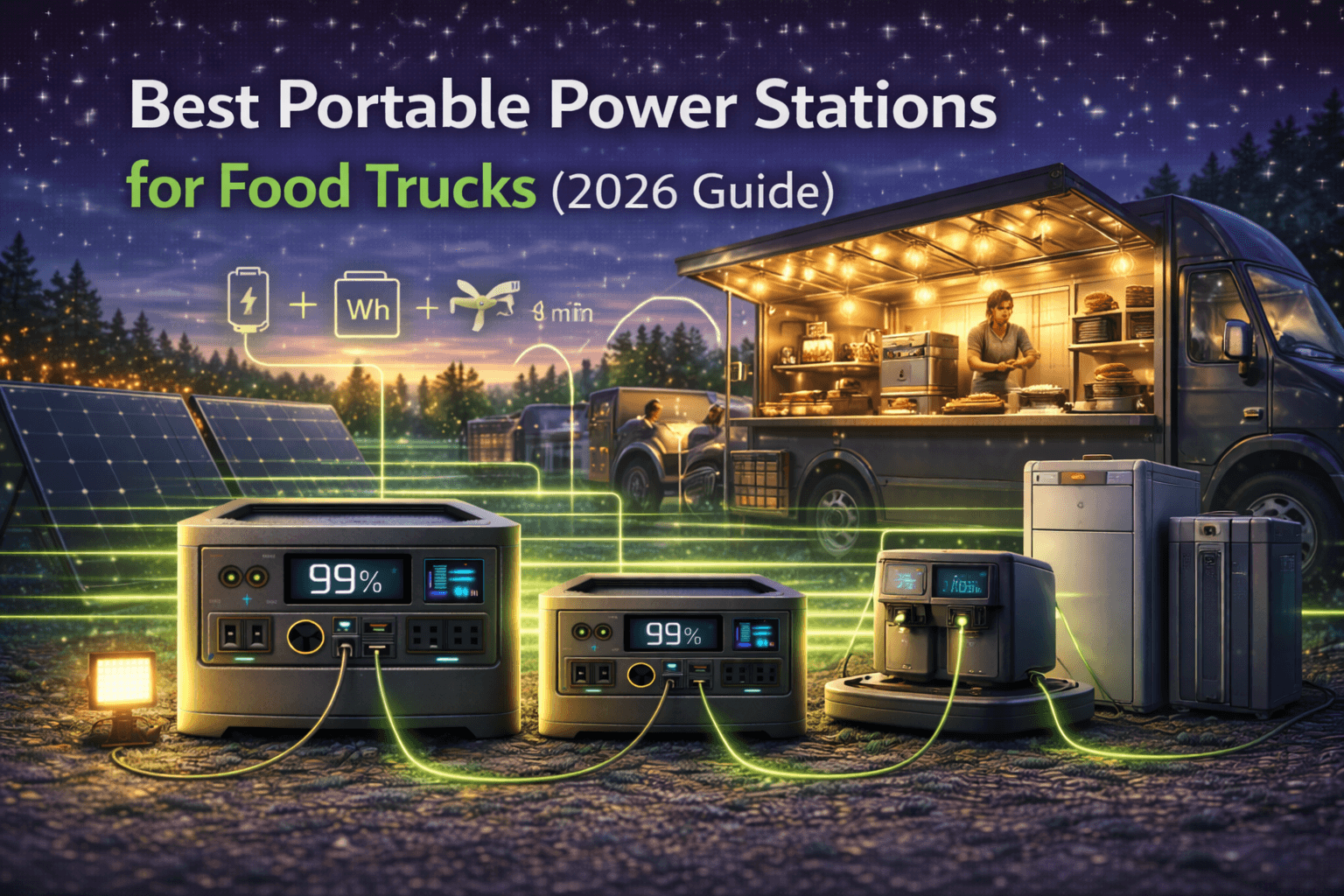
Food trucks eat electricity. Commercial refrigeration running 24/7, espresso machines pulling 1,500W, blenders crushing ice at 1,200W, POS terminals processing payments all day — the power demands of a mobile food business make a weekend camping trip look like charging a phone.
And the traditional options? They all come with real trade-offs. Shore power ties you to specific locations with electrical hookups, often costing $50–200 per event just for the privilege of plugging in. Generators work, but they’re loud enough to drive away customers, burn through fuel at $15+ per day, and get you banned from an increasing number of festivals and venues. Onboard electrical systems drain your truck battery and barely handle modern commercial equipment.
Portable power stations solve a specific problem for food truck operators: they let you serve anywhere, silently, without depending on hookups or generators. But food truck power is a different beast from camping or home backup. You’re running commercial equipment daily, for 8–12 hours straight, and a mid-service power failure costs you real money — both in lost sales and spoiled inventory.
This guide breaks down exactly how much power your food truck actually needs, how to size a portable power system correctly, which models deliver the best commercial value, and how to calculate whether the investment makes financial sense for your operation.
Note: This guide contains affiliate links. If you purchase through our links, we may earn a commission at no extra cost to you.
Food Truck Equipment Power Requirements
Getting capacity sizing right starts with understanding what your equipment actually draws. Overestimate and you waste thousands on capacity you’ll never use. Underestimate and you’re dead in the water during a Saturday lunch rush.
Commercial Refrigeration: Your Biggest Continuous Load
Refrigeration runs non-stop — and it’s almost always the single largest power consumer on any food truck. Here’s what the real numbers look like:
Under-counter commercial refrigerator (standard food truck unit): 600–800W when the compressor kicks in, but it cycles on and off. Typical duty cycle runs 40–60% depending on ambient temperature and how often you open the door. That averages out to 250–400W continuous, translating to roughly 6,000–9,600Wh over a full 24-hour period.
Beverage cooler: 100–200W running, 30–50% duty cycle, averaging 50–75W continuous. Daily consumption: 1,200–1,800Wh.
A full-service truck with multiple units — under-counter fridge, beverage cooler, and ingredient prep fridge — can easily hit 13,500Wh per day on refrigeration alone. That’s before you turn on a single piece of prep equipment.
Food Prep Equipment: High Draw, Intermittent Use
Prep equipment pulls hard but runs in bursts, which changes the math considerably:
Commercial blender (smoothie/juice operations): 800–1,500W operating power. If you’re doing 30 blends a day at 3–5 minutes each, that’s roughly 1.5–2.5 hours of actual runtime — around 1,800–3,000Wh daily.
Espresso machine: The big one for coffee trucks. Heating elements pull 1,000–1,500W, and these run continuously during service. With a grinder at 200–400W on top, a full coffee setup running 6 hours of service easily consumes 4,000–8,000Wh daily.
Food processor/mixer: 300–800W, typically 1–3 hours of intermittent use. Daily draw: 600–2,400Wh.
POS Systems, Lighting, and Ventilation
These feel minor individually but add up fast across a service day:
POS terminal + card reader + printer: 40–60W average, pulling 320–480Wh over an 8-hour day. Tablet-based systems (Square, Toast) are lighter — 15–30W, roughly 120–240Wh daily.
Lighting: Interior LED work lights (30–60W) plus exterior menu boards (20–50W) plus safety lighting (40–80W). Running 8–14 hours depending on setup and cleanup needs: 800–2,400Wh combined daily.
Ventilation: Required for any cooking operation. Commercial exhaust fans draw 200–400W, running 4–8 hours during cooking. Interior circulation adds 50–150W. Combined daily: 1,200–5,000Wh.
Total Daily Power Budgets by Truck Type
Here’s where the numbers get real:
Coffee cart/stand — Beverage cooler (1,500Wh) + espresso machine (4,000Wh) + grinder (1,500Wh) + POS (200Wh) + lighting (400Wh) = ~7,600Wh daily
Standard taco/sandwich truck — Under-counter fridge (3,000Wh) + beverage cooler (1,500Wh) + food processor (800Wh) + POS (400Wh) + lighting (800Wh) + ventilation (1,200Wh) = ~7,700Wh daily
Premium gourmet truck — Multiple refrigeration units (7,000Wh) + commercial blenders ×2 (4,000Wh) + espresso machine (5,000Wh) + processors/mixers (2,000Wh) + POS (500Wh) + extensive lighting (1,500Wh) + ventilation (2,500Wh) = ~22,500Wh daily
The Supplemental Power Reality
Let’s be blunt: very few food trucks run entirely on portable power. A full gourmet operation at 22,500Wh daily would need $15,000–25,000 worth of batteries. That’s rarely practical.
Instead, portable power works best as part of a hybrid approach. Shore power at your commissary handles overnight refrigeration and battery charging. Portable power handles everything during service hours — POS, lighting, prep equipment, supplemental cooling. If you still use a generator, it covers peak cooking loads while portable power handles the quieter shoulder hours when customers care most about noise.
The practical investment levels:
- Coffee carts: 7,000–10,000Wh daily (manageable at $3,000–5,000 in portable power)
- Standard trucks: 7,000–15,000Wh daily ($5,000–10,000 or hybrid setup)
- Premium operations: 20,000–30,000Wh+ daily (portable supplements, not replaces, primary power)
For a detailed breakdown of how capacity translates to runtime, check our portable power station runtime calculator.
Capacity Sizing and Operational Strategies
The right approach depends entirely on how you operate. Here are the four strategies that actually work for food truck operators.
Strategy 1: Supplemental Power for Location Flexibility
The scenario: You have reliable shore power at your commissary and regular venues, but you want to work prime locations without electrical hookups — festivals, street corners, special events.
How to size it: Calculate service-hour consumption only (typically 8–12 hours). Shore power handles overnight refrigeration and charging at the commissary. Portable power enables location independence during service.
Example — Standard taco truck: Service hours equipment draws roughly 4,500Wh over an 8-hour day. Add a 30% margin: 5,850Wh required capacity. Target ~6,000Wh (two 3,000Wh units or a single expandable system). Investment: $4,000–6,000. The payoff is operating anywhere without shore power dependency.
Strategy 2: Generator Replacement (Silent Operation)
The scenario: You’re tired of noise complaints, venue restrictions, fuel costs, and generator maintenance. You want silent operation.
How to size it: Full daily consumption including 24/7 refrigeration, plus solar supplementation if you’re at stationary locations.
Example — Coffee cart going generator-free: Total daily draw of 7,600Wh × 1.3 margin = ~9,900Wh. Target 10,000Wh capacity across multiple units or an expandable system. Investment: $6,000–8,000. ROI: eliminates $3,000–5,000 in annual generator fuel and maintenance costs.
Strategy 3: Redundancy and Backup
The scenario: You have reliable shore power but want protection against revenue-killing power outages at venues.
How to size it: Critical equipment only — refrigeration (protect your inventory), POS (keep taking payments), minimal lighting.
Example — Premium truck backup: Critical loads total ~7,900Wh daily. For 12 hours of backup coverage, target 4,000–5,000Wh capacity. Investment: $3,000–4,000. A single major outage prevented saves $500–2,000 in lost revenue and spoiled food.
Strategy 4: Primary Power for Minimal Operations
The scenario: A small coffee cart or ice cream stand with truly minimal power needs running entirely off portable power.
How to size it: Complete daily consumption — feasible only with minimal equipment operations.
Example — Pre-frozen ice cream cart: Freezer (6,000Wh to keep frozen), POS (200Wh), lighting (300Wh) = 6,500Wh daily × 1.3 margin = ~8,500Wh. Investment: $5,000–7,000. Complete location independence, zero generator costs.
The Hybrid Model (What Most Successful Trucks Actually Do)
The most common setup among profitable food truck operations combines three elements:
- Shore power overnight at the commissary (8pm–6am) handles refrigeration and charges all batteries
- Portable power during service (6am–8pm) runs POS, lighting, prep equipment — all customer-facing hours are silent
- Generator as emergency-only backup in case portable power runs low or equipment fails
This approach minimizes cost (no need for $20,000+ in batteries), maximizes flexibility (location independence during service hours), maintains reliability (generator backup prevents catastrophic service disruption), and optimizes customer experience (silent operation when it matters most).
Best Portable Power Stations for Food Trucks
1. Jackery Explorer 2000 Plus — Best Food Truck Value ($1,999)
The Jackery 2000 Plus hits the sweet spot for most food truck operators: substantial capacity without breaking the bank, with room to grow as your business scales.
| Specification | Detail |
|---|---|
| Capacity | 2,042Wh base, expandable to 12kWh with add-on battery packs |
| AC Output | 3,000W continuous / 6,000W surge |
| Battery | LiFePO4, 4,000 cycles to 80% capacity |
| Weight | 60 lbs |
| Solar Input | Up to 1,400W (6 × SolarSaga 200W panels) |
| AC Charging | ~2 hours wall outlet |
| Warranty | 5 years (extended) |
| Price | ~$1,599–$1,999 (expansion packs ~$1,599 each) |
Why it works for food trucks: The 2,042Wh base capacity handles a coffee cart’s service-day equipment on its own — espresso machine, grinder, POS, and lighting across a full shift. For larger operations, expansion battery packs (2,042Wh each, up to 5 total) let you scale to 12kWh without replacing the whole system.
The 4,000-cycle LiFePO4 battery is the real business case here. A food truck running 250 days per year burns through 250 cycles annually. At 4,000 total cycles, you get 16 years of daily commercial use before hitting 80% capacity. That’s genuinely long-term infrastructure, not a disposable tool. Compare that to lithium-ion units with 500–1,000 cycles that need replacing every 2–4 years under daily use.
The 3,000W output handles any single piece of commercial equipment — espresso machine (1,500W), commercial blender (1,200W), mixer (800W). You can’t run an espresso machine and a blender simultaneously at full draw (2,700W approaches the limit), but realistic food truck operations naturally stagger equipment use. Prep happens before service, espresso runs during service, cleanup happens after.
At 60 pounds, this is permanent-installation equipment. Plan to mount it in your truck and leave it there. That’s fine — you’re not hauling it to a picnic. For details on how LiFePO4 batteries compare to other chemistries, see our LiFePO4 power station guide.
The growth path: Start with the base unit at ~$1,999 supplementing shore power. Add expansion packs as business grows and power needs increase. Eventually achieve full off-grid capability without replacing equipment. That incremental investment model beats dropping $6,000+ on day one.
Limitations: Base capacity alone won’t run a full-service truck. Expansion packs at ~$1,599 each add up. Can’t run multiple high-draw appliances simultaneously.
Check Price on Jackery
Also on Amazon
2. EcoFlow Delta Pro — Best Premium Food Truck Power ($3,299)
The Delta Pro targets high-revenue operations where power reliability directly affects profitability and downtime costs real money.
| Specification | Detail |
|---|---|
| Capacity | 3,600Wh base, expandable to 25kWh |
| AC Output | 3,600W continuous / 4,500W with X-Boost |
| Battery | LiFePO4, 6,500 cycles to 50% (3,500 to 80%) |
| Weight | 99 lbs |
| Solar Input | Up to 1,600W |
| AC Charging | ~2.7 hours (120V wall), ~1.8 hours (240V) |
| Warranty | 5 years |
| Price | ~$3,299 |
Why it works for premium operations: The 3,600Wh capacity provides meaningfully more runway than the Jackery. For a gourmet truck pulling 8,000Wh during service, the Delta Pro handles 45% of daily consumption — enough for extended shoulder-hour operation (early morning prep, late evening cleanup) on portable power alone while shore power covers peak loads.
The 3,600W output is the practical differentiator. You can run a blender (1,200W) + espresso machine (1,500W) + mixer (800W) simultaneously at 3,500W — well within limits. During high-volume service periods when you need multiple stations running at once, that extra 600W over the Jackery means you’re not sequencing equipment and slowing down service.
The EcoFlow app provides genuinely useful business intelligence: real-time power flow tracking, battery health monitoring, consumption analytics. Track your daily patterns, identify peak usage periods, spot failing equipment through consumption spikes. For operators optimizing profitability, that data has real value.
At 99 pounds, this is strictly permanent-mount equipment. The wheels and handle help for initial placement, but this unit lives in your truck for good.
The trade-off: You’re paying $1,300 more than the Jackery for 76% more base capacity and higher simultaneous output. For trucks grossing $300,000+ annually where power flexibility directly increases revenue, the premium is justified. For a coffee cart, it’s overkill. For more on the EcoFlow ecosystem, see our EcoFlow power station guide.
Limitations: Expensive at $3,299 base. Very heavy at 99 lbs. AC charging via standard 120V outlet takes 2.7 hours (not the 1.6 hours some marketing implies — that’s with 240V input). Complex features may overwhelm operators who just want to press a button.
3. Dual Bluetti AC200L — Best Full-Service Setup (~$2,200–2,800 total)
Running two AC200L units instead of one large system gives you something no single unit can: redundancy. When your business depends on electricity, having a backup for your backup matters.
| Specification | Detail (per unit / combined) |
|---|---|
| Total Capacity | 4,096Wh combined (2 × 2,048Wh) |
| Combined Output | 4,800W (2 × 2,400W, 3,600W Power Lifting each) |
| Battery | LiFePO4, 3,500 cycles to 80% per unit |
| Weight | ~62 lbs per unit (~124 lbs total) |
| Expandability | Each unit expandable to 8,192Wh (16,384Wh total potential) |
| Solar Input | 1,200W per unit (2,400W combined) |
| Connectivity | WiFi + Bluetooth per unit |
| UPS | 20ms switchover per unit |
| Charging Speed | 0-80% in 45 minutes per unit (2,400W AC input) |
| Noise Level | ≤50dB per unit |
| Warranty | 5 years per unit |
| Price |
Why two units beats one big one for food trucks: Unit 1 powers refrigeration (your critical, always-on load). Unit 2 powers service equipment (POS, lighting, prep). If Unit 2 dies mid-service, your refrigeration keeps running — food safety maintained, inventory protected. With a single high-capacity unit, one failure shuts down everything.
The load separation also simplifies power management. Refrigeration compressor cycling doesn’t affect POS stability. You can monitor each load category independently. And if one unit needs maintenance, you’re at 50% capacity instead of zero.
Combined capacity of 4,096Wh handles a standard truck’s service day at around 61% of total daily consumption — solid supplemental coverage while shore power handles overnight needs.
WiFi monitoring changes the game for dual setups: Both units connect to the Bluetti app via WiFi, so you can monitor battery levels, consumption, and alerts on both units simultaneously from your phone — even while running the fryer or pulling espresso shots. No walking to the back of the truck to check displays mid-rush. During a busy lunch service, a push notification warning that Unit 1 dropped below 30% gives you time to shift non-critical loads before refrigeration is affected.
20ms UPS protects your revenue: Both units include automatic switchover that keeps your POS terminal, card reader, and refrigeration running through micro-outages. A payment terminal rebooting mid-transaction loses that sale and frustrates the customer. The AC200L prevents that entirely.
Blazing fast recharge between services: The 2,400W AC input charges each unit from 0-80% in just 45 minutes. Back at the commissary after a lunch event, plug both units in while you prep for the evening service — they’re ready before you are. Compare that to older units requiring 4-6 hours of wall charging that ate into your turnaround time.
At competitive pricing: Two AC200L units at ~$2,200–2,800 total cost significantly less than one Delta Pro ($3,299) while giving you redundancy, load distribution, WiFi monitoring on both units, and effectively more combined output (4,800W versus 3,600W). Each unit can also independently expand with B300K, B210, B230, or B300 battery modules for further capacity growth. The Power Lifting Mode pushes each unit to 3,600W for demanding heating appliances — useful for food trucks running electric griddles or warming equipment. Read more in our Bluetti power station guide.
Limitations: Requires space for two units in your truck. More complex cable management. Heavier combined weight at 124 lbs. Individual unit output of 2,400W means you can’t run a 3,000W piece of equipment on a single unit (the Delta Pro can).
Check Price on Bluetti
Also on Amazon
ROI and Business Justification
Portable power for a food truck isn’t an expense — it’s a revenue enabler. Here’s how the math works.
Direct Revenue Gains
Location flexibility premium: Operating high-traffic locations without shore power — festivals, busy street corners, special events — typically commands 30–50% higher hourly revenue versus commissary-adjacent spots. At $200–500 extra per premium service day across 50 days annually, that’s $10,000–25,000 in incremental revenue.
Extended hours: Portable power enables quiet early morning and late evening service when generators aren’t appropriate. Two extra hours daily at $100/hour average across 250 service days = $50,000 in additional annual revenue for established operations.
Generator-restricted events: More venues now prohibit generators (noise ordinances, green initiatives). Access to those events — often paying $500–2,000 per vendor slot — opens $5,000–20,000 in revenue that was previously inaccessible.
Cost Savings
Generator elimination: Fuel at ~$15/day × 250 days ($3,750) + annual maintenance ($500) + prorated replacement ($400–667/year) = $4,650–4,900 in annual savings.
Shore power hookup fees: Event hookups run $75–200 per event. If portable power reduces your hookup dependency across 100 events, that’s $7,500–20,000 in savings.
Food waste prevention: A single refrigeration failure during a power outage can cost $500–2,000 in spoiled inventory plus potential health code issues. Backup power prevents that entirely.
Payback Example
A $5,000 portable power investment generating $15,000 in incremental revenue (conservative location flexibility + extended hours) plus $5,000 in cost savings (generator elimination) = $20,000 annual benefit. Payback period: roughly 3 months.
For mobile food businesses grossing $100,000–500,000 annually, a $3,000–6,000 portable power investment represents 0.6–6% of annual revenue with payback in 2–12 months. That’s a compelling business case by any standard.
Choosing the Right Strategy for Your Operation
If you’re a coffee cart or minimal operation starting out, the Jackery 2000 Plus base unit gives you enough capacity to operate independently during service hours, with a clear upgrade path as you grow.
If you’re a standard truck looking for location flexibility, a two-unit setup (whether dual Bluetti AC200L or a Jackery 2000 Plus with expansion packs) provides the capacity and redundancy your business needs.
If you’re a high-revenue gourmet operation where every hour of downtime costs hundreds in lost sales, the EcoFlow Delta Pro’s larger capacity and simultaneous high-draw capability justify the premium investment.
Regardless of your choice, the hybrid approach works best: shore power overnight at the commissary, portable power during customer-facing hours, generator as emergency-only backup. That combination gives you silent operation when it matters, location independence for revenue growth, and reliability when things go sideways.
For a broader comparison of how these units stack up against the full market, check our complete portable power station buyer’s guide. And if you’re still weighing whether a power station or generator makes more sense for your operation, our power stations vs generators comparison. Running a food truck? Your power station may qualify as a business tax deduction breaks down the full trade-off analysis.
Frequently Asked Questions
Can portable power stations fully replace generators for food trucks?
It depends on your operation. Coffee carts and minimal setups consuming 7,000–10,000Wh daily can go fully generator-free with a $4,000–6,000 portable power investment — shore power overnight handles refrigeration and charging, portable power covers service hours.
For standard trucks, portable power realistically replaces 50–70% of generator runtime. The hybrid approach — generator during peak cooking hours only, portable power for everything else — dramatically reduces fuel costs and noise complaints without requiring massive battery investments.
Full generator elimination for high-volume trucks pulling 15,000–30,000Wh+ daily is rarely economical. The battery investment ($10,000–25,000+) exceeds multi-year generator operating costs. These operations benefit most from portable power supplementation, reducing generator dependency by 70–90%.
How do I charge my power station between service days?
Most food truck operators charge at their commissary overnight. A standard 120V wall outlet charges the Jackery 2000 Plus in about 2 hours, the Delta Pro in about 2.7 hours. If you have 240V access, the Delta Pro drops to under 2 hours.
Solar panels at stationary daytime locations can supplement charging. With 400–800W of panels and good sun, you can recover 30–50% of your service-day consumption during setup and early hours — useful for extending runtime at all-day festivals.
What happens if my power station fails during service?
This is exactly why the dual-unit approach has merit. Two separate units mean one failure doesn’t shut you down completely. For single-unit setups, keeping a small backup generator (even a quiet inverter generator) available for emergencies protects against worst-case scenarios. The goal isn’t eliminating generators entirely — it’s running them only when absolutely necessary.
Is the investment worth it for a new food truck business?
For brand-new operations, start small. A single Jackery 2000 Plus at ~$1,999 provides meaningful location flexibility from day one. As revenue grows and you identify your actual power patterns, expand capacity with additional battery packs. Avoid over-investing before you understand your real daily consumption — the theoretical calculations in this guide are starting points, not guarantees. Your actual usage will vary based on equipment, service hours, weather, and customer volume.