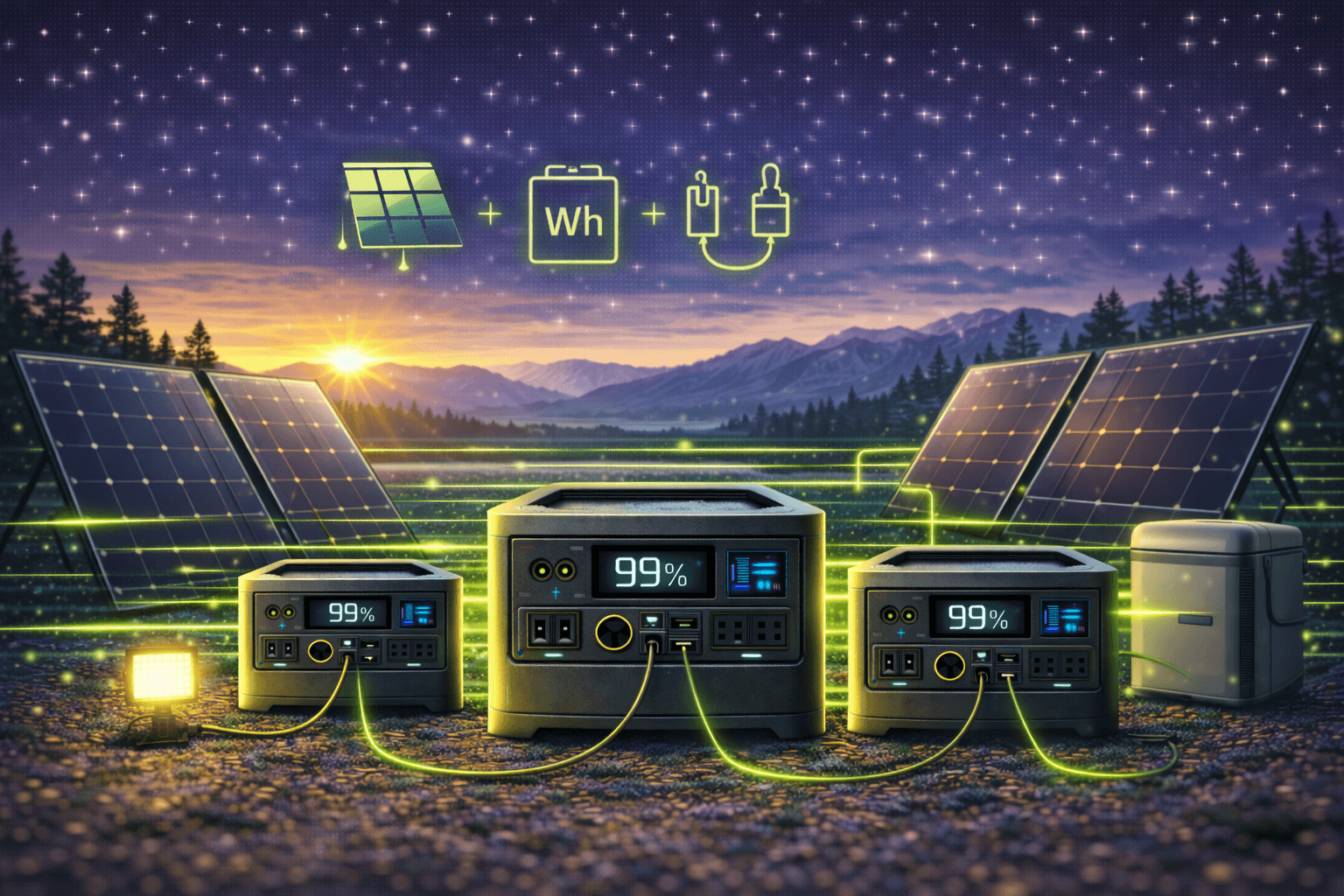
Adding solar panels to a portable power station changes the equation entirely. Without solar, you’ve got a big battery with a finite charge. With properly sized solar, you’ve got a renewable power system that can run indefinitely off-grid — no gas, no noise, no grid dependency.
But here’s where most buyers go wrong: they grab a manufacturer bundle assuming it’s a good deal, unbox it at camp, and discover their “200W solar generator” barely keeps up with a phone charger and mini cooler on a cloudy day. The panel is undersized, the “savings” are inflated, and they end up buying more panels anyway.
This guide cuts through the bundle marketing. We’ll show you exactly how to evaluate whether a bundle is worth it, how much solar you actually need for your capacity tier, and which specific setups deliver the best value — whether that’s a manufacturer package or a smarter separate purchase.
Note: This guide contains affiliate links. If you purchase through our links, we may earn a commission at no extra cost to you.
Bundle vs. Separate Purchase: Do the Math First
Manufacturers love advertising bundle “savings” — big red slashed prices, “$300 off!” banners, the works. Sometimes those savings are real. Often, they’re not.
The only way to know is to run the numbers yourself.
How to Calculate Actual Bundle Value
Step 1: Find the real street price of each component. Not MSRP — what the power station and panel actually sell for right now on Amazon, the manufacturer’s site, or major retailers. Prices in this category fluctuate constantly with sales and promotions.
Step 2: Add them up. That’s your true separate-purchase cost.
Step 3: Compare to the bundle price. The difference is your actual savings — which may be much less than the advertised discount.
Step 4: Ask the harder question — is the included solar adequate? A 15% discount means nothing if the bundle includes 200W of solar for a 2000Wh station. You’ll need to buy more panels anyway, wiping out any “savings.”
Real Example: EcoFlow Delta 2 + 220W Bundle
EcoFlow currently sells the Delta 2 + 220W bifacial solar panel bundle for around $599 on their site (pricing fluctuates — check current pricing below). The Delta 2 standalone runs $499-699 depending on promotions, and the 220W bifacial panel sells for $399-649 standalone.
At full retail, that’s $1,048-$1,348 bought separately versus $599 bundled. When the pricing aligns like this, the bundle is genuinely excellent value — you’re essentially getting the solar panel at a steep discount or free.
But here’s the catch: 220W of solar generates roughly 420-560Wh per day in good conditions. For light weekend camping (phones, lights, a small fan), that’s adequate. For heavier loads — running a cooler, charging a laptop, keeping multiple devices topped off — you’ll consume 700-900Wh daily and fall short. The bundle gets you started, but serious off-grid users will want to add a second panel.
The bifacial technology is a genuine advantage, adding 10-25% generation on reflective surfaces like sand, snow, or light gravel. On dark grass or dirt, the bifacial benefit drops to near zero.
When Bundles Make Sense
Bundles justify their price when three conditions align: genuine savings of 15%+ over separate component pricing, solar wattage adequate for your consumption pattern, and the convenience of guaranteed plug-and-play compatibility matters to you. First-time buyers who want zero hassle — unbox, connect, charge — should lean toward bundles when the price is right.
When Separate Purchase Wins
Buy separately when bundle “savings” are under 10%, when the included solar is undersized for your needs (the most common scenario with 1000Wh+ stations), or when third-party panels offer dramatically better value per watt. Experienced users who are comfortable verifying voltage compatibility and using MC4 adapter cables ($15-25) can often build a better system for less money.
After evaluating dozens of manufacturer bundles across EcoFlow, Jackery, Bluetti, and Anker, roughly 40% deliver genuine value, 35% are acceptable convenience purchases with minimal savings, and 25% are poor value you should avoid in favor of separate buying.
Solar Panel Sizing: The Most Common Mistake
Most manufacturer bundles include inadequate solar for the station’s capacity. A 1000Wh power station bundled with a single 200W panel sounds reasonable — until you realize that 200W panel generates maybe 420Wh on a good day, and you’re consuming 800Wh. That’s a daily deficit that depletes your battery in two to three days regardless of the solar.
The mistake is sizing solar to battery capacity instead of daily consumption. Your battery stores power; your solar needs to replace what you use each day.
The Solar Sizing Formula
Required Solar (W) = Daily Consumption (Wh) × 1.5 ÷ Peak Sun Hours (3-4) ÷ System Efficiency (0.75)
The 1.5× safety factor accounts for cloudy days, suboptimal panel angle, temperature losses, dirt accumulation, and seasonal variation. Without it, you’re sizing for perfect conditions that rarely exist.
Sizing by Consumption Level
Light use (300-500Wh/day) — phones, LED lights, small devices. You need 200-300W of solar. Most compact bundles (River-class stations + 100-110W panel) fall short here; add a second panel or go third-party at 200W.
Moderate use (600-1000Wh/day) — cooler, laptop, lights, multiple devices. This is the sweet spot for weekend camping and short-term backup. You need 400-600W of solar. This is where nearly every manufacturer bundle falls short — they’ll include 200-220W when you need double that. Plan on supplementing with third-party panels, or skip the bundle entirely and buy adequate solar from the start.
Heavy use (1200-2000Wh/day) — fridge, extensive electronics, occasional cooking appliances. Common for extended off-grid, RV boondocking, and serious emergency prep. You need 800-1200W of solar. No manufacturer bundle at this tier includes adequate solar without the highest-tier (and most expensive) configuration. Budget for a proper solar array from day one.
Real-World Generation vs. Marketing Claims
A “200W panel” doesn’t generate 200W all day. It hits rated output for maybe an hour or two at peak noon with perfect angle and cool temperatures. Real-world sustained averages run 60-75% of rated capacity.
200W panel, realistic daily output:
- Good conditions (clear sky, decent angle): 120-160W average × 4 peak sun hours = 480-640Wh
- Average conditions (some clouds, okay angle): 100-130W average × 3.5 hours = 350-455Wh
- Poor conditions (overcast, winter, extreme heat): 40-80W average × 3 hours = 120-240Wh
Temperature plays a bigger role than most people expect. Solar panels lose roughly 0.3-0.5% efficiency per degree Fahrenheit above 77°F. In summer desert heat with panel surface temperatures reaching 140°F, you can lose 30%+ of rated output from heat alone. The same panel in cool 65°F mountain air will significantly outperform.
Season matters too. Summer delivers 4-6 peak sun hours; winter drops to 2-4 hours with lower sun angles. If you need year-round off-grid capability, size your solar for winter minimums — not summer peaks.
For a deeper look at how to calculate runtime based on your specific devices and consumption, see our portable power station runtime calculator.
Best Solar Bundles and Setups by Capacity Tier
Best Mid-Range Bundle: EcoFlow Delta 2 + 220W Bifacial Panel
Best for: Weekend camping with light-to-moderate consumption, short-term home backup, first-time solar users wanting a plug-and-play experience.
The EcoFlow Delta 2 paired with the 220W bifacial solar panel remains the strongest mid-range bundle value, particularly when pricing dips during frequent EcoFlow promotions.
Power Station Specs (Delta 2):
| Spec | Detail |
|---|---|
| Capacity | 1024Wh (LiFePO4) |
| AC Output | 1800W (2200W X-Boost) |
| Weight | 27 lbs |
| AC Charge Time | 80 minutes |
| Solar Input | 500W max |
| Battery Cycles | 3,000+ to 80% |
| Expandable | Up to 3,072Wh |
| Warranty | 5 years |
Solar Panel Specs (220W Bifacial):
| Spec | Detail |
|---|---|
| Rated Output | 220W front / up to 155W rear |
| Cell Efficiency | 23% (monocrystalline) |
| Weight | 15.4 lbs |
| Waterproof Rating | IP68 |
Real-world performance: In typical weekend camping scenarios with 400-600Wh daily consumption (phone charging, LED lights, a small fan, occasional laptop use), the 220W panel keeps up reasonably well. On good-sun days, expect 420-560Wh of generation — roughly matching light consumption and keeping the battery topped off through a two-night trip.
The bundle breaks down for heavier use. If you’re running a 12V cooler (drawing 300-400Wh/day on its own) plus devices, consumption jumps to 700-900Wh daily. The 220W panel can’t keep pace, and you’ll drain the battery by day two. For that scenario, add a second 200W third-party panel ($200-300) to bring total solar to 400W+ for sustainable operation.
The bifacial panel provides a real boost on reflective surfaces — we’ve seen 10-25% more output on sand and snow versus standard panels. On dark ground (forest floor, grass), the benefit is minimal. Worth noting if your camping tends toward beaches and desert versus dense woods.
EcoFlow’s app solar monitoring is a genuine advantage here. Real-time generation tracking helps you reposition panels for maximum output, and historical data reveals patterns useful for planning consumption.
Limitations: 1024Wh is tight for multi-day trips without supplemental solar. The proprietary XT60 connector limits (but doesn’t prevent) third-party panel additions — you’ll need an MC4-to-XT60 adapter cable. And while 27 lbs is manageable, you’re carrying 42+ lbs total with the panel.
For a full breakdown of Delta 2 capabilities versus competitors at this capacity tier, see our EcoFlow Delta 2 vs Jackery 1000 Plus comparison.
Best Large-Capacity Bundle: Jackery 2000 Plus + Solar Generator Kit
Best for: Extended off-grid stays, RV boondocking, serious emergency preparedness, users who need multi-day autonomy.
The Jackery 2000 Plus anchors Jackery’s most capable solar generator system. The critical decision here isn’t whether to buy it — it’s choosing the right solar configuration.
Power Station Specs (Explorer 2000 Plus):
| Spec | Detail |
|---|---|
| Capacity | 2,042Wh (LiFePO4) |
| AC Output | 3,000W (6,000W surge) |
| Weight | 61.5 lbs |
| Solar Input | 1,000W max |
| Battery Cycles | 4,000 to 70% |
| Expandable | Up to 24kWh (with battery packs + parallel) |
| Warranty | 5 years (3+2 extended via official site) |
Solar configuration breakdown:
| Bundle Config | Adequacy | Verdict |
|---|---|---|
| 2000 Plus + 200W (2× 100W or 1× 200W) | Severely undersized — generates ~420Wh/day vs 1200Wh+ consumption | Avoid |
| 2000 Plus + 400W | Marginal — matches light consumption, zero buffer for clouds | Acceptable only for light use |
| 2000 Plus + 800W (4× 200W) | Adequate — generates ~1,600Wh/day, sustainable for typical 1200Wh consumption | Recommended minimum |
This is the pattern we see constantly with large-capacity bundles: the entry-level solar configurations are wildly undersized. A 2042Wh battery with 200W of solar recharges maybe 10-15% per day under real conditions. You’d drain the battery in three days and be stuck with an expensive paperweight and a toy solar panel.
The 800W configuration with four SolarSaga 200W panels makes the system actually work. With 1,600Wh+ daily generation in good conditions, you can sustain 1,200-1,500Wh daily consumption indefinitely — running a fridge, charging devices, powering lights, and handling moderate cooking loads.
The separate-purchase alternative: Buy the Explorer 2000 Plus standalone ($1,399-1,999 depending on promotions) and add 800W of third-party panels (4× 200W Renogy or similar) for $600-900 total. Compare total cost against Jackery’s bundled 800W configuration and buy whichever is cheaper at time of purchase. Third-party panels work perfectly via standard MC4 connections — just verify voltage compatibility (the 2000 Plus accepts up to 1000W solar input).
The 4,000-cycle LiFePO4 battery is a significant advantage for a system designed for daily solar cycling. At one cycle per day, that’s over 10 years of use before the battery drops to 70% capacity. For extended off-grid living, this longevity matters more than any other single spec.
For more on what this capacity tier can power and how it compares to alternatives, check our best 2000Wh+ portable power stations guide.
Best Value Approach: Separate Purchase (Any Capacity)
Best for: Budget-conscious buyers, experienced users, anyone whose consumption exceeds what bundled solar can handle.
For many situations — especially at the 1000Wh+ tier — skipping the manufacturer bundle entirely and assembling your own system yields dramatically better value.
The process is straightforward:
Pick your power station based on capacity and features alone. Don’t compromise on the station to chase a “bundle deal” with inadequate solar. Our complete buying guide walks through the selection process.
Calculate your required solar using the formula above. Measure or estimate your actual daily consumption, then apply the 1.5× safety factor.
Buy third-party panels at competitive pricing. Renogy, Rich Solar, and BougeRV offer strong value with standard MC4 connectors and 25-year output warranties. Expect to pay $1.00-1.50 per watt for quality portable/foldable panels versus $2.00-3.00+ per watt for manufacturer-branded panels.
Example build: Jackery Explorer 1000 Plus ($899 street price) + 2× Renogy 200W portable panels ($400-500 total) = $1,299-$1,399 all-in with 400W of solar. Jackery’s own bundle with only 200W of solar runs $1,699+. The separate approach costs $300-400 less while delivering double the solar wattage — that’s the kind of math that makes separate purchasing compelling.
The trade-offs are real but manageable: you’ll need MC4-to-manufacturer adapter cables ($15-25), you should verify voltage/wattage compatibility before buying (check your station’s solar input specs against the panel’s open-circuit voltage), and you’ll have separate warranties from different vendors. For most buyers comfortable with basic research, these are minor inconveniences compared to the value gained.
For panel compatibility specifics with major brands, our solar panel setup and sizing guide covers connector types, voltage matching, and MPPT optimization in detail.
Setting Realistic Solar Expectations
Solar marketing implies you’ll get rated wattage all day. Reality is more nuanced, and understanding the gap prevents frustration and under-planning.
Temperature, Season, and Weather
Temperature is the silent killer of solar output. Panels are rated at 77°F (25°C). Every degree above that costs 0.3-0.5% efficiency. In Arizona summer heat with panel surfaces at 140°F, a 200W panel might peak at 136W — a 32% loss from heat alone. That same panel at 65°F in Colorado mountains can hit 185W+. If you camp in hot climates, oversize your solar accordingly.
Seasonal swing is dramatic. Summer gives you 4-6 peak sun hours with high sun angles. Winter drops to 2-4 hours with weaker, lower-angle sunlight. A system that produces comfortable surplus in July may run a significant daily deficit in December. For year-round off-grid use, size solar to your worst-case winter scenario.
Example: 400W solar with 1,000Wh daily consumption.
- Summer: 400W × 5 hrs × 0.70 efficiency = 1,400Wh (40% surplus)
- Winter: 400W × 3 hrs × 0.65 efficiency = 780Wh (22% deficit)
To sustain year-round operation, you’d need 600W+ of solar — or reduce winter consumption to match reduced generation. Our winter usage guide covers cold-weather strategies in depth.
Panel Maintenance Matters
Dirty panels lose 10-20% output. A quick wipe with a soft cloth before each charging session makes a measurable difference. Angle optimization matters too — panels flat on the ground produce 20-30% less than panels aimed directly at the sun. Most portable panels include adjustable kickstands for a reason.
Frequently Asked Questions
How much solar do I actually need?
Size solar to your daily consumption, not your battery capacity. Use the formula: Daily consumption × 1.5 ÷ 3.5 peak sun hours ÷ 0.75 efficiency. For 800Wh daily consumption, that works out to roughly 457W minimum — round up to 500W for comfortable margin. For detailed per-device calculations, see our capacity guide comparing 500Wh vs 1000Wh vs 2000Wh.
Can I mix solar panel brands with my power station?
Yes. Most portable power stations accept standard MC4 solar connections. You’ll need an MC4-to-manufacturer adapter cable for brands like EcoFlow (XT60 connector) or Jackery (DC8020). Verify two things before buying: total panel wattage doesn’t exceed your station’s maximum solar input, and open-circuit voltage stays within the station’s accepted voltage range. Both specs are in your station’s manual. Our Jackery guide and EcoFlow guide cover brand-specific compatibility details.
Bundle or separate — which should I pick?
Run the numbers for your specific situation. If the bundle saves 15%+ over current street pricing AND includes adequate solar for your consumption, buy the bundle. If either condition fails — marginal savings OR undersized solar — go separate. Most buyers with 1000Wh+ stations end up better served by separate purchases because manufacturer bundles consistently under-solar large capacity stations.
Bottom Line
Solar transforms a portable power station from a finite battery into a self-sustaining power system. But the gap between a well-sized solar setup and an undersized one is the difference between indefinite off-grid capability and a battery that drains in two days despite having a panel attached.
For mid-range needs (weekend camping, light backup): The EcoFlow Delta 2 + 220W bundle offers strong value when on promotion, with adequate solar for light consumption under 600Wh daily. Add a second panel for heavier use.
For large-capacity needs (extended off-grid, RV, emergency prep): The Jackery 2000 Plus with 800W+ solar delivers genuine sustainable operation. Avoid the undersized 200W bundle configurations — they defeat the purpose of owning a 2042Wh battery.
For best overall value: Buy your power station and solar panels separately. You’ll typically get 50-100% more solar wattage for the same money as a manufacturer bundle, enabling the properly-sized system that actually delivers on the promise of solar independence.
Size your solar for real-world conditions, not marketing specs. Your future self, sitting comfortably off-grid with a fully charged battery at sunset, will thank you.