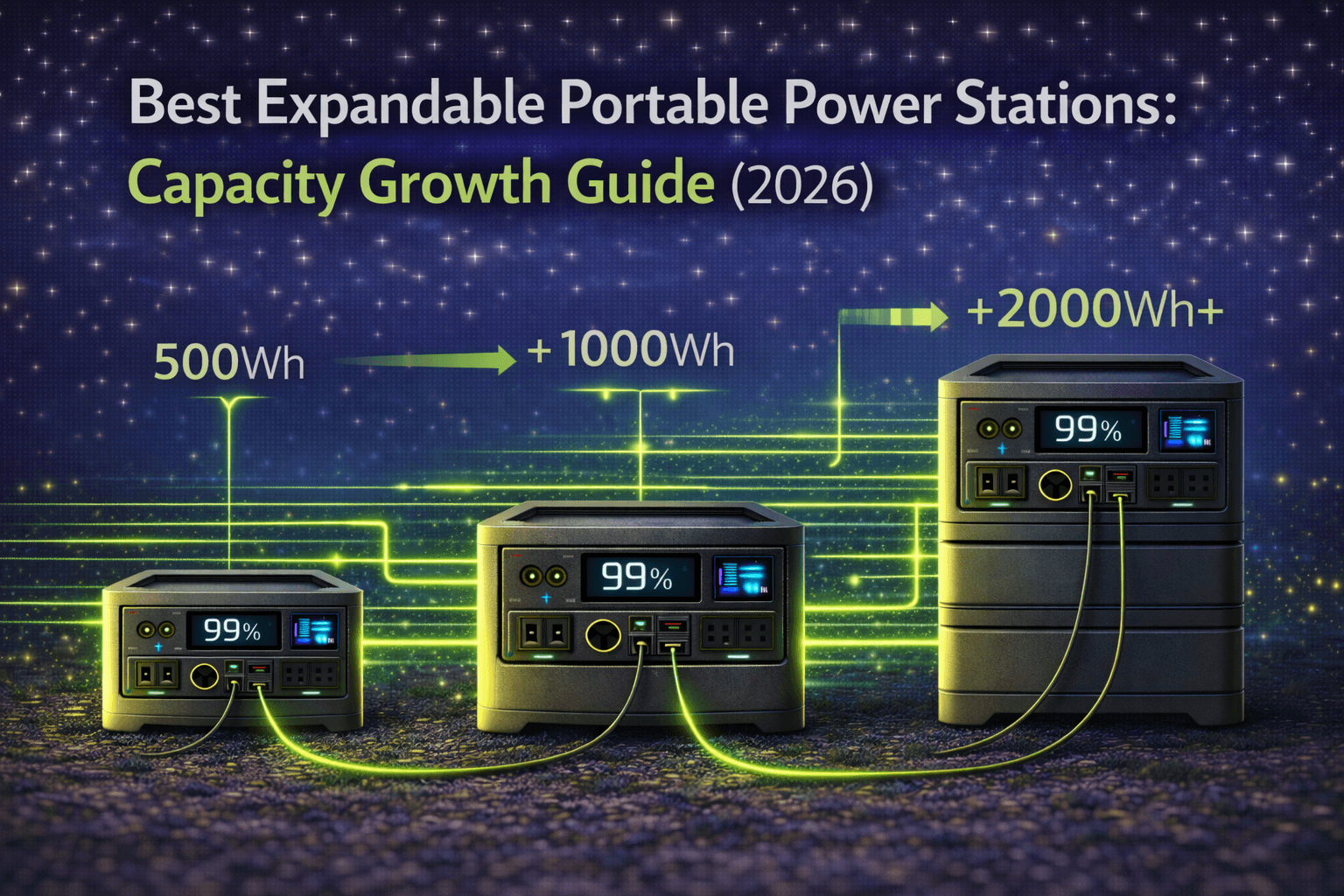
Expandable portable power stations let you start with what you need and add capacity later, protecting your initial investment as your power demands grow. Rather than guessing your future requirements and buying the biggest unit upfront, expandable systems let you add battery modules incrementally — useful when you’re transitioning from weekend camping to van life, or when your budget doesn’t stretch to full capacity on day one.
The concept is straightforward. A base unit contains the inverter, battery management system, outlets, charging circuitry, and an initial battery. Expansion batteries are simpler — just battery cells and basic protection circuitry in a housing that connects to the base. Because expansion packs skip the inverter and electronics, they typically cost 10–50% less per watt-hour than the base unit. Connect one, and the system treats the combined capacity as a single integrated battery.
That flexibility carries trade-offs worth understanding before you commit. Expandable base units typically cost 20–30% more than equivalent fixed-capacity models because you’re paying for expansion ports and compatible electronics. Every expansion battery locks you into one manufacturer’s ecosystem — Jackery packs only work with Jackery, EcoFlow only with EcoFlow. And the total cost of a base unit plus multiple expansion batteries often exceeds what you’d pay for a single larger all-in-one system. This guide breaks down when expandability genuinely saves you money, when it doesn’t, and which models deliver the best expansion value in 2026.
Note: This guide contains affiliate links. If you purchase through our links, we may earn a commission at no extra cost to you. This supports our testing and content creation.
How Expandable Systems Work
Understanding the architecture helps you make smarter expansion decisions and set realistic expectations about what these systems can and can’t do.
Base unit vs. expansion battery. The base unit is a complete, standalone portable power station — it works perfectly without any expansion attached. It contains the inverter (converting DC battery power to AC), the main battery management system, all charging circuitry for AC, solar, and DC input, every outlet and port, the display, and cooling. Expansion batteries strip all of that away. They contain battery cells, basic cell-level protection, and a proprietary connector. That simplicity is why they cost less per watt-hour.
How they connect. Expansion batteries link to the base unit through proprietary cables, typically 2–6 feet long. These carry DC power between batteries and communication signals for the BMS to coordinate capacity reporting and cell balancing. The connectors are manufacturer-specific and not interchangeable between brands. Once connected, the system operates as a single unit: the display shows combined capacity, discharge draws from all batteries proportionally, and charging fills them together. No manual switching required.
Solar input doesn’t scale with expansion. This catches people off guard. Your base unit’s solar input rating stays fixed regardless of how much expansion capacity you add. A Jackery 2000 Plus accepts 1,400W of solar whether it’s running its 2,042Wh base alone or a fully expanded 12,000Wh+ system. That means a fully expanded system takes proportionally longer to recharge from solar — roughly 1.4 hours for the base versus 8+ hours at maximum expansion. Plan your solar panel setup around your expanded capacity, not just the base.
Maximum expansion limits exist for safety. Each system caps total expansion to protect the base unit’s inverter and BMS from overcurrent. Exceeding published limits risks overheating and component failure. The caps vary significantly: Jackery 2000 Plus supports up to ~12,000Wh, EcoFlow Delta Pro goes to 25,000Wh with its broader ecosystem, and Bluetti AC200L tops out at 8,192Wh.
Space and weight add up fast. A single expansion battery weighs 40–62 lbs depending on the model. Two or three expansion packs turn a portable system into semi-permanent infrastructure requiring dedicated mounting in an RV, cabin, or garage. Cable routing between units also demands planning, especially in van builds where every inch matters.
Expansion Cost Analysis
The economics of expandable systems aren’t always intuitive. Sometimes expansion saves money; sometimes it costs significantly more than buying the right capacity upfront. Here’s how to evaluate.
Cost-per-watt-hour drops with expansion batteries. Because expansion packs contain only battery cells, they deliver cheaper capacity than the base unit:
| System | Base Cost/Wh | Expansion Cost/Wh | Savings vs. Base |
|---|---|---|---|
| Jackery 2000 Plus | $0.98/Wh | ~$0.49/Wh | ~50% less |
| EcoFlow Delta Pro | ~$0.78/Wh | ~$0.56/Wh | ~28% less |
| Bluetti AC200L | ~$0.54–0.68/Wh | ~$0.43/Wh (B300K) | ~20–37% less |
Note: AC200L base pricing ~$1,099–1,399 for 2,048Wh. B300K is 2,764.8Wh at ~$1,199.
Jackery delivers the steepest expansion discount, making gradual growth particularly cost-effective in that ecosystem.
But total expanded cost often exceeds all-in-one alternatives. Building a 4,000Wh system through expansion (base + expansion) typically costs 10–30% more than buying a single 4,000Wh unit — plus you lose the redundancy benefit of owning two independent units. Two separate 2,000Wh power stations can back each other up if one fails. A single expanded system creates one point of failure.
When expansion makes financial sense:
You’re genuinely uncertain about future needs. Starting at 2,000Wh and expanding to 4,000Wh over two years costs more total than buying 4,000Wh upfront — but if you never actually need that extra capacity, you’ve saved $1,000 by not overbuying. This is the core value proposition: paying a flexibility premium to avoid waste.
Your budget is limited now but growing. Spending $1,999 today on a Jackery 2000 Plus base, then adding a $999 expansion next year, spreads the financial impact in a way that buying a $3,000 all-in-one unit doesn’t.
Your application is actively evolving. Weekend camping that’s trending toward van life or extended boondocking benefits from the ability to scale capacity alongside your lifestyle changes.
When fixed capacity is the better buy:
You know exactly what you need. If you’ve calculated 4,000Wh daily consumption and that number isn’t changing, buying a single large unit is cheaper and mechanically simpler.
Redundancy matters to you. For home backup where reliability is critical, two independent units provide insurance that a single expanded system can’t match.
You can afford adequate capacity upfront. No point paying the expansion premium if your budget already covers what you need in one purchase.
Best Expandable Portable Power Stations
1. Jackery Explorer 2000 Plus — Best Expansion Value ($1,999 base)
The Jackery 2000 Plus offers the most compelling expansion economics of any system we’ve tested. The base unit delivers 2,042Wh of LiFePO4 capacity with 3,000W continuous output — enough for most camping, RV, and backup scenarios before you ever think about expanding. When you do expand, the Battery Pack 2000 Plus adds another 2,042Wh for approximately $929–999, working out to roughly $0.49 per watt-hour. That’s the best expansion rate in the industry by a wide margin.
Expansion Path:
| Configuration | Capacity | Approx. Total Cost | Cost/Wh | Use Case |
|---|---|---|---|---|
| Base only | 2,042Wh | $1,999 | $0.98 | Weekend camping, emergency backup |
| + 1 expansion | 4,084Wh | ~$2,998 | ~$0.73 | Van life entry, multi-day autonomy |
| + 2 expansions | 6,126Wh | ~$3,997 | ~$0.65 | Full-time nomad with solar |
| + 5 expansions (max) | 12,252Wh | ~$6,994 | ~$0.57 | Off-grid installation, commercial |
The 2,042Wh base handles most scenarios without expansion. Weekend camping at 800Wh daily gives you roughly 2.5 days of autonomy. Emergency backup covers 12–18 hours of essential home devices. A CPAP with humidifier runs a full night on about 480Wh. Many buyers never need to expand at all.
The 4,000-cycle LiFePO4 battery across both base and expansion units means your investment is protected for a decade or more of regular use. This matters for expansion planning — you won’t need to worry about the base unit degrading before you’ve finished building out your system. Jackery’s 3+2 year warranty (extended automatically with registration) covers both base and expansion batteries.
The maximum 12,252Wh expansion (base + 5 packs) enables applications that portable power stations don’t typically handle: sustained multi-day whole-home backup, commercial food truck operations, group overlanding for 4–6 people, or permanent off-grid cabin battery banks. At that scale, though, you’re looking at 360+ lbs of equipment requiring permanent installation.
Solar input caps at 1,400W regardless of expansion level. With the base alone, that’s a theoretical 1.4-hour full recharge. At maximum expansion, the same 1,400W input takes over 8 hours to fill 12,000Wh. For large expanded configurations, consider our solar sizing guide to set realistic recharge expectations.
Key Specs:
- Capacity: 2,042Wh base (LiFePO4, 4,000 cycles)
- Output: 3,000W continuous / 6,000W surge
- Solar Input: 1,400W max (6× 200W panels)
- Weight: 60 lbs per unit
- Ports: 3× AC, 2× USB-C (100W), 2× USB-A, 1× car socket
- Max Expansion: ~12,252Wh (5 expansion packs)
- Warranty: 3 years base + 2 years extended
Strengths:
- Industry-best expansion value at ~$0.49/Wh per pack
- Largest expansion ceiling (12,000Wh+) among portable systems
- 4,000-cycle battery justifies long-term expansion investment
- 2,042Wh base is genuinely adequate as standalone
- Seamless automatic capacity integration
Limitations:
- 60 lbs per unit makes expanded systems permanent-install only
- Proprietary ecosystem locks you into Jackery
- Solar input doesn’t scale with capacity
- Only 3 AC outlets on base unit
Check Price on Jackery
Also on Amazon
Expansion Battery on Amazon
2. EcoFlow Delta Pro — Best Premium Expansion ($2,799 base)
The EcoFlow Delta Pro targets buyers building comprehensive whole-home backup or commercial-grade systems. At 3,600Wh base capacity with 3,600W continuous output, it handles serious loads before expansion enters the picture. The broader EcoFlow ecosystem — Smart Home Panel, dual-unit configurations, EV charging compatibility — creates integration possibilities that no other expandable system matches.
Expansion Path:
| Configuration | Capacity | Approx. Cost | Cost/Wh | Use Case |
|---|---|---|---|---|
| Base only | 3,600Wh | ~$2,799 | ~$0.78 | Professional work, serious camping |
| + 1 extra battery | 7,200Wh | ~$4,798 | ~$0.67 | Extended overlanding, multi-day backup |
| + Smart Home Panel | 7,200Wh | ~$5,697 | ~$0.79 | Whole-home integration with auto-transfer |
| Dual base units | 7,200Wh | ~$5,598 | ~$0.78 | Redundancy-priority backup |
The 3,600Wh base is substantial. Week-long overlanding at 1,500Wh daily gives you 2.4 days of autonomy — enough for most trips with solar supplementation. Home backup essentials (refrigerator, WiFi, lights) at 2,000Wh daily covers roughly 1.8 days. Professional mobile operations — food trucks, construction sites, event production — run comfortably within the 3,600W output envelope.
EcoFlow’s Smart Home Panel integration is what elevates the Delta Pro beyond portable power territory. The panel provides automatic transfer switching (grid fails, Delta Pro takes over seamlessly), selective circuit management to prioritize critical loads, and time-of-use optimization for charging during off-peak rates. This is genuine residential energy management, not just a big battery with outlets. Professional installation is required, but the result is a system that functions as a proper home backup solution.
The expansion ecosystem extends to 25kWh through combinations of extra batteries, Smart Home batteries, and dual-unit configurations. Solar input reaches 1,600W per base unit. With dual base units, you get 3,200W of combined solar input and 7,200W of combined output — enough for genuinely serious applications.
AC charging reaches full from a standard 1,800W outlet in approximately 2.7 hours, or 1.8 hours from a 240V/3,000W connection. The 6,500W MultiCharge capability (combining AC, solar, and Smart Generator simultaneously) provides the fastest overall recharge in the category.
Key Specs:
- Capacity: 3,600Wh base (LiFePO4, 6,500 cycles)
- Output: 3,600W continuous / 4,500W with X-Boost
- Solar Input: 1,600W max per unit
- Weight: ~99 lbs
- Ports: 5× AC, 4× USB-A, 2× USB-C, 2× DC, Anderson port
- Max Expansion: 25,000Wh (ecosystem)
- Warranty: 5 years
Strengths:
- Massive 3,600Wh base is adequate for most uses without expansion
- Smart Home Panel enables true residential integration
- 25kWh maximum within broader ecosystem
- 6,500-cycle battery for exceptional longevity
- EV charging station compatibility
- Sophisticated app with real-time monitoring
Limitations:
- Premium pricing: ~$2,799 base, ~$1,999 per extra battery
- Heavy at ~99 lbs (not portable in any practical sense)
- Smart Home Panel requires professional installation
- Overkill for users who just need portable power
Check Price on Amazon | Extra Battery on Amazon
3. Bluetti AC200L — Best Mid-Range Expansion (~$1,099–1,399 base)
The Bluetti AC200L occupies the middle ground between Jackery’s value positioning and EcoFlow’s premium ecosystem. At ~$1,099–1,399 for 2,048Wh with 2,400W output (3,600W Power Lifting Mode), the base unit delivers more power and faster charging than its predecessor at a lower price point. Expansion options include four battery sizes — the B300K (2,764.8Wh, ~$1,199), B210 (2,150Wh), B300 (3,072Wh), and B230 (2,048Wh) — with a maximum of two modules connected simultaneously.
Expansion Path:
| Configuration | Capacity | Approx. Cost | Cost/Wh | Use Case |
|---|---|---|---|---|
| Base only | 2,048Wh | ~$1,099–1,399 | ~$0.54–0.68 | Emergency backup, camping |
| + 1× B300K | 4,812.8Wh | ~$2,298–2,598 | ~$0.48–0.54 | Van life, extended trips |
| + 2× B300K | 7,577.6Wh | ~$3,497–3,797 | ~$0.46–0.50 | Off-grid living, small cabin |
| + 2× B300 (max) | 8,192Wh | ~$4,097–4,397 | ~$0.50–0.54 | Maximum capacity configuration |
The base 2,048Wh handles standard applications well. Van life at 1,200–1,500Wh daily gives about 1.4 days of autonomy with disciplined solar use. Emergency home backup covers a full 24 hours of essential devices — and the 20ms UPS switchover keeps sensitive electronics running through grid transitions. Weekend camping runs comfortably for 2–3 days.
The B300K expansion battery is the standout choice for new buyers. At 2,764.8Wh with 4,000+ cycle LiFePO4 cells, it delivers 15% more lifespan than the older B230/B300 batteries and features a next-generation wireless internal design that improves reliability. The B300K is also backward-compatible with older Bluetti units (AC200MAX, AC300, AC500), so if you upgrade your base unit later, your expansion batteries carry forward.
The flexibility of choosing between four expansion battery sizes is a practical advantage no other brand offers. Start with one B300K for the best value per watt-hour, or add two for 7,577Wh of total capacity that handles full-time van life with 3–5 days of autonomy. The 8,192Wh ceiling with dual B300s supports small cabin operations or multi-day commercial use.
WiFi + Bluetooth connectivity lets you monitor the entire expanded system — base unit and all connected batteries — from anywhere on your property via the Bluetti app. Track individual battery levels, consumption patterns, and receive low-battery alerts without walking to the unit. This is a meaningful upgrade over older Bluetti models that only offered Bluetooth.
Solar input reaches 1,200W through the base unit — a 33% increase over the previous generation. With 1,000W of panels, the base unit recharges in roughly 2 hours. At maximum expansion (8,192Wh), the same solar input takes proportionally longer, so plan your solar panel setup around your expanded capacity.
The AC200L’s 0-80% recharge in 45 minutes via 2,400W AC input is the fastest in this tier — dramatically faster than the 4–6 hour charge times of the previous model. For users who deplete their system daily and need rapid turnaround, this alone justifies the upgrade.
The 11 output ports include a 30A TT-30 RV outlet and a 48V/8A DC output, making it particularly well-suited for RV applications where diverse port options reduce the need for adapters.
Key Specs:
- Capacity: 2,048Wh base (LiFePO4, 3,500+ cycles)
- Output: 2,400W continuous / 3,600W Power Lifting Mode
- Solar Input: 1,200W max
- AC Charging: 0-80% in 45 minutes (2,400W input)
- Connectivity: WiFi + Bluetooth
- UPS: 20ms automatic switchover
- Noise Level: ≤50dB
- Weight: ~62 lbs (base), ~65 lbs (B300K), ~74 lbs (B300)
- Ports: 4× AC, 1× TT-30 RV, 1× USB-C (100W), 2× USB-A, 1× 48V/8A DC, 1× 12V/10A car
- Max Expansion: 8,192Wh (2× B300)
- Warranty: 5 years (base), 3+1 years (B300K)
Strengths:
- Lowest base price in expandable tier (~$1,099–1,399)
- Four expansion battery sizes offer the most flexible growth paths of any brand
- B300K features 4,000+ cycles with next-gen design — future-proof investment
- WiFi + Bluetooth app monitoring for entire expanded system
- 45-minute 0-80% fast charging — fastest in class
- 20ms UPS protects sensitive electronics during grid transitions
- 11 output ports including RV-specific outlets
- Expansion batteries are backward/forward compatible across Bluetti ecosystem
Limitations:
- Maximum 8,192Wh is lower than Jackery (12,000Wh) or EcoFlow (25,000Wh)
- B230 and B300 being phased out — B300K is the recommended expansion going forward
- Individual unit output of 2,400W limits simultaneous high-draw equipment
- Heavier expansion batteries (65–74 lbs each)
Check Price on Bluetti
Also on Amazon
B300K Battery on Amazon
Expansion Timing Strategy
When you expand matters almost as much as what you expand with.
Start with the base and live with it. Resist the temptation to buy expansion batteries immediately unless you have a confirmed need from day one (permanent off-grid installation, whole-home backup sized to calculated requirements). Most buyers overestimate their power needs. Spend at least one full season — camping trips, a few outage events, your typical usage pattern — with the base unit before deciding whether expansion is necessary.
Watch for these expansion signals. You consistently deplete below 20% and feel constrained. You’re actively restricting device usage to stretch runtime. You need multiple recharges per outing, limiting your mobility. Your use case has genuinely evolved — weekend camping became week-long boondocking, or you added a refrigerator to your van build.
Avoid these false expansion signals. You depleted once during unusually heavy use (outlier, not pattern). You want expansion “just in case” without a specific scenario in mind. Your battery anxiety comes from unfamiliarity rather than actual capacity shortfall — many new users worry about running out but find 2,000Wh covers their needs comfortably after a few trips.
Strategic timing saves money. Black Friday, Prime Day, and manufacturer sales events regularly discount expansion batteries 20–40%. If you know you’ll expand eventually, buying the base unit now and waiting for a sale on the expansion pack can save $200–400. The Jackery Battery Pack 2000 Plus has dropped to $699–799 during major sales versus its ~$929–999 normal price.
Budget for the full system cost. Before choosing an expandable system, calculate your maximum realistic expansion cost. If you might need 6,000Wh, price out base + 2 expansions for each brand. Sometimes a larger fixed-capacity unit at a different brand delivers equivalent capacity for less total investment. Our buying guide walks through capacity sizing in detail.
Who Should (and Shouldn’t) Buy Expandable
Expandable systems make sense for:
Lifestyle transitioners — people moving from recreational camping toward van life, overlanding, or off-grid living. Your power needs will grow, and expandable systems grow with you without requiring a complete equipment swap.
Budget-conscious buyers with growing needs. If $2,000 is your current ceiling but you’ll need 4,000Wh within two years, buying an expandable base now and adding capacity later beats either overspending today or buying a smaller fixed unit you’ll outgrow.
RV and van builders who plan to add appliances over time. Starting with base capacity and expanding as you install a compressor fridge, add a second battery for your inverter setup, or upgrade to a larger solar array.
Fixed-capacity units are better for:
Home backup with known requirements. Calculate your critical loads, add 25% buffer, and buy a single unit that covers it. The runtime calculator can help size this precisely.
Users prioritizing redundancy. Two separate 1,000Wh units provide backup capability that a single expanded system can’t match — if one fails, the other still works.
Known fixed requirements with adequate budget. When you’ve calculated exactly what you need and can afford it today, paying the expansion premium for flexibility you won’t use is wasted money.
Frequently Asked Questions
Can I mix expansion batteries from different brands?
No. Expansion batteries use proprietary connectors and communication protocols. Jackery packs only work with Jackery base units, EcoFlow with EcoFlow, and Bluetti with Bluetti. Even within a brand, specific expansion batteries only pair with specific base models — a Jackery Battery Pack 2000 Plus won’t connect to a Jackery Explorer 1000 Plus, for example.
Does expanding affect my warranty?
Using manufacturer-approved expansion batteries doesn’t void your base unit warranty. Third-party or modified batteries would. Both base and expansion units carry their own warranty terms — check that expansion batteries purchased later still receive full coverage.
How long do expansion batteries last compared to the base?
LiFePO4 expansion batteries carry the same cycle ratings as their corresponding base units (typically 3,500–4,000 cycles). Calendar aging is minimal with proper storage — buying an expansion battery two years after your base unit won’t meaningfully reduce its useful lifespan.
Should I buy an expandable system or just buy the right capacity initially?
If you can confidently predict your needs for the next 3–5 years and your budget covers that capacity today, fixed is usually cheaper. If any of the following apply — uncertain future needs, limited current budget, actively evolving use case, or wanting to test before committing — expandable provides flexibility worth the moderate premium.
Do expanded systems work in cold weather?
Yes, but with the same cold-weather considerations as any LiFePO4 system. Charging below freezing can damage cells (most units have built-in protection that prevents this), and capacity temporarily decreases in cold temperatures. This affects both base and expansion batteries equally.
Our Recommendations
Best expansion value: Jackery Explorer 2000 Plus — The ~$0.49/Wh expansion batteries are unmatched in the industry. With a 12,000Wh ceiling and 4,000-cycle LiFePO4 chemistry, the growth potential and longevity justify long-term investment. Start here if you’re budget-conscious or have growing-but-uncertain power needs.
Best premium expansion: EcoFlow Delta Pro — The 3,600Wh base, Smart Home Panel integration, and 25kWh ecosystem ceiling make this the choice for comprehensive residential backup or commercial applications where sophisticated energy management matters.
Best mid-range expansion: Bluetti AC200L — The lowest base price in the expandable tier, four expansion battery options (including the next-gen B300K with 4,000+ cycles), WiFi + Bluetooth monitoring, and 45-minute fast charging make this the most versatile mid-range choice. The 8,192Wh maximum covers most expandable scenarios, and the B300K’s backward/forward compatibility protects your investment across Bluetti’s evolving ecosystem.
Before committing to any expandable system, honestly assess the probability that you’ll actually expand. If it’s below 50%, a well-sized fixed-capacity unit from our complete buying guide will likely serve you better for less money.