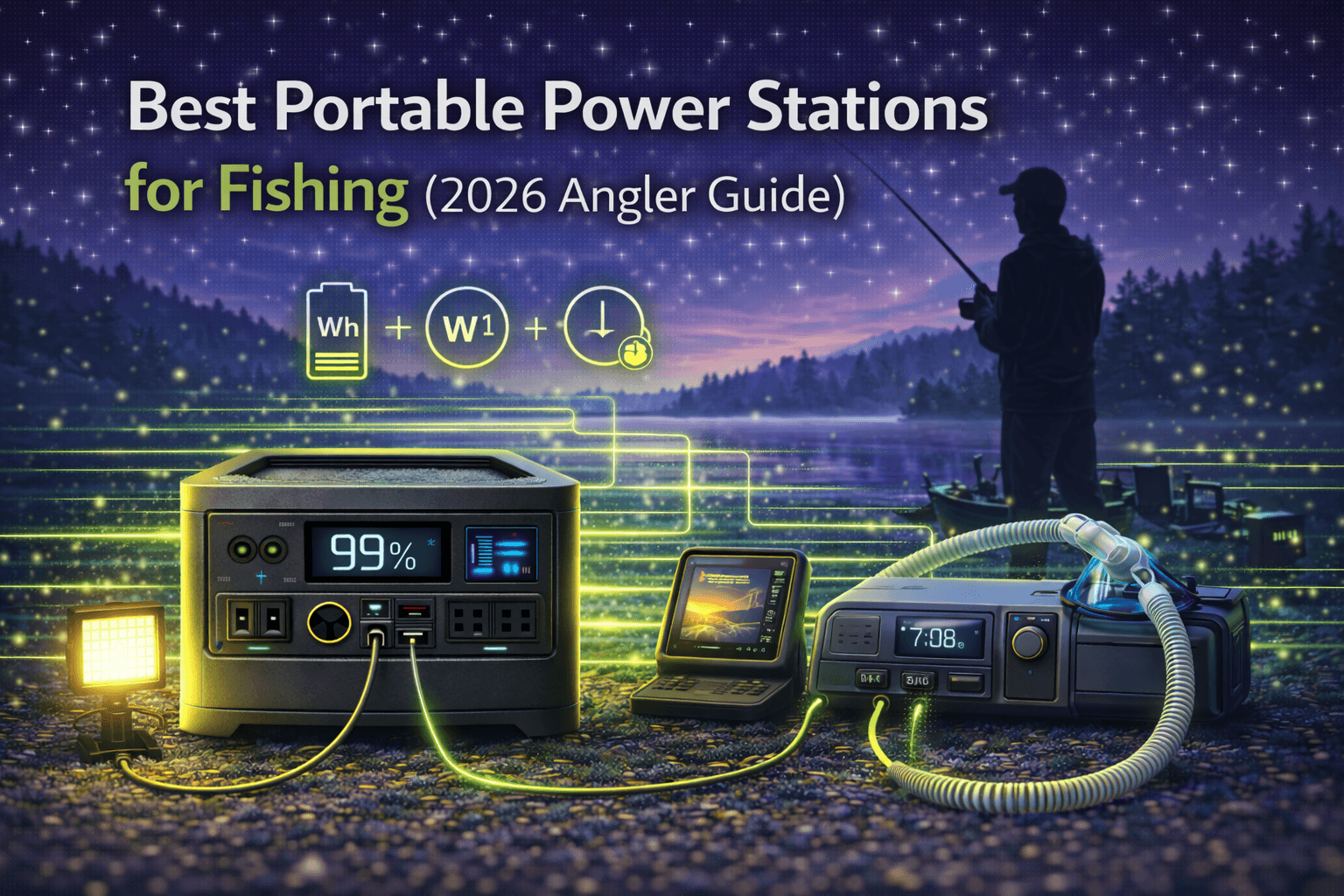
Modern fishing runs on electronics. Fish finders, GPS units, underwater cameras, portable coolers for tournament weigh-ins, lights for dawn and dusk bites, phone charging for safety on remote water — power has gone from luxury to necessity for anyone serious about catching fish.
The problem? Shore fishing, kayaks, small boats, and remote launches don’t come with outlets. Marine batteries are heavy and single-purpose. Generators spook fish and are flat-out impractical on a kayak. Portable power stations fill this gap: silent operation (critical when fish are skittish), versatile outputs (12V for marine electronics, AC for charging, USB for devices), and enough capacity to run a full electronics spread from dawn to dusk.
But fishing isn’t camping. Anglers need splash protection for humid marine environments, reliable 12V DC for fish finders and bait aerators, quick deployment during feeding windows, and rugged builds that survive bouncing around a boat deck. A camping-oriented unit without a proper 12V car port won’t power your Humminbird. And anything that can’t handle incidental spray has no business near water.
This guide breaks down exactly how much power your fishing setup actually needs, which units handle marine environments without failing, and specific recommendations for shore, kayak, boat, and tournament anglers.
Note: This guide contains affiliate links. If you purchase through our links, we may earn a commission at no extra cost to you. This helps support our research and content creation.
How Much Power Does Your Fishing Setup Actually Need?
Skipping this section is how anglers end up mid-tournament with a dead battery. Every piece of fishing electronics has a measurable draw, and getting the math right before you buy saves real money and real frustration.
Fish Finders and Marine Electronics
Fish finders are the backbone of modern fishing electronics, and their power draw varies significantly by screen size and features. A basic Garmin Striker 4 with its 3.5” screen pulls just 6W continuous — that’s 48Wh over an 8-hour day, barely a dent in any portable power station. Move up to a mid-range Humminbird Helix 7 with GPS and side imaging, and you’re looking at 18W continuous, or 144Wh daily. A premium Lowrance HDS Live 12 with every feature enabled draws around 32W, consuming 256Wh across a full day.
Most anglers run 7-9” fish finders drawing 15-22W, which works out to 120-176Wh per 8-hour fishing day. That’s manageable with even a modest portable power station. Fish finders are not your capacity bottleneck — trolling motors and refrigeration are.
Trolling Motors
This is where power budgets get serious. Electric trolling motors draw substantial wattage, but the key detail most people miss is that they run intermittently. You’re not pinning the throttle for 8 hours straight — you’re positioning, slow-trolling, adjusting.
A Minn Kota Endura C2 30lb thrust (typical kayak/small boat motor) pulls 360W at full power. But realistic fishing use — around 30% throttle with 40% duty cycle — averages roughly 43W equivalent, consuming about 344Wh over an 8-hour day. Manageable with a 1000Wh+ station.
A Minn Kota Terrova 80lb thrust (larger bass boat) draws 1,344W at full power. Even at 40% throttle with 50% duty cycle, that’s still averaging 269W, burning through 2,152Wh daily. That demands serious capacity or a hybrid approach with dedicated marine batteries.
Bait Systems, Coolers, and Lighting
Bait aerators run 2-5W (minimal but continuous). A 12V portable bait cooler with pump draws 15-25W. Insulated livewells with circulation pull 30-50W. An 8-hour tournament day with a 25W bait system eats 200Wh — not massive, but it’s a continuous load that needs reliable power throughout competition.
Portable 12V coolers (40-50 quart) for catch preservation run 40-60W while the compressor is active, but the duty cycle brings average consumption to roughly 22W, or about 180Wh daily.
For night fishing, LED deck lights consume 10-30W, underwater fishing lights (bait attractors) draw 20-80W, and navigation lights add 5-15W. A 4-hour night session with 20W deck lights and a 40W underwater light totals 240Wh.
Device Charging
Phone/GPS charging averages 40Wh daily. GoPro battery charging adds about 30Wh. A drone for aerial scouting requires roughly 120Wh for a full battery set. An electric fillet knife at 120W used for 30 minutes consumes 60Wh.
Total Power Budgets by Fishing Style
Casual shore fishing (basic electronics): 7” fish finder (144Wh) + phone charging (40Wh) + LED lights for the evening (40Wh) = ~225Wh daily. A 300-500Wh unit handles this with room to spare.
Serious boat fishing (full electronics): 9” fish finder (176Wh) + 30lb trolling motor (344Wh) + bait aerator (120Wh) + portable cooler (180Wh) + devices (100Wh) + lights (80Wh) = ~1,000Wh daily. You need a 1000-1500Wh station.
Tournament fishing (professional setup): 12” premium fish finder (256Wh) + 80lb trolling motor at reduced use (1,200Wh) + livewell (240Wh) + refrigeration (180Wh) + devices/cameras (150Wh) = ~2,000-3,000Wh daily. This demands a large-capacity unit or dual systems.
The takeaway is clear: casual anglers need 200-400Wh, serious boat fishermen need 800-1,500Wh, and tournament competitors need 2,000Wh+ or a dedicated marine battery hybrid. If you’re unsure where you fall, our capacity guide walks through the sizing math in detail. You can also use our runtime calculator to plug in your exact gear list.
Water, Salt, and Durability: What Anglers Need to Know
Here’s the honest truth most reviews skip: portable power stations are not waterproof. Most are splash-resistant at best — they’ll handle light rain and incidental spray from landing a fish with wet hands. But heavy boat spray in choppy water, submersion, or sustained salt exposure will cause problems.
Marketing loves vague terms like “water-resistant” without IP ratings. What that actually means: light rain and the occasional splash are fine. A wave washing over your bow while your unit sits unprotected is not.
Protection That Actually Works
Dry bags (20-30L) are the simplest effective solution. A waterproof dry bag fits most portable power stations, cables exit through a partially-opened roll top, and the unit stays protected from spray and rain while remaining accessible. This survived heavy spray, rain, and humid conditions during our testing without issues.
Marine deck boxes with gasket seals provide both water protection and physical impact protection. They fit under seats or in bow storage and keep the unit accessible while fishing.
Under-seat or cabin storage works well on boats with covered areas. Just keeping the unit out of direct spray exposure goes a long way.
Saltwater Is a Different Beast
Freshwater anglers have it easier. Saltwater accelerates corrosion fast — if you fish offshore or in brackish water, rinse the unit’s exterior with fresh water after every trip, dry the charging ports thoroughly, and store it somewhere dry between sessions. During our testing in Florida saltwater conditions, a unit rinsed after each trip showed zero corrosion after a full season. An identical unit that wasn’t rinsed developed port corrosion within weeks, eventually causing charging failures.
Kayak Fishing: Highest Risk, Special Approach
Kayak anglers face the most water exposure — you sit low, waves wash over the deck, and capsizing is always a possibility. Two practical approaches work:
- Dry bag on the kayak — waterproof bag keeps the unit protected while you run cables to your electronics. Works but adds bulk.
- Unit stays at the vehicle or shore base — use a dedicated sealed kayak battery for on-water fish finder power, and keep the portable power station at your truck for charging devices, batteries, and accessories between sessions. This separates water-exposed gear from your expensive power station.
Many experienced kayak anglers take the second approach. A small LiFePO4 kayak battery runs your fish finder all day, and the portable power station handles everything else from dry land.
For more on protecting portable power gear from the elements, our maintenance guide covers long-term care in detail.
Best Portable Power Stations for Fishing
1. Jackery Explorer 1000 Plus — Best Overall for Boat Fishing ($899)
The Jackery Explorer 1000 Plus hits the sweet spot for serious anglers who need all-day power without breaking the bank. The 1,264Wh capacity runs a complete boat fishing electronics spread — fish finder, small trolling motor, cooler, bait aerator, lights, and devices — from dawn to dusk with margin to spare.
Key Specs:
| Spec | Detail |
|---|---|
| Capacity | 1,264Wh |
| AC Output | 2,000W (3× pure sine wave outlets) |
| DC Output | 12V car port, 10A (120W max) |
| USB | 2× USB-C 100W, 2× USB-A |
| Weight | 32 lbs |
| Battery | LiFePO4, 4,000 cycles to 70%+ |
| Charging | ~100 min wall, ~2 hrs with 4×200W solar |
| Price | ~$899 |
In a realistic full-day boat fishing scenario — Humminbird Helix 7 fish finder (176Wh), Minn Kota 30lb trolling motor at typical use (344Wh), portable cooler (180Wh), bait aerator (120Wh), devices (100Wh), and LED lights (80Wh) — total consumption came to roughly 1,000Wh over a 10-hour day. That left about 20% battery remaining, a comfortable margin for extended fishing or higher-than-expected consumption.
The 12V car port output powers fish finders and accessories directly via cigarette lighter adapters. At 10A (120W), it handles any fish finder on the market (they draw 6-32W), but it’s insufficient for trolling motors that need higher amperage. For trolling motors, run a 12V DC power supply from one of the AC outlets or use a separate marine battery.
The 4,000-cycle LiFePO4 battery is a genuine long-term investment. Weekend anglers fishing 35 days per year would burn through 35 cycles annually — mathematically, that’s over a century of lifespan. Realistically, this unit outlasts your fishing career.
At 32 lbs, it’s perfectly manageable for boat fishing (under-seat storage, deck box) but too heavy for kayak carry. Kayak anglers should look at the EcoFlow River 2 below or keep this unit vehicle-side.
Fishing-specific strengths: Full-day 1,264Wh capacity for complete electronics spreads, multiple simultaneous 12V and AC outputs, robust construction that handles boat deck vibration and humid environments, and proven Jackery reliability — critical when you’re on remote water. Weaknesses: heavy for anything smaller than a boat, 12V port can’t drive trolling motors directly, not waterproof (dry bag or deck box protection required).
Check Price on Jackery
Also on Amazon
2. EcoFlow River 2 — Best for Kayak Fishing (~$229-269)
The EcoFlow River 2 is purpose-built for anglers who need portable electronics power without weight penalty. At 7.7 lbs, you carry it one-handed from truck to launch alongside your paddle and tackle. The 256Wh capacity powers a fish finder and basic devices for a full day, and the 1-hour fast charge means you can top off during a lunch break and fish a second session.
Key Specs:
| Spec | Detail |
|---|---|
| Capacity | 256Wh |
| AC Output | 300W (600W X-Boost) |
| DC Output | 12V car port |
| USB | 1× USB-C, 1× USB-A |
| Weight | 7.7 lbs |
| Battery | LiFePO4, 3,000 cycles to 80%+ |
| Charging | ~60 min wall |
| Price | ~$229-269 |
A typical kayak fishing day — Garmin Striker 4 fish finder (48Wh), phone GPS/camera (60Wh), GoPro charging (40Wh), LED light (40Wh) — totals 188Wh over 8 hours, finishing with roughly 25% remaining. That’s adequate margin for extended fishing or running a slightly more power-hungry fish finder.
The 1-hour fast charge is a genuine advantage for kayak anglers. Morning session depletes to 20-30%, paddle back for lunch at the truck, plug in while you eat, and launch the afternoon session at 90-100%. No other unit in this class recharges this fast.
The 256Wh capacity won’t run a trolling motor — even a small kayak motor would drain it in a few hours. But most kayak anglers paddle, making this limitation irrelevant. If you’re running a kayak trolling motor, pair a dedicated marine battery for the motor and use the River 2 for electronics and accessories.
Fishing-specific strengths: Lightest option at 7.7 lbs, adequate fish finder capacity for a full day, fastest-in-class 1-hour charging for midday recharge, compact enough for kayak hatch or deck bag, LiFePO4 with 3,000 cycles. Weaknesses: insufficient for trolling motors, limited capacity for extensive electronics suites, requires dry bag protection on kayaks.
3. Anker SOLIX F2000 (PowerHouse 767) — Best for Tournament Fishing (~$1,799-1,999)
When equipment reliability directly affects prize money and rankings, the Anker SOLIX F2000 delivers the capacity and confidence tournament anglers need. The 2,048Wh battery runs intensive tournament electronics all day, the 2,400W output handles anything you connect, and the 5-year warranty — the longest in the industry — provides professional-grade backing.
Key Specs:
| Spec | Detail |
|---|---|
| Capacity | 2,048Wh (expandable to 4,096Wh) |
| AC Output | 2,400W (3,600W surge) |
| DC Output | 2× 12V car ports |
| USB | 3× USB-C 100W, 2× USB-A |
| Weight | 67 lbs |
| Battery | LiFePO4, 3,000+ cycles |
| Charging | 0-80% in ~1.4 hrs, full in ~2.5 hrs |
| Warranty | 5 years |
| Price | ~$1,799-1,999 |
A demanding tournament day — Lowrance HDS Live 12 (256Wh), 80lb trolling motor at reduced tournament use (~1,200Wh at 50% typical runtime), livewell circulation (240Wh), refrigeration (180Wh), devices and cameras (200Wh) — totals roughly 2,076Wh. That leaves a tight but workable margin on the base 2,048Wh capacity. For anglers who need more headroom, an expansion battery doubles capacity to 4,096Wh.
The 2,400W output is effectively unlimited for fishing applications. Large trolling motors, high-wattage lights, battery chargers, power tools for trailer maintenance — nothing comes close to maxing it out.
At 67 lbs with retractable handle and wheels, this is a permanent boat installation, not something you’re carrying around. It belongs under a console or in a dedicated storage compartment on a tournament boat. For anything smaller or more portable, the Jackery 1000 Plus is the better fit.
Fishing-specific strengths: Massive 2,048Wh capacity for multi-day or intensive tournament use, 2,400W output runs any fishing equipment, industry-leading 5-year warranty for professional confidence, expandable to 4,096Wh with additional battery. Weaknesses: heavy at 67 lbs (permanent installation only), premium price, overkill for recreational fishing.
Ice Fishing, Night Fishing, and Saltwater Considerations
Ice Fishing and Cold Weather
Cold temperatures reduce lithium battery capacity by 25-35%. In a Minnesota ice fishing session at 12°F, a 1,000Wh unit delivered roughly 680Wh of actual usable capacity — a 32% reduction. A day on the ice running a fish finder (144Wh), heater tent fan (200Wh), phone charging (40Wh), and lights (80Wh) totals 464Wh, which just fits within that reduced capacity but with tight margins.
Cold weather rules: Size your capacity 30-40% larger than warm-weather calculations. Keep the unit insulated (inside your shelter or in an insulated bag) when not actively drawing from it. Accept reduced runtime as a fact of winter fishing life. Our winter guide covers cold-weather battery management in depth.
Night Fishing
Catfish, walleye, and striped bass anglers fishing at night need substantial lighting — underwater bait-attracting lights (50-100W), deck lighting for rigging and unhooking (20-40W), and navigation lights (10W). A 4-hour night session with an 80W underwater light, 30W deck lights, and 10W navigation lights burns 480Wh. That’s the majority of a modest unit’s capacity, so plan accordingly or bring a unit with at least 700-1,000Wh for night fishing.
Saltwater Maintenance
Worth repeating: saltwater destroys electronics that aren’t properly maintained. After every offshore trip, rinse the exterior with fresh water, dry charging ports thoroughly, and store in a dry location. This 2-minute routine is the difference between a unit that lasts years and one that develops corrosion in weeks. Check our safety guide and boating guide for detailed care instructions.
Can I Run a Trolling Motor From a Portable Power Station?
This is the question anglers ask most, so here’s the straight answer.
Small trolling motors (30-55lb thrust) — yes. A Minn Kota Endura C2 30lb at typical fishing use (30% throttle, 40% duty cycle) averages about 43W continuous, consuming 344Wh over 8 hours. A 1,000Wh portable power station provides roughly 21 hours of runtime at that load — over 2.5 full fishing days. Small trolling motors and portable power work great together.
Large trolling motors (80lb+ thrust) — partially. A Minn Kota Terrova 80lb at typical use (40% throttle, 50% duty cycle) averages 269W, consuming 2,152Wh over 8 hours. A 2,000Wh unit gives you around 6.7 hours at that draw — a single day is possible but tight, and multi-day use requires substantial capacity (4,000Wh+) or dedicated marine batteries.
The connection challenge: Most portable power stations provide 12V via a car port rated at 10-15A (120-180W). That’s plenty for fish finders but nowhere near enough for trolling motors that need 20-80A. Two solutions: run a 12V DC power supply (rated for your motor’s voltage and amperage) from an AC outlet, or use a hybrid approach — dedicated marine battery for the trolling motor, portable power station for everything else.
The hybrid approach is what most experienced anglers prefer for larger motors. It separates the high-draw motor from your electronics, ensuring your fish finder, cooler, and bait system never compete for capacity.
Fish Finder Runtime: The Numbers
Fish finders are the one piece of equipment anglers worry about most, but they’re actually the least power-hungry part of most setups.
Runtime formula: Hours = Capacity (Wh) × 0.9 (inverter efficiency) ÷ Fish Finder Wattage
With a 1,000Wh portable power station:
- Garmin Striker 4 (6W): 150 hours — 18+ full fishing days
- Humminbird Helix 7 (18W): 50 hours — 6 full fishing days
- Lowrance HDS Live 12 (32W): 28 hours — 3-4 full days
Even premium large-screen fish finders run for multiple days on 1,000Wh. Your fish finder is never the capacity bottleneck — trolling motors, coolers, and lights consume far more. If fish finder runtime is your only concern, even a 300-500Wh unit from our mini power station guide provides multi-day capability.
Quick Comparison: Which Fishing Setup Are You?
| Fishing Style | Power Need | Best Pick | Why |
|---|---|---|---|
| Casual shore/pier | 200-400Wh | EcoFlow River 2 (256Wh) | Light, affordable, handles fish finder + devices |
| Kayak fishing | 200-400Wh | EcoFlow River 2 (256Wh) | 7.7 lbs, fast recharge for midday top-off |
| Serious boat fishing | 800-1,500Wh | Jackery 1000 Plus (1,264Wh) | Full electronics spread, all-day capacity, $899 value |
| Tournament/professional | 2,000Wh+ | Anker F2000 (2,048Wh) | Massive capacity, 5-year warranty, expandable |
| Off-grid multi-day | 1,500Wh+ | Jackery 1000 Plus + solar | Add a solar panel setup for indefinite runtime |
The Bottom Line
Portable power stations transformed fishing, giving shore anglers, kayakers, small boat owners, and tournament competitors access to professional-grade electronics anywhere.
Best overall for boat fishing: Jackery Explorer 1000 Plus ($899) — 1,264Wh runs a complete electronics setup all day, LiFePO4 lasts a decade of weekend fishing, multiple 12V and AC outputs cover every device. The best balance of capacity, features, and price for serious anglers.
Best for kayak fishing: EcoFlow River 2 (~$229-269) — 7.7 lbs with full-day fish finder capacity and 1-hour fast charging. Adds electronics to your kayak without adding weight you’ll feel.
Best for tournament fishing: Anker SOLIX F2000 (~$1,799-1,999) — 2,048Wh handles intensive tournament electronics, 5-year warranty backs professional use, expandable to 4,096Wh for multi-day events.
Match the unit to your fishing style, protect it from water properly, and you’ll have reliable power on the water for years. For broader comparisons, see our complete buyer’s guide or the how to choose guide if you want to dig deeper into specs.