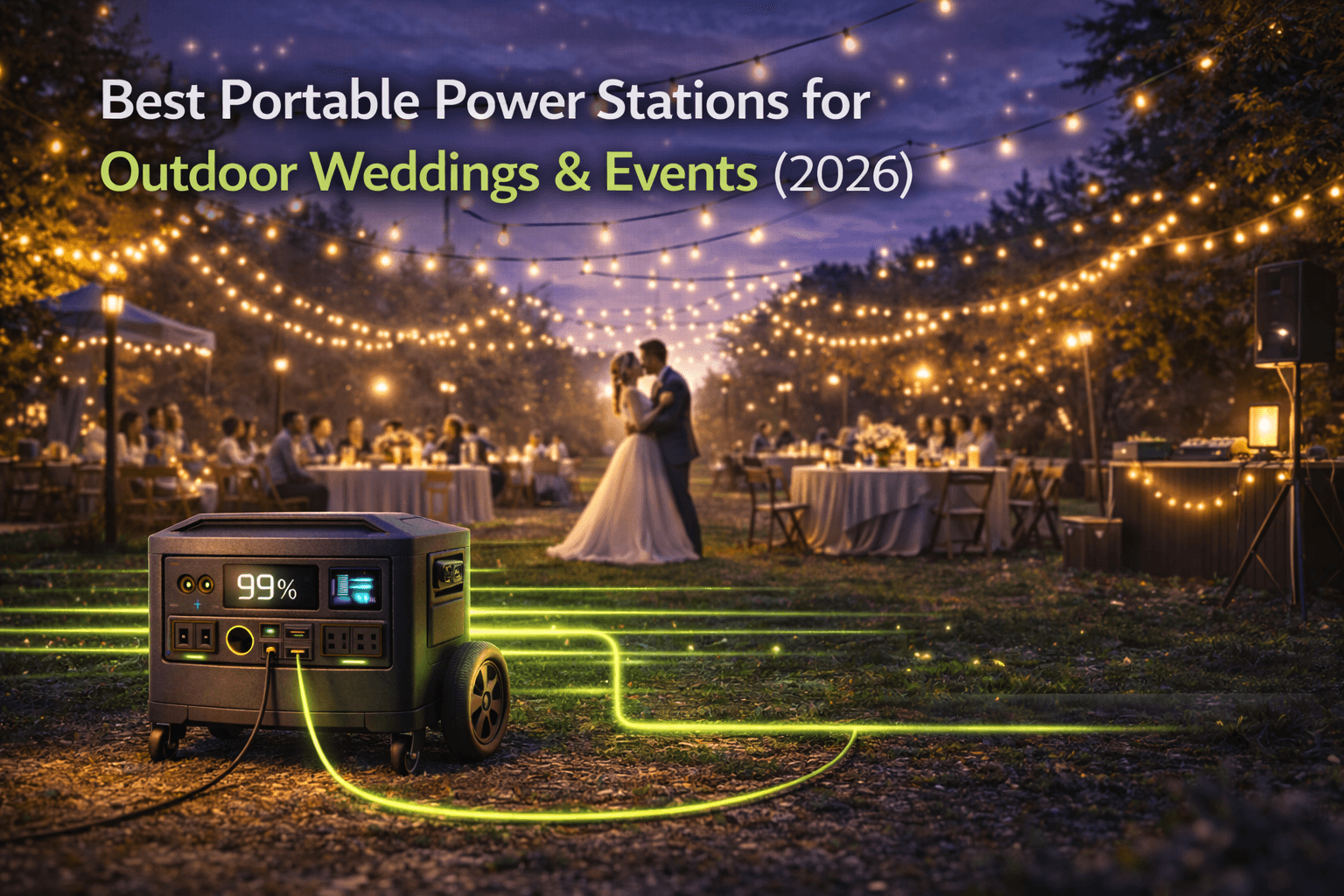
Outdoor weddings demand absolute reliability. When the microphone cuts out during vows or the music dies mid-first dance, guests remember that failure—not the centerpieces. Unlike camping where power is a convenience, event power must be invisible and flawless: silent enough to hide behind décor, powerful enough to run professional sound and lighting for 6-8 hours straight, and robust enough to never fail at the worst moment.
Traditional solutions have significant drawbacks. Shore power limits layouts to wherever outlets happen to be, creating trip hazards and visual clutter. Gas generators solve capacity issues but introduce noise during vows, exhaust fumes near guests, and outright bans at many upscale venues. Modern portable power stations change this equation entirely—silent, fume-free electricity with enough output for professional-grade production while remaining compact enough to hide behind drape, floral installations, or stage risers.
The stakes are high. A mis-sized system that fails mid-event can derail once-in-a-lifetime moments, damage professional reputations, and create real financial liability. This guide covers realistic power requirements by equipment category, capacity sizing by event scale, and specific product recommendations built for professional event use.
Note: This guide contains affiliate links. If you purchase through our links, we may earn a commission at no extra cost to you. This helps support our testing and content creation.
Understanding Event Power Requirements
Event power combines multiple equipment categories running simultaneously for several continuous hours. Total energy consumption in watt-hours (Wh) matters more than peak wattage—a DJ system rated at 800W that runs for 5 hours needs 4,000Wh of usable capacity, not just an inverter that handles 800W.
Sound Systems: The Non-Negotiable Load
Professional audio is typically the most critical electrical load. Poor or interrupted sound during vows, toasts, or the first dance is immediately noticeable to every guest.
DJ System (Standard Wedding Reception)
A typical professional DJ rig for 50-150 guests includes powered speakers, mixer/controller, laptop, wireless microphone system, and sometimes a lighting controller.
| Component | Peak Rating | Average Draw |
|---|---|---|
| Powered PA speakers (pair) | 400-800W | 200-400W |
| DJ mixer/controller | 50W | 30-50W |
| Laptop | 100W | 60-80W |
| Wireless mic receivers | 30W | 20-30W |
| Lighting controller | 50W | 30-50W |
| Total system | ~1,000W peak | 340-610W continuous |
Real-world testing at a 120-guest wedding: a professional DJ using dual 15-inch powered speakers, controller, laptop, and wireless microphones averaged 420W over 4.5 hours, consuming roughly 1,890Wh. Peak draw during dance-floor moments briefly hit 680W but settled much lower during dinner and quieter segments.
Ceremony Audio
Ceremony sound runs lighter but is equally critical. A portable PA for the officiant, background music, and processional typically draws 100-200W for 30-60 minutes—roughly 50-200Wh total. Many planners dedicate a separate, smaller unit to ceremony sound, isolating vows from any reception-side issues.
Lighting: Atmosphere After Sunset
Modern LED fixtures are dramatically more efficient than old incandescent strings, but across 200-500 feet of string lights plus accent lighting, total draw adds up.
String and Decorative Lighting
| Setup | Draw | 5-Hour Runtime |
|---|---|---|
| 200 ft LED strings (8 strands @ 10W) | 80W | 400Wh |
| 300 ft LED strings (12 strands @ 10W) | 120W | 600Wh |
| 500 ft LED strings (20 strands @ 10W) | 200W | 1,000Wh |
One wedding test: 300 feet of LED Edison strings (12 strands at 10W each) operating for 5 hours consumed about 600Wh—substantial but manageable for a medium power budget.
Uplighting and Accent Fixtures
Battery-powered wireless uplights are now common and effectively offload a major category from your power budget. If using AC-powered uplights, plan for 10-30W each across 8-16 fixtures running 5-7 hours. That’s potentially 400-3,400Wh depending on fixture count and brightness.
Photography, Videography, and Media
Media teams bring their own batteries but often rely on on-site charging. These loads run long but draw modestly.
| Equipment | Draw | 6-8 Hour Presence |
|---|---|---|
| Camera battery chargers (rotating 2-4 batteries) | 20-40W | 160-320Wh |
| LED video lights (1-2 units) | 30-60W each | 180-480Wh |
| Laptop for culling/backup | 60W | 360-480Wh |
Photography and video stations make excellent candidates for a secondary power station, keeping them isolated from primary entertainment loads.
Catering Equipment: Plan Carefully
Catering draws vary wildly. Many caterers intentionally avoid heavy electrical appliances for outdoor events, favoring propane or canned fuel. When electric equipment is necessary, factor it conservatively:
| Equipment | Draw | Notes |
|---|---|---|
| Electric warmers/chafers | 200-400W each | Continuous when active |
| Small beverage cooler | 60-100W average | Cycles on/off |
| Coffee maker/hot water urn | 800-1,500W | Avoid on battery power |
| Cocktail blender | 300-500W | Intermittent spikes |
Recommendation: Keep coffee makers, ovens, and induction burners off your battery system. Their sharp, high-wattage spikes drain capacity fast and risk tripping overload protection at inconvenient moments. Warmers and coolers are manageable if budgeted.
Calculating Total Event Power Budgets
Combining all categories reveals how quickly energy needs accumulate.
Intimate Ceremony (Under 50 Guests)
| Category | Consumption |
|---|---|
| Ceremony sound system | 100Wh |
| String lighting (200 ft, 4 hours) | 320Wh |
| Photography charging | 150Wh |
| Total | ~570Wh |
Recommended capacity: 1,000-1,500Wh provides a healthy 75-160% buffer.
Standard Wedding (50-150 Guests)
| Category | Consumption |
|---|---|
| Ceremony sound | 100Wh |
| DJ reception system (4.5 hours) | 1,890Wh |
| String lighting (300 ft, 5 hours) | 600Wh |
| Battery-powered uplights | 0Wh (self-contained) |
| Photography/video | 400Wh |
| Catering warmers (2 units, 2 hours) | 800Wh |
| Total | ~3,790Wh |
Recommended capacity: 4,500-5,500Wh across primary and backup units, providing 20-45% margin.
Large Elaborate Event (150+ Guests)
| Category | Consumption |
|---|---|
| Ceremony sound (larger system) | 200Wh |
| Reception DJ system (6 hours, larger rig) | 2,520Wh |
| String lighting (500 ft, 6 hours) | 1,200Wh |
| AC-powered uplighting (16 units, 6 hours) | 1,920Wh |
| Multiple photographer stations | 600Wh |
| Photo booth equipment (4 hours) | 300Wh |
| Catering equipment | 1,200Wh |
| Contingency devices | 500Wh |
| Total | ~8,440Wh |
Recommended capacity: 10,000-12,000Wh with structured redundancy across multiple units.
The most common planning error is treating sound and lighting as small loads because individual watt ratings seem modest—while forgetting they run together, at near-continuous duty, for many hours.
Capacity Sizing by Event Scale
Intimate Ceremonies and Micro-Weddings (Under 50 Guests)
These events feature minimal vendor teams, shorter timelines, and simple setups. Music may be acoustic or lightly amplified, lighting relies on natural sunset and candles, and photography needs are modest.
Typical setup:
- Portable PA for ceremony (sometimes shared with reception)
- Small speaker system or compact DJ
- Modest string lighting
- Photographer charging station
Total consumption typically falls in the 500-1,000Wh range. A single 1,000-1,500Wh unit covers everything with 50-100% safety margin when heavy cooking appliances are avoided.
Field example: A 35-guest micro-wedding with portable PA, small DJ system, 150 feet of string lights, and photographer charging combined for ~820Wh over ceremony and four-hour reception. A 1,264Wh-class unit started at 100% and finished near 35%—comfortable margin without a dedicated backup.
Standard Weddings (50-150 Guests)
Standard weddings introduce professional vendors, larger audio systems, and substantial lighting. The event day spans ceremony, cocktail hour, dinner, and dancing over 6-8 hours with brief transitions. Redundancy becomes essential rather than optional.
Recommended approach: 4,000-6,000Wh of total capacity, split between at least two units. A primary unit in the 2,000-3,000Wh class handles DJ and primary lighting, while a secondary 1,000-2,000Wh system covers photography, warmers, and contingency loads.
Field example: A 120-guest wedding with professional DJ, 300 feet of string lights, photographer, and two electric warmers consumed ~2,510Wh from a 2,042Wh primary unit plus expansion, and ~630Wh from a secondary unit powering photography and warmers. The primary ended the night close to empty while the backup maintained reserve—underscoring why you should size with margin rather than right at calculated totals.
Large Elaborate Events (150+ Guests)
Large events add multi-zone sound, extensive lighting designs, multiple media teams, and specialty experiences like photo booths or branded activations. At this level, power planning resembles commercial production.
Recommended approach: 8,000-12,000Wh divided across several large units or expandable systems. Dedicated circuits separate critical loads (ceremony audio, essential safety lighting) from non-critical or decorative loads.
At the highest tiers, combining clean, well-silenced generators with power conditioning and battery buffering may be more appropriate than relying solely on portable stations. The principles of redundancy, dedicated circuits, and real-time monitoring remain the same.
Best Portable Power Stations for Events
Jackery Explorer 2000 Plus – Best Event Flexibility
Starting at $1,999
The Jackery Explorer 2000 Plus delivers outstanding flexibility because of its modular design and professional-grade battery chemistry. The 2,042Wh base unit handles intimate to small standard weddings, while expansion batteries scale capacity up to 12kWh for larger productions.
Key Specifications:
| Spec | Value |
|---|---|
| Capacity | 2,042Wh base (expandable to 12kWh) |
| Inverter output | 3,000W continuous, 6,000W surge |
| Battery chemistry | LiFePO4 (4,000 cycles to 70%) |
| AC outlets | 5 |
| USB ports | 4 (2× USB-A, 2× USB-C 100W) |
| Noise level | ~30dB (library-quiet) |
| Weight | 61.5 lbs |
| Pass-through charging | Supported |
| Warranty | 5 years |
Expansion configurations:
- Base unit: 2,042Wh (intimate events)
- Base + 1 expansion: ~4,085Wh (standard weddings)
- Base + 2 expansions: ~6,127Wh (large receptions)
- Maximum: ~12,254Wh (multi-zone productions)
Jackery’s 4,000-cycle LiFePO4 battery allows event professionals to amortize cost over many seasons. A planner or rental house running 20-30 outdoor weddings per year can expect well over a decade of useful life before significant capacity degradation.
Why it works for events: Running multiple 2000 Plus units on separate circuits distributes risk. One station handles DJ power, another handles lighting, and a third supports photography and catering. If one unit has an issue, critical functions can be rerouted to remaining stations—avoiding total outage.
Considerations: The base unit alone is tight for larger standard weddings. At 61.5 lbs, plan for two-person carries or wheeled transport. Multiple units increase setup complexity.
Check Price on Jackery
Also on Amazon
Check Expansion Battery Price on Amazon
EcoFlow Delta Pro – Best Premium Event Power
~$3,299
The EcoFlow Delta Pro targets premium, high-demand productions requiring maximum single-unit capacity and sophisticated monitoring. With 3,600Wh of storage and a 3,600W inverter, it shoulders an entire standard wedding reception or serves as the backbone of a larger system.
Key Specifications:
| Spec | Value |
|---|---|
| Capacity | 3,600Wh (expandable to 25kWh) |
| Inverter output | 3,600W (4,500W with X-Boost) |
| Battery chemistry | LiFePO4 (6,500 cycles to 50%) |
| AC outlets | 5 |
| USB ports | 4× USB-A, 2× USB-C |
| AC recharge time | ~1.8-2.7 hours |
| App control | Full monitoring via EcoFlow app |
| Weight | 99 lbs |
| Warranty | 5 years |
The rapid charging capability proves critical when a unit is discovered partially discharged on event morning. Plugged into a standard outlet, it reaches usable levels within an hour and full charge in under two—the difference between crisis and non-issue.
The EcoFlow app provides granular, real-time visibility into power draw and projected runtime. During receptions, power managers can monitor how music volume or lighting intensity changes affect remaining capacity, then make informed decisions about non-essential loads.
Why it works for events: Large single-unit capacity for simpler setups. Ultra-fast charging for tight timelines. Advanced monitoring for active power management. Strong expandability for venues diversifying into backup services.
Considerations: At 99 lbs, logistics require carts, ramps, and planning. High upfront cost suits professional operators more than one-time personal use. Single-unit design concentrates risk compared to distributed systems.
Dual EcoFlow Delta 2 System – Best Standard Wedding Value
~$1,998 for two units
A dual EcoFlow Delta 2 configuration—two units at roughly $999 each—strikes an excellent balance between capacity, redundancy, and manageability for typical 75-125 guest weddings.
Dual System Specifications:
| Spec | Per Unit | Combined |
|---|---|---|
| Capacity | 1,024Wh | 2,048Wh |
| Inverter output | 1,800W | 3,600W (across 2 circuits) |
| Battery chemistry | LiFePO4 | — |
| Cycle life | 3,000 cycles to 80% | — |
| Weight | 27 lbs | 54 lbs total |
| Warranty | 5 years | — |
Why it works for events: Built-in redundancy by design. If one unit fails or depletes, the other continues running critical functions. At 27 lbs each, one person easily carries and repositions units mid-event. Natural load separation keeps critical audio on one unit and non-critical elements on another.
Typical load distribution:
- Unit 1 (Critical): DJ system, essential lighting
- Unit 2 (Secondary): String lights, photo booth, photography charging, catering warmers
If the secondary unit runs low, music and speeches continue while you adjust non-essential elements.
Considerations: Combined 2,048Wh is insufficient for power-dense standard weddings drawing 3,500-4,000Wh without supplemental systems. Best suited for lean setups with efficient LED lighting, battery uplights, and careful catering equipment choices.
Event Planning and Vendor Coordination
Even the best hardware fails if vendors aren’t aligned on its use. Treat power the same way you would a detailed floorplan or timeline: as a shared document that every stakeholder understands.
Pre-Event Equipment Audit (2-4 Weeks Out)
- Contact all vendors (DJ, photographer, caterer, lighting) and request specific equipment lists with wattage or amperage ratings
- Calculate total expected consumption and add at least 30% safety margin
- Verify your planned power stations can handle both total wattage and runtime
- Flag high-draw equipment (coffee makers, ovens, induction burners) and explore propane or alternate solutions
- Draft a backup plan outlining priorities if the primary power source fails mid-event
Vendor Power Coordination (1-2 Weeks Out)
Schedule a brief call or meeting with all power-dependent vendors. Walk through:
- Which portable power station feeds each vendor
- Where outlets will be located
- How cables will be routed
- Who has authority to approve additional loads or deny last-minute plug-ins
Designate a power manager—often the planner or production lead—who can say “no” to unexpected requests that threaten capacity.
Setup Day Protocol
- Charge verification: Confirm all units show 100% charge on arrival
- Full-load test: Connect all planned equipment and observe actual watt draw using built-in meters or companion apps
- Positioning: Place units where they’re accessible for monitoring but visually hidden and weather-protected
- Cable management: Secure and tape down all cabling to prevent trips and maintain aesthetics
- Assign monitor: One team member checks battery levels at least hourly during active periods
During-Event Monitoring
- Check state of charge on each unit hourly
- Be ready to reduce or switch off non-critical loads (photo booth, extra decorative lighting) if capacity trends lower than expected
- Keep at least one backup unit fully charged for rapid swap if a primary depletes unexpectedly
- Maintain clear physical access to each unit—don’t bury them under drape or décor
Post-Event Evaluation
- Record starting and ending charge levels for each unit
- Compare actual runtime and draw to pre-event estimates
- Note any equipment that exceeded stated ratings or behaved unexpectedly
- Update internal power-planning guidelines with lessons learned
Frequently Asked Questions
How much power do I actually need for an outdoor wedding?
Quick sizing guide:
| Event Size | Guest Count | Typical Consumption | Recommended Capacity |
|---|---|---|---|
| Intimate | Under 50 | 500-1,000Wh | 1,000-1,500Wh |
| Standard | 50-150 | 3,000-4,500Wh | 4,500-6,000Wh |
| Large | 150+ | 6,000-10,000Wh | 8,000-12,000Wh |
These numbers refer to total energy over the event, not just instantaneous wattage. The most common mistake is calculating based only on peak wattage or a single hour of operation, forgetting that DJ and lighting rigs run nearly continuously for many hours.
What equipment should never go on a portable power station at an event?
High-draw, heat-generating appliances: coffee makers, large hot water urns, convection ovens, and induction burners. These spike to 1,000-2,000W or more and cycle repeatedly, draining even large batteries quickly. Keep them on propane, dedicated generators, or venue shore power.
Focus your portable power stations on AV and lighting—the elements guests actually notice most.
Do I really need redundancy for a small backyard wedding?
Yes. Redundancy is strongly recommended any time power loss would be unacceptable, regardless of venue size. Even a 40-person backyard wedding can be devastated if the only power station shuts down during vows or the first dance.
For lean budgets, pair one robust primary unit with a smaller, lower-cost backup devoted to microphones and essential music. This ensures emotional highlights stay protected even if non-critical systems must shut down late in the evening.
Can I run my event entirely on solar charging?
Not reliably. Solar charging depends on weather, sun angle, and panel positioning—none of which you can control on event day. Use solar panels to top off batteries during setup or as a supplemental charge between events, but never count on real-time solar input during the event itself.
How do I hide power stations at an elegant venue?
Strategic placement options:
- Behind DJ booth or band riser
- Inside decorative wooden crates or fabric-wrapped boxes
- Behind bar structures or catering stations
- Tucked behind floral installations or large planters
- Under skirted tables with cable management through grommets
The key is maintaining access for monitoring while keeping units visually invisible and protected from weather.
Conclusion
Portable power stations have opened up venue options that were once dismissed as impractical due to limited electrical infrastructure. Silent operation, clean power, and flexible placement enable professional-grade production in open fields, forest clearings, private estates, rooftops, and beachfronts—without generator noise and fumes.
For most planners and vendors, the Jackery Explorer 2000 Plus offers the most flexible foundation, scaling from intimate ceremonies to large productions as your event business grows. The EcoFlow Delta Pro serves premium productions favoring a single high-capacity powerhouse with sophisticated monitoring. Dual EcoFlow Delta 2 units provide a practical standard-wedding solution where redundancy, portability, and cost control all matter.
The underlying principles remain consistent: start with accurate load estimates, add generous margins, build in redundancy, and coordinate closely with every vendor who will plug into the system.
When the lights stay warm, the microphones stay clear, and the music never stops, guests remember the joy of the night—not the power infrastructure that quietly made it possible.
Related Guides:
- Best Portable Power Stations for Camping – Foundation for outdoor entertainment power
- How to Choose a Portable Power Station – Complete buying fundamentals
- Portable Power Station Capacity Guide – 500Wh vs 1000Wh vs 2000Wh sizing
- Best Portable Power Stations for Food Trucks – Professional mobile hospitality power
- Best Portable Power Stations for Tailgating – Outdoor event entertainment