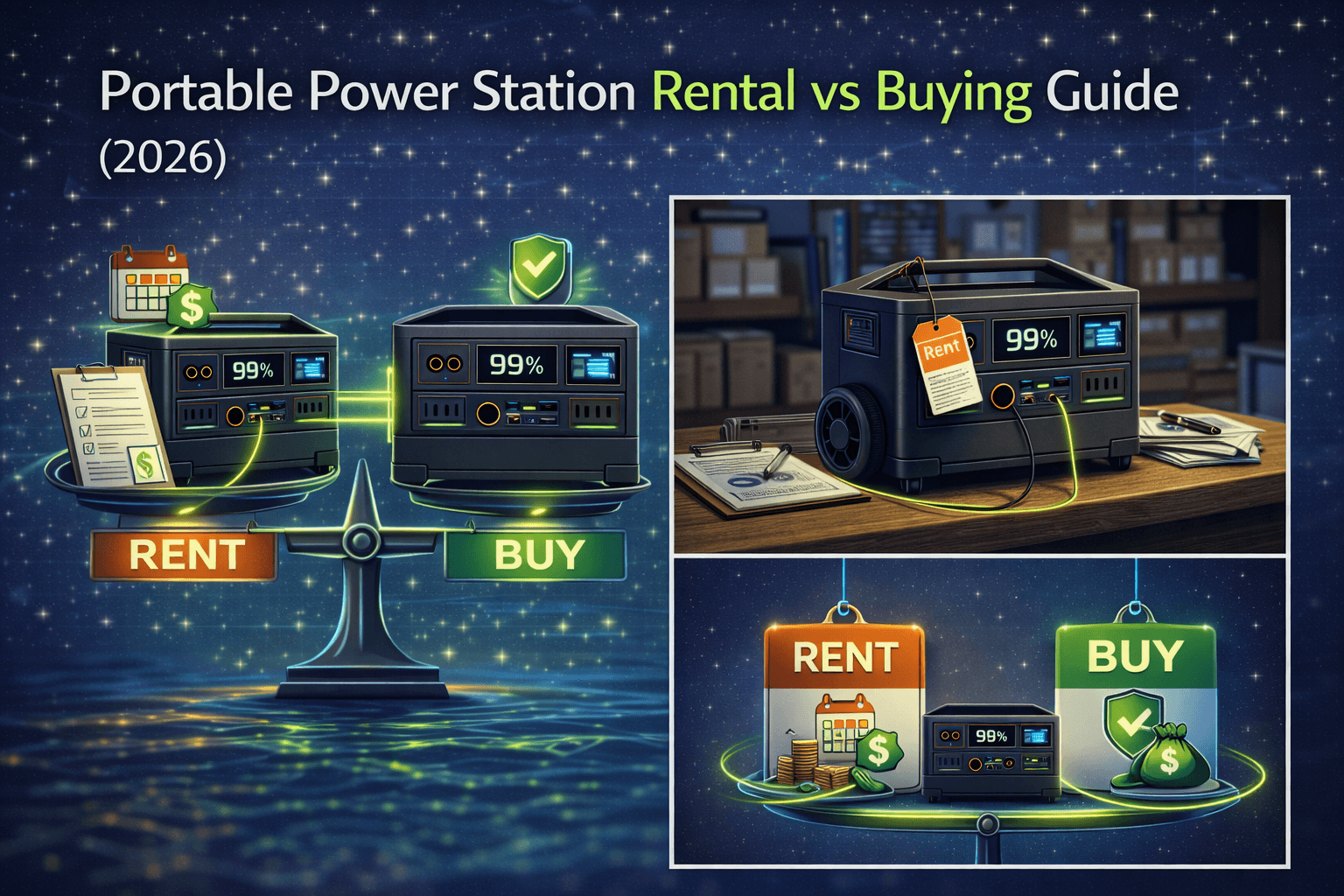
The rent-or-buy question comes down to one number: how many times per year will you actually use a portable power station? Not how often you plan to use it — how often you realistically will.
That single variable determines whether a $500–$2,000 purchase is a smart investment or an expensive paperweight. And whether paying $40–$150 per day for a rental is efficient budgeting or slow financial bleeding.
This guide runs the math both ways so you can decide with numbers, not gut feelings.
What Renting a Portable Power Station Actually Costs
The rental market for portable power stations is still immature compared to gas generators. Home Depot and major tool rental chains mostly stock traditional generators — not lithium battery stations. Your realistic rental options break down into three channels, each with different pricing:
Peer-to-peer platforms (FriendWithA, Hygglo, local gear marketplaces) offer the lowest rates. Owners list their personal units, you pick up and return. Expect $25–$40/day for 500–1,000Wh units and $40–$70/day for 1,000–1,500Wh models. Availability varies wildly by city — great in metros, sparse everywhere else.
AV/photo rental houses stock portable stations for film and event production. Day rates run $30–$60 for smaller packs, $60–$100 for mid-range units. Weekend rates often bundle Friday through Monday as a single rental period.
Full-service event rental companies handle delivery, setup, support, and pickup. This convenience costs significantly more: $75–$200/day depending on capacity, with three-day weekend minimums standard. A 1,500Wh unit for a Saturday outdoor wedding typically runs $270–$480 all-in once you add the damage waiver ($15–$30/day) and delivery fees ($50–$150 each way).
Here’s a real-world example that illustrates the spread:
A 1,500Wh station for a three-day weekend event:
- Full-service rental: ~$480 (base rate + damage waiver + delivery/pickup)
- Peer-to-peer with self-pickup: ~$225 (daily rate + platform insurance)
- Buying outright: ~$800–$1,200 one-time
The full-service option costs nearly half the purchase price for a single weekend. Peer-to-peer is more reasonable, but still adds up fast over multiple events.
Other hidden rental costs to budget for: refundable deposits ($200–$500 on larger units), platform insurance fees, and the time cost of reserving, picking up, and returning equipment. None of these are deal-breakers for occasional use, but they compound when you start renting regularly.
Bottom line: expect $150–$500 per event depending on capacity, service level, and duration. For a couple of events per year, that’s reasonable. Beyond that, the math starts tilting toward ownership.
What Owning a Portable Power Station Actually Costs
The purchase price is the obvious number. Current market ranges:
- 500–800Wh (compact): $300–$600
- 1,000–1,500Wh (mid-range): $700–$1,200
- 2,000–2,500Wh (heavy-duty): $1,400–$2,200
- 3,000Wh+ (flagship): $2,400–$3,500
But purchase price alone overstates ownership cost per use and understates the total economic cost. Two factors most people overlook:
Depreciation. Portable power stations lose value like any electronics. A $1,500 unit might resell for $900–$1,000 after one year, $750–$850 after two, and $600–$750 after three. That’s $750–$900 in value erosion over three years regardless of how much (or little) you use it. New model releases accelerate this — last year’s flagship becomes this year’s mid-tier.
Opportunity cost. That $1,500 sitting in a closet instead of an index fund means roughly $75/year in foregone returns at a conservative 5% rate. Over a decade, that compounds to about $900–$950. This matters more for expensive units and long ownership periods. For a $500 station, it’s negligible.
Maintenance is minimal but not zero. LiFePO4 batteries need occasional exercise — keep them between 20–80% charge during long storage, avoid extreme temperatures, and run a full cycle every few months. The maintenance guide covers best practices. Battery replacement (relevant only after 3,000+ cycles, so 10+ years for most users) runs $400–$900 depending on capacity. Most owners upgrade to newer technology long before reaching that point.
Insurance varies by situation. Your homeowner’s or renter’s policy may already cover portable electronics — check your policy. Professionals transporting expensive equipment regularly should consider dedicated coverage ($50–$150/year).
Here’s what the full picture looks like for a $1,500 mid-range station over 10 years:
| Cost Component | Approximate Total |
|---|---|
| Purchase price | $1,500 |
| Foregone investment returns | ~$900 |
| Maintenance, accessories, storage | ~$300 |
| Total economic cost | ~$2,700 |
At 20 uses per year, that’s roughly $13.50 per use over a decade — far cheaper than any rental. At 5 uses per year, it’s $54 per use — competitive with peer-to-peer rental but still cheaper than full-service. At 2 uses per year, it’s $135 per use — rental wins convincingly.
The Break-Even Calculation
The math is simple: divide purchase price by rental cost per use. That gives you the number of rental days it takes to equal the purchase price.
| Scenario | Purchase Price | Rental/Day | Break-Even |
|---|---|---|---|
| Budget unit, peer rental | $500 | $35/day | ~14 days |
| Mid-range, peer rental | $1,000 | $50/day | ~20 days |
| Mid-range, full-service | $1,000 | $90/day | ~11 days |
| Premium, peer rental | $2,000 | $70/day | ~29 days |
| Premium, full-service | $2,000 | $120/day | ~17 days |
Then map those break-even numbers against your realistic usage:
1–5 uses per year: Renting almost always wins. Even at the fastest break-even (11 days with full-service rental), you’re looking at 2+ years before ownership pays off — and technology will have evolved significantly by then. Renting also gives you flexibility to try different capacities through our capacity guide recommendations before committing.
6–12 uses per year: Gray zone. Ownership breaks even within 1–3 years depending on price tier and rental channel. If your usage pattern is stable and you’ve done this for at least one season, buying makes sense. If you’re in your first year of a new hobby, rent for one season first.
15+ uses per year: Buy. No question. You’ll break even within the first year for most price tiers, and every use after that is essentially free power. This covers regular campers, RV travelers, professional photographers, food truck operators, and anyone using power stations for work.
The optimism bias trap: Be honest with yourself. If you camped three weekends last year, don’t project twelve for next year. Base your estimate on actual past behavior. The number-one reason people regret buying is aspirational usage that never materializes. Our buying mistakes guide covers this and six other common errors in detail.
When Renting Is the Smart Move
One-off events. An outdoor wedding, a single corporate activation, a weekend film shoot. You need 1,500–3,000Wh for one event and won’t need that capacity again for months or years. Spending $200–$500 on a rental beats tying up $1,500–$3,000 in equipment you’ll use once. For wedding-specific recommendations, see our outdoor events guide.
Exploring a new hobby. You’re getting into camping or overlanding and aren’t sure what capacity you need. Renting different sizes over two or three trips teaches you more than any spec sheet. Then buy the right unit the first time instead of guessing wrong.
Testing before a business commitment. A food vendor considering portable power for pop-up markets can rent for three events to validate the concept before investing $1,000+.
Rare high-capacity needs. Your normal life requires zero portable power, but once a year you need a 3,000Wh system for a family reunion or community event. Ownership never pencils out here.
When Buying Is the Clear Winner
Regular recreational use (10+ days/year). Weekend campers, seasonal RV travelers, and fishing enthusiasts who use power consistently will recoup their purchase within the first year or two. After that, every trip is nearly free.
Professional use. Photographers, videographers, drone operators, and construction crews using portable power at 20–40+ events per year would spend more on annual rentals than the purchase price of a premium unit. A $1,200 station paying for itself in 15–20 uses is a straightforward business decision.
Home and medical backup. This is where the rent-vs-buy framework breaks down — because you can’t schedule a power outage. When you need backup for a home office, CPAP machine, or refrigerated medications, you need the power station right now, not available for pickup tomorrow morning. Ownership is insurance here, not a per-use cost calculation. The value of one avoided crisis — a missed deadline, a medical complication, spoiled food — can exceed the entire purchase price.
Off-grid living and van life. Daily use makes rental absurd. These users should focus on choosing the right capacity tier and solar panel setup rather than debating rental.
Quick Decision Checklist
Ask yourself these five questions:
- How many days per year will I realistically use a power station? (Base on past behavior, not aspirations.)
- Is this a one-time need or recurring? One-time → rent. Recurring → calculate break-even.
- Do I need guaranteed instant availability? If yes (medical, work backup) → buy.
- Am I still figuring out what capacity I need? If yes → rent a few different sizes first.
- Does rental availability even exist near me? In many suburban and rural areas, it doesn’t — which answers the question for you.
If you’ve decided to buy, our complete buying guide walks through exactly how to match capacity, output, and features to your needs. For budget-conscious buyers, our guides covering stations under $300, under $500, and under $1,000 narrow the field by price.
Frequently Asked Questions
Can I rent a portable power station from Home Depot or Lowe’s?
As of 2026, major hardware chains primarily rent gasoline generators, not lithium battery stations. Your best options are peer-to-peer platforms (FriendWithA, Hygglo), AV/photo rental houses, or specialized event rental companies. Availability is heavily city-dependent — excellent in major metros, limited to nonexistent in rural areas.
How much does it cost to rent a portable power station for a weekend?
Expect $75–$150 through peer-to-peer platforms (self-pickup, 500–1,500Wh units) or $250–$500 through full-service event companies (delivery included, larger units). Costs vary significantly by capacity, location, and service level. Always factor in deposits, insurance, and delivery fees beyond the base daily rate.
Is it worth buying a portable power station if I only camp twice a year?
Probably not, purely on cost-per-use math. Two uses per year means 10+ years to break even on even a budget unit. Renting gives you flexibility to try different capacities and skip years without penalty. The exception: if you also want home backup power, those dual-purpose uses shift the math toward buying. Check our emergency preparedness guide to see if backup needs tip the scale.
Do portable power station rentals include solar panels?
Sometimes. Peer-to-peer listings occasionally bundle panels, especially outdoor-focused listings. Full-service event rentals rarely include them unless specifically requested (and priced). If solar charging matters for your use case, confirm what’s included before booking and read our solar panel guide to understand sizing requirements.
How long do portable power stations last if I buy one?
Quality LiFePO4 units deliver 3,000–4,000 charge cycles before dropping to 80% capacity. At 50–100 full cycles per year, that’s 10–15+ years of useful life. Most owners upgrade for feature reasons (faster charging, more ports, better app control) long before the battery degrades meaningfully. See our lifespan guide for detailed longevity data by chemistry type.
Portable Power Station Rental vs Buying Guide: Ownership Economics
Introduction
Deciding whether to rent or buy a portable power station is fundamentally a question of ownership economics rather than just sticker price. The upfront cost of a quality unit—often between 500 and 3000 dollars—naturally draws attention, but it is only one part of the financial picture. Over a multi-year horizon, depreciation, maintenance, opportunity cost of tied-up capital, and how often the unit is actually used all combine to determine the real cost per use.
Rental flips this model around. Instead of a large one-time expense, you pay only when you need power, with no depreciation risk and no long-term capital commitment. Rental providers handle maintenance, basic testing, and sometimes delivery and setup. In exchange, you accept much higher per-day costs, limited availability on popular dates, and the logistical overhead of reserving, picking up, and returning equipment. For light or sporadic use, that trade can be rational; for heavy use, it becomes expensive quickly.
At the center of the decision is utilization—how many times per year you will truthfully use a portable power station. High-utilization owners amortize the purchase across many days of use, pushing the effective cost per day down into the tens of dollars or less. Low-utilization owners see the opposite effect: a pricey asset sitting idle in a closet for 360 days a year, silently depreciating while tying up capital that could have been earning elsewhere.
A portable power station rental vs buying cost comparison therefore needs to go beyond “Can I afford the purchase price?” and ask “How many days of rental would equal that purchase, including hidden costs?” Break-even math is straightforward: divide the purchase price by the typical per-use rental cost to find how many rental days equal ownership. Then, compare that threshold to realistic usage over a three-to-five-year window. Above that threshold, ownership usually wins; below it, rental often minimizes total outlay.
Complicating matters is the current state of the rental market. Unlike generators, tents, or heavy tools, portable power stations are not yet universally stocked at national rental chains. Availability is excellent in some cities, patchy in many suburbs, and nearly absent in rural areas. Peer-to-peer platforms help fill gaps but can be inconsistent in model availability and quality control. That immaturity makes rental attractive for some scenarios and essentially irrelevant for others.
The sections that follow examine real-world rental pricing, ownership costs beyond the initial purchase, break-even examples at different price points, and concrete scenarios—from weddings and weekend camping to professional shoots and home backup—where renting or buying is the more financially sound choice. The aim is to approach the decision with the rigor you would apply to any business investment, even if the primary use is recreational.
Rental Market Reality and Pricing
The current rental landscape for portable power stations is fragmented and highly local. Traditional equipment rental giants, which have long offered gasoline generators, have been slower to adopt battery-based stations. In many branches, the closest analog remains a small inverter generator, not a lithium-based unit. Where battery stations are available, selection often clusters around mid-sized models rather than the full range of capacities you might see at retail.
Urban centers fare best. Specialized event rental companies, photography and video rental houses, and peer-to-peer platforms collectively provide a reasonable mix of capacities in major metros. Corporate events, outdoor weddings, film shoots, and trade shows are driving this early adoption. In contrast, suburban and rural users may find that no nearby providers stock portable stations at all, or that they only appear in niche peer listings.
Peer-to-peer platforms have become a notable source for renters. Owners of popular models list them at daily or weekly rates, often bundling cables and sometimes solar panels. Prices tend to respond to local demand: in cities with many similar listings, daily rates can be competitive; in areas with only one or two options, rates are higher. Insurance is typically available through the platform, which adds cost but also reduces risk for both sides.
Event rental houses occupy the other end of the spectrum. They often focus on higher-capacity units fit for DJ rigs, lighting, PA systems, or multiple vendor tents. Their value proposition includes delivery, setup, on-site support, and pickup—services critical for clients who cannot afford power failures on important days. These conveniences are priced in, making their per-day rates higher than peer-to-peer alternatives.
Typical rental ranges by capacity and channel (illustrative):
- 500–800Wh units: ~20–40 USD/day via peer listings; ~30–50 USD/day via tool rental counters
- 1000–1500Wh units: ~40–70 USD/day peer-to-peer; ~60–90 USD/day tool rental; ~75–120 USD/day with full-service event companies
- 2000–3000Wh units: ~70–120 USD/day peer-to-peer; ~100–150 USD/day tool rental; ~120–200 USD/day full-service events
Minimum rental periods also affect economics. Event companies commonly apply a three-day minimum over weekends—Friday delivery, Sunday event, Monday pickup—even if the equipment is only used for a few hours. Photography houses may charge one-day rates but structure weekends as a single rental from Friday to Monday. Tool counters sometimes offer four-hour rates, but portable stations, when stocked, usually follow full-day billing.
Layered on top of base rates are deposits, insurance, and potential delivery charges. A refundable deposit of 200–500 dollars is common, particularly on higher-capacity models. Insurance or damage waivers may add 10–30 dollars per day. Delivered setups often incur 50–150 dollars each way, depending on distance and equipment size. These additions can meaningfully increase the effective cost per event, particularly for smaller users.
Example: three-day weekend event rental (≈1500Wh, full-service):
- Base rental: ~90 USD/day × 3 days ≈ 270 USD
- Damage waiver: ~20 USD/day × 3 days ≈ 60 USD
- Delivery and pickup: ~75 USD each way ≈ 150 USD
- Total non-refundable: ~480 USD (excluding refundable deposit)
A similar capacity via peer-to-peer, with self pick-up and return, might instead cost around 60 USD/day for three days plus modest platform insurance, totaling roughly 225 USD. The spread between these options illustrates how service level and convenience factor heavily into rental economics, beyond watt-hours alone.
Overall, renters should expect real-world costs of roughly 150–500 dollars per event, depending on duration, capacity, and service. That can be entirely rational a few times a year; scaled to dozens of uses annually, it quickly eclipses purchase cost.
Purchase Economics and Total Cost of Ownership
Buying a portable power station replaces recurring rental payments with a single capital expenditure—but that does not make ownership cost-free over time. A proper portable power station rental vs buying cost comparison must account for depreciation, opportunity cost, maintenance, accessories, and, in some cases, insurance.
On purchase price alone, current market bands look roughly like this: compact 500–800Wh units often run 300–600 dollars, 1000–1500Wh mid-tier models 700–1200 dollars, 2000–2500Wh units 1400–2200 dollars, and 3000–3600Wh flagships 2400–3500 dollars. These ranges shift with promotions and new releases, but they outline the capital required to own different tiers.
Depreciation is the first hidden cost. Like most electronics, portable power stations lose a significant fraction of their resale value in the first few years. A 1500-dollar unit may realistically sell for 900–1000 dollars after one year, 750–850 dollars after two, and 600–750 dollars after three, depending on condition and market evolution. Over three years, that implies an economic loss of roughly 750–900 dollars even if you never rent the device out or damage it.
Opportunity cost is the second factor. The same 1500 dollars, left in a diversified index fund at a modest 5% annual return, could generate about 75 dollars in the first year, growing to nearly 120 dollars in yearly returns by year ten. Over a decade, compounding yields close to 900–1000 dollars of foregone gains. From a purely financial perspective, the true economic cost of ownership is therefore purchase price plus the income your capital could have earned elsewhere.
Illustrative 10-year ownership cost for a 1500 USD station:
- Purchase price: 1500 USD
- Foregone investment returns (5% annual, approximate): ≈900–950 USD
- Minor maintenance, accessories, and time value: ≈300 USD over a decade
- Total economic cost: ≈2700–2800 USD (before any battery replacement)
Battery replacement is a longer-horizon concern. Quality LiFePO4-based units can often deliver 3000–4000 cycles before dropping to 80% of original capacity, which, at 50–100 full cycles per year, translates to well over a decade. Many casual owners will sell or upgrade for other reasons before reaching that point; heavier users may eventually face replacement battery costs in the 400–900 dollar range depending on capacity.
Storage and minimal maintenance—keeping the unit at healthy states of charge, avoiding extreme temperatures, and periodically exercising the battery—carry small but non-zero costs in time and attention. Accessories such as extension cords, protective cases, or optional solar panels add further to the capital base but can pay off in usability.
Insurance is situational. Some homeowners’ or renters’ policies cover portable equipment against theft or damage, while others exclude it or carry deductibles high enough to make claims impractical. Dedicated equipment policies for mobile professionals may run 50–150 dollars per year. For high-value units frequently transported to events, that insurance can be worthwhile; for mostly homebound units, the homeowner’s policy plus prudent storage is often sufficient.
Taken together, these factors suggest that a realistic per-year cost for a mid-range, 1500-dollar station might hover around 300–400 dollars over a decade of ownership. If you use it 20 times per year, that yields an effective cost of roughly 15–20 dollars per use, not counting any residual resale value at the end. That figure provides a benchmark to compare against rental rates.
Break-Even Analysis and Decision Framework
Break-even analysis translates qualitative impressions into simple, comparative numbers. At its core, it asks: at what number of uses do total rental payments equal the economic cost of owning a unit? For first-pass analysis, you can ignore secondary ownership costs and focus on purchase price versus rental day rate, then refine if needed.
The most basic calculation divides purchase price by rental cost per use. If a 1000-dollar station would cost 50 dollars per day to rent, the break-even point is roughly 20 days of use. Below that number, renting is likely cheaper; above it, ownership tends to win. This assumes that ownership’s ongoing costs—maintenance, opportunity cost, insurance—are modest relative to the purchase and rental amounts in the early years.
Simple break-even examples (ignoring secondary costs):
- 1000 USD unit vs 50 USD/day rental: break-even ≈ 20 rental days
- 2000 USD unit vs 75 USD/day rental: break-even ≈ 27 rental days
- 500 USD unit vs 40 USD/day rental: break-even ≈ 13 rental days
To make this meaningful, you then estimate realistic annual usage. A camper going out one weekend per month might use a station 6–12 days per season, depending on trip length. A photographer shooting 40 events per year might deploy power at 30–40 of them. A home office backup used only during outages in a reliable grid region might see three days per year of actual draw.
Over a multi-year horizon, the picture becomes clearer. In the 2000-dollar versus 75-dollar/day case, a user deploying the station ten times per year would hit 30 uses in three years—slightly above the 27-day break-even. In contrast, at five uses per year, it would take more than five years to cross that threshold. If, after that period, technology or personal needs have changed enough to warrant an upgrade, the economic advantage of buying narrows.
Usage pattern sanity checks:
- 1–5 uses/year: often better to rent, especially if needs may change
- 10–15 uses/year: borderline—evaluate expected duration of use (years)
- 20+ uses/year: ownership usually more economical within a few years
It is crucial to guard against optimism bias. Many people buy gear assuming aspirational usage—“We’ll definitely camp every month”—only to discover work, weather, and other obligations cut that in half. A conservative approach bases projections on past behavior, not hopes. If you only managed three trips last year, planning for twelve going forward should be treated as uncertain.
A practical decision framework looks like this: calculate a simple break-even in uses; estimate your likely uses per year based on history; consider how many years you expect to stay in the relevant lifestyle or business; and then weigh non-financial factors such as convenience, availability, and peace of mind. Use that to classify your situation into “clearly rent,” “clearly buy,” or a gray area where either can be justified depending on preferences.
Use Case Scenarios: Rent vs Buy
Scenarios illustrate how the same portable power station rental vs buying cost comparison logic plays out under different conditions. For one-off or rare events, renting nearly always dominates. A couple needing a 1500Wh station for an outdoor wedding, for instance, is unlikely to use that capacity again soon. Spending 200–300 dollars to rent for the weekend—even with delivery—is far more rational than buying a 1500–2000 dollar unit that will gather dust afterward.
For occasional recreational users—say, families camping four to six weekends per year—the economics are closer. Renting a mid-range station at 50 dollars per trip might cost 200–300 dollars per season. A 1000-dollar purchase would equal four to five seasons of rental at that rate. If camping is a new hobby, renting for one or two seasons provides flexibility if interest wanes. If it becomes a long-term staple, crossing into ownership later can still deliver long-run savings.
Professionals with recurring power needs almost always favor buying. A photographer shooting 40 events per year who pays 60 dollars per event in rental fees would lay out 2400 dollars annually—more than the cost of owning a premium mid-range station. In that context, a 1200–1500 dollar purchase pays for itself within the first year, after which per-event power costs drop to a fraction of rental rates.
Home and medical backup present a different dynamic. Outages are inherently unpredictable, and rentals require advance scheduling and physical pickup or delivery. For teleworkers protecting their income or patients relying on powered medical devices, the value is not per-use savings but assured availability. Even if a station is used only a few times a year, the alternative cost of a single missed critical deadline or a medical emergency can overwhelm rental-versus-buy arithmetic. In such cases, ownership behaves more like insurance than like a discretionary asset.
In each of these scenarios, the key is not just counting uses, but also considering timing, stakes, and logistics. Renting is about aligning cash outlay with occasional needs; buying is about reducing marginal cost and ensuring control over a key piece of infrastructure.
Frequently Asked Questions
When does renting make more financial sense than buying?
Renting tends to make more sense when usage is low, uncertain, or tied to one-time events. If you anticipate using a portable power station only a handful of days per year, and especially if your needs may change in capacity or features, paying 40–100 dollars on the few occasions you need power will usually total far less than owning an 800–2000 dollar unit. This is particularly true over a three-to-five-year window, where many consumer electronics see significant value erosion.
Renting is also attractive while you are still learning what you actually need. Early in a camping or production hobby, you may not know whether 800Wh is sufficient or if 1500Wh is necessary. Trying different capacities via rentals provides real-world data without committing capital prematurely. Similarly, businesses piloting new services or events can rent first, confirm demand and operational patterns, then buy once the model is proven.
One-time or rare high-capacity needs stand out as strong rental candidates. If you normally require no portable power but have a single large event where you need a 3000Wh system, ownership almost never pencils out. Paying a few hundred dollars once and then walking away is better than tying up thousands in gear that will be functionally obsolete before its second major outing.
When is buying clearly the better choice?
Buying is clearly advantageous when regular use will quickly exceed break-even, or when reliability and immediate availability are mission-critical. Frequent campers, full-season RV travelers, professional photographers and videographers, mobile food and retail operators, and off-grid homeowners typically fall into this category. Their annual usage often reaches dozens of days, making per-day ownership costs far lower than ongoing rental.
In addition, certain applications treat backup power as non-negotiable infrastructure. Home offices that must remain online during outages, medical setups relying on powered devices, and businesses where a lost event would cost thousands in revenue cannot depend on same-day or next-day rentals. In these cases, the peace of mind and control that come with ownership justify the investment beyond pure cost-per-use math.
Conclusion
Choosing between renting and buying a portable power station is a financial decision that rewards careful, numbers-based thinking. Looking past upfront prices to consider depreciation, opportunity cost, and realistic utilization clarifies when ownership is a smart investment and when it is an expensive indulgence. Framing the choice as a portable power station rental vs buying cost comparison encourages a disciplined approach that parallels other capital decisions in business and personal finance.
For infrequent, low-stakes use, or during the exploratory phase of a new hobby, renting often keeps total expenditure modest and flexible. For frequent, professional, or mission-critical use, owning the right-sized station can dramatically lower per-day costs while ensuring availability when it matters most. The key is to calculate your break-even, be honest about how often you will actually use the equipment, and remember that in emergencies and professional contexts, reliability carries its own economic value.