You don’t think about portability until you’re staring at a 60-pound box in your trunk, wondering how to get it 200 yards to your campsite. Capacity, output, ports — that’s what grabs your attention during research. Weight gets a glance. Then reality hits.
The truth is, anything over 40 pounds becomes a genuine hassle to carry solo, and anything over 60 pounds is a two-person job. Wheels change the equation entirely — turning a unit that would otherwise sit wherever you first set it down into something you’ll actually reposition throughout the day. Following the sun for solar charging, moving between the cooking area and the fire pit, loading and unloading from your vehicle without throwing your back out.
But not all wheels are created equal. Some are glorified furniture casters that jam on the first pebble. Others are legitimate transport systems that roll across grass, gravel, and packed dirt without breaking a sweat. This guide breaks down which power stations have genuinely useful built-in wheels, when aftermarket carts make more sense, and what terrain you can realistically expect wheels to handle.
Note: This guide contains affiliate links. If you purchase through our links, we may earn a commission at no extra cost to you.
When Do You Actually Need Wheels?
Here’s a rough framework based on weight:
Under 25 lbs — skip wheels entirely. Units like the EcoFlow River 2 (7.7 lbs) or Jackery Explorer 240 (6.6 lbs) are genuinely portable. One hand, reasonable distances, no problem. Wheels would add unnecessary bulk.
25–40 lbs — manageable without wheels, but it depends. The Jackery Explorer 1000 Plus (32 lbs) or Bluetti AC180 (34 lbs) fall here. Short distances are fine. If you’re hauling one across an RV park multiple times a day, you’ll wish you had a cart. For most people, carrying works.
40–60 lbs — wheels make a real difference. This is the sweet spot where wheels transform the experience. Units like the Bluetti AC200MAX (60.6 lbs) and the Jackery Explorer 2000 Plus (61.5 lbs) are technically one-person carry, but you’ll be stopping every 30 yards, and your back will remind you tomorrow. Wheels turn a 15-minute ordeal into a 4-minute roll.
60+ lbs — wheels are essentially mandatory. The EcoFlow Delta Pro at 99 lbs is not something you casually carry anywhere. Fortunately, it has built-in wheels. Without them, these units are semi-permanent installations — they go where you first put them and they stay there.
If you want a more detailed breakdown on how weight affects real-world use, our capacity guide covers how size and weight scale with watt-hours.
What Makes Good Wheels vs. Bad Wheels
This matters more than most people realize. “Has wheels” and “has useful wheels” are two very different things.
Wheel Diameter
The single most important spec. Bigger wheels clear obstacles, roll over uneven ground, and don’t get stuck on every door threshold or tree root.
Under 4 inches — basically decoration. These catch on everything: small rocks, grass, door thresholds, sidewalk cracks. You end up tilting the unit and dragging it more than rolling it. Multiple budget units ship with tiny hard-plastic casters that look useful on paper but fail immediately on anything besides smooth indoor floors.
4–6 inches — workable on smooth to moderate surfaces. Pavement, hard-packed dirt, indoor floors, and maintained RV park roads are fine. Grass requires extra effort but functions. Loose gravel starts to be a problem.
6–8 inches — genuinely useful across most terrain you’ll encounter. Grass, moderate gravel, packed dirt, campsite ground — all manageable. This is where wheels start justifying their existence for outdoor use.
8+ inches (pneumatic preferred) — true all-terrain capability. Beach sand, loose gravel, rough ground. Pneumatic (air-filled) tires absorb bumps and provide flotation over soft surfaces that would bury smaller wheels. This is what you find on quality aftermarket carts and hand trucks.
Wheel Material
Hard plastic — cheap, loud, jarring on anything but smooth floors. Cracks under impact. The wheels you get on a $15 office chair.
Solid rubber — better shock absorption, quieter, longer-wearing. Adequate for most paved and hard-packed surfaces.
Pneumatic (air-filled) — the gold standard. Near-silent, excellent shock absorption, floats over soft ground. Some are puncture-resistant. The difference between pneumatic and hard plastic across a grassy campsite is night and day — one rolls, the other drags.
Handle Design
Wheels without a proper handle are like a car without a steering wheel. Telescoping handles (extending to 36–42 inches) let you pull in an upright posture — critical for longer distances and for protecting your back. Fixed, low-mounted handles force you into an awkward bent-over pull that negates most of the wheel advantage.
Look for: telescoping extension, padded grip, center-of-gravity positioning (so the unit doesn’t tip), and a locking mechanism that won’t collapse mid-transport.
Best Portable Power Stations with Built-In Wheels
1. EcoFlow Delta Pro — Best Heavy-Duty Wheeled Unit
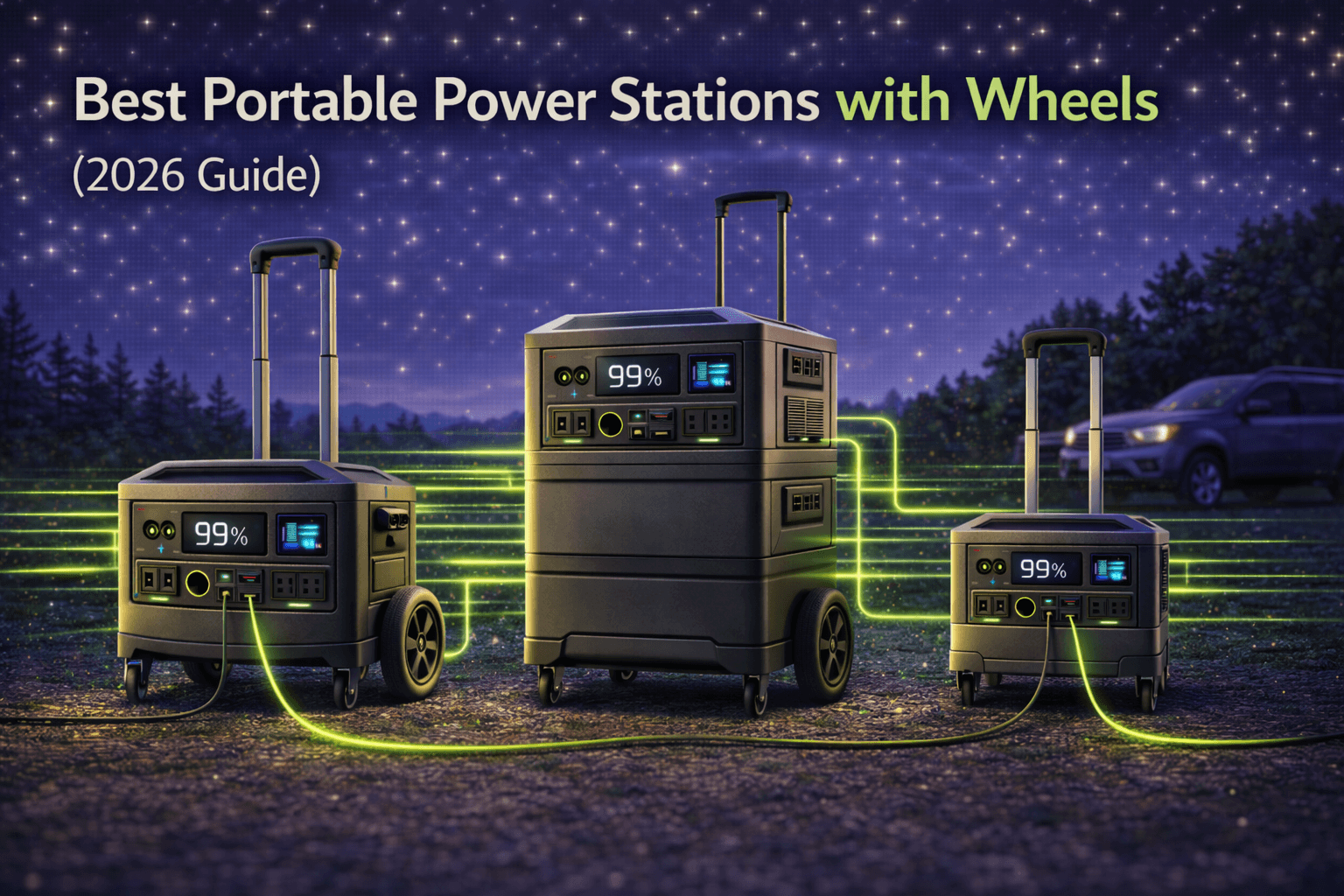
The Delta Pro is one of the few power stations that genuinely needs its wheels, and EcoFlow delivered. At 99 lbs with 3600Wh of capacity, this unit would be effectively immobile without them. The built-in wheels and telescoping suitcase-style handle make solo transport possible — not effortless at that weight, but possible.
| Spec | Detail |
|---|---|
| Capacity | 3600Wh |
| Output | 3600W (7200W surge) |
| Weight | 99 lbs |
| Wheels | Built-in, rear-mounted |
| Handle | Telescoping suitcase-style |
| Battery | LiFePO4, 3,500 cycles to 80% |
| Solar Input | Up to 1600W |
| Expandable | Up to 25kWh with Smart Extra Batteries |
| Warranty | 5 years |
| Price | ~$2,399–$3,299 (varies by retailer/sales) |
The wheels handle pavement and hard surfaces well. On grass and packed dirt, they work but require noticeably more effort — the wheels are solid plastic, not pneumatic, so they’re functional rather than premium. Loose gravel and sand are marginal. For genuinely rough terrain, an aftermarket heavy-duty cart with larger pneumatic wheels is worth considering as a supplement.
The telescoping handle extends to a comfortable pulling height for most adults. The unit tilts back on its rear wheels like rolling luggage. It’s not elegant — you’re pulling 99 pounds — but it beats carrying it by a mile.
Where this setup shines: RV users who need to roll the unit from a storage compartment to a solar-optimized position, then back again. Home backup installations where the unit lives in a garage but needs occasional repositioning. Off-grid setups where you’re moving between a shed and the cabin seasonally.
The 3600Wh capacity with expansion up to 25kWh makes the wheel investment worthwhile — you’re going to have this unit for years and you’ll be moving it regularly. Without wheels at this weight, it’s a permanent fixture wherever you first set it down.
What’s great:
- Built-in wheels — no aftermarket cart needed
- Telescoping handle at comfortable height
- 3600Wh justifies the weight and wheel system
- Expandable ecosystem (Smart Home Panel, extra batteries)
- 5-year warranty
What’s not:
- 99 lbs is still heavy even with wheels — slopes and stairs require help
- Wheels are hard plastic, not pneumatic — struggle on soft/loose terrain
- Expensive ($2,399+ depending on configuration)
- Overkill for anyone who doesn’t need 3600Wh
2. Jackery Explorer 2000 Plus — Best Mid-Range with Built-In Wheels
The 2000 Plus is one of the more popular units in this weight class, and Jackery included built-in rear wheels and a telescoping handle. At 61.5 lbs with 2042Wh, it sits right in the sweet spot where wheels make a material difference — heavy enough that carrying any distance is genuinely unpleasant, but light enough that wheels make it manageable solo.
| Spec | Detail |
|---|---|
| Capacity | 2042Wh |
| Output | 3000W (6000W surge) |
| Weight | 61.5 lbs |
| Wheels | Built-in, rear-mounted |
| Handle | Telescoping |
| Battery | LiFePO4, 4,000 cycles to 70% |
| Solar Input | Up to 1400W |
| Expandable | Up to 24kWh with battery packs |
| Warranty | 5 years (3 + 2 extended on Jackery website) |
| Price | ~$1,999 |
Outdoor Gear Lab’s testing noted something important: the handle and wheels on the 2000 Plus are “made almost entirely out of plastic and are not ideal for use on uneven and sloped terrain.” They’re functional for smooth surfaces — paved RV park roads, driveways, garage floors, sidewalks — but don’t expect them to perform like the wheels on a quality hand truck. Grass and packed dirt work with extra effort. Rocky or rooted terrain? You’re better off carrying.
That said, for the applications most people buy this unit for — camping at established campgrounds, RV use, tailgating, and home emergency backup — the built-in wheels do the job. Rolling it from your vehicle to a paved campsite pad, across a parking lot for tailgating, or around your garage: perfectly adequate.
The 2042Wh capacity and 3000W output handle most demanding loads — refrigerators, power tools, air conditioners. The 4,000-cycle LiFePO4 battery means this is a 10+ year purchase. The expandability to 24kWh with additional battery packs gives it serious long-term versatility.
One note: if you’re comparing this to the newer Jackery Explorer 2000 v2, the v2 offers similar capacity (2042Wh) at a lower price and lighter weight (around 48 lbs), but it does not have built-in wheels. At 48 lbs, you may not need them — but that’s a personal call based on how often and how far you’ll be moving it.
What’s great:
- Built-in wheels and telescoping handle — no accessories needed
- 61.5 lbs is the sweet spot for wheel benefit
- Excellent 4,000-cycle LiFePO4 battery
- Expandable to 24kWh for serious off-grid or backup use
- 3000W output handles heavy appliances
What’s not:
- Plastic wheels and handle lack durability on rough terrain
- 61.5 lbs still requires effort despite wheels
- Pricier than the newer 2000 v2 (which is lighter but wheel-less)
- Handle height may not suit very tall users comfortably
Check Price on Jackery
Also on Amazon
3. EcoFlow Delta 2 Max — Compact Wheels for the 50-lb Class
The Delta 2 Max includes small built-in wheels, making it one of the more portable options in the 2000Wh range. At roughly 50 lbs with 2048Wh, it’s lighter than the Jackery 2000 Plus and includes wheels — though they’re smaller and less robust.
| Spec | Detail |
|---|---|
| Capacity | 2048Wh |
| Output | 2400W (3100W X-Boost) |
| Weight | ~50 lbs |
| Wheels | Built-in (smaller diameter) |
| Handle | Integrated |
| Battery | LiFePO4 |
| Solar Input | Up to 1000W |
| Expandable | Up to 6144Wh |
| Warranty | 5 years |
| Price | ~$1,699–$2,099 |
The wheels are designed for smooth surfaces — think of them as quality casters rather than outdoor transport wheels. They’re fine for rolling across a garage floor, through an RV, or across a paved surface. For campsite grass or gravel, they’ll struggle, and you may end up carrying anyway.
At 50 lbs, this unit is manageable to carry for shorter distances even without wheels. The wheels are a nice convenience feature for indoor repositioning and loading/unloading from vehicles, but they won’t transform your off-road transport experience the way larger wheels on the Delta Pro do.
The real advantage here is the balance of capacity (2048Wh), output (2400W, 3100W with X-Boost), and relative portability. At 50 lbs with wheels, it’s significantly easier to live with day-to-day than the 99-lb Delta Pro or the 61.5-lb Jackery 2000 Plus.
What’s great:
- Built-in wheels at a more manageable weight
- 2048Wh capacity with 2400W output
- X-Boost extends to 3100W for high-draw devices
- Expandable to 6144Wh
- Lighter than competitors with similar capacity
What’s not:
- Smaller wheels — limited off-surface utility
- 50 lbs still needs two hands
- Less terrain capability than Delta Pro’s wheel setup
Best Aftermarket Cart and Trolley Options
Not every heavy power station comes with built-in wheels, and sometimes the built-in wheels aren’t good enough for your terrain. Aftermarket carts fill the gap — and in many cases, they outperform built-in wheels because they have larger diameter, better-quality tires.
Bluetti Official Trolley Cart — Best Branded Option
Bluetti sells an official folding hand truck compatible with their AC200P, AC200MAX, AC300, B300, B230, and several other models. It’s a flat-platform design with small universal caster wheels and a 330-lb weight capacity.
| Detail | Spec |
|---|---|
| Compatible Models | AC200P, AC200MAX, AC300, B300, B230, EB70, EB240 |
| Weight Capacity | 330 lbs |
| Cart Weight | ~13.6 lbs |
| Folded Size | 26 × 16 × 3 inches |
| Wheels | Small universal casters (360° swivel) |
| Price | ~$69–$89 |
This is essentially a quality folding dolly with Bluetti branding. The 360° swivel casters work well on smooth indoor floors and pavement. They’ll roll the 60.6-lb AC200MAX across a garage or RV park road without issue.
The limitation: small caster wheels struggle with anything beyond smooth surfaces. Grass, gravel, and uneven terrain will be frustrating. If you primarily need to move your Bluetti around indoors or across paved surfaces, it’s a solid branded option with guaranteed fit. For outdoor terrain, consider a generic cart with larger wheels.
Bluetti also sells a newer upright folding trolley (compatible with AC200MAX, AC300, AC500) with 330-lb capacity, 360° front wheels, and a foot brake. Same general limitations — great on smooth surfaces, limited off-road.
Generic Folding Utility Carts — Best Budget Universal Option
For any power station without built-in wheels, a quality folding utility cart is often the best and most cost-effective solution. The Magna Cart Personal (or similar 150–300 lb capacity folding carts) works with virtually any unit.
Why generic carts often beat branded options:
They’re cheaper ($40–$80 vs. $70–$200 for branded), they work with any power station (not locked to one brand), and you can choose larger wheel sizes. A generic cart with 6–8 inch rubber wheels will outperform a branded cart with 3-inch casters on outdoor terrain every time.
Best practices for aftermarket carts:
- Measure your power station dimensions before buying — make sure it fits the platform
- Secure the unit with bungee cords or ratchet straps. This isn’t optional — an unsecured 60-lb box will slide off the first time you hit a bump
- Choose the largest wheel diameter that still folds compact enough for your storage
- Look for rubber or pneumatic wheels if you’ll be on grass, gravel, or dirt regularly
- Check weight capacity — your power station plus any accessories should be well within limits
A heavy-duty appliance hand truck ($100–$200) with 10+ inch pneumatic wheels is the ultimate aftermarket solution for the heaviest units. Overkill for occasional use, but if you’re a food truck operator, event vendor, or construction site user moving a heavy unit daily, the investment pays for itself fast.
Platform Dollies — Best for Semi-Permanent Setups
If your power station lives in one spot 90% of the time but needs occasional repositioning — like inside an RV, a garage, or a workshop — a low-profile platform dolly with locking casters is the smartest option. The unit sits on the dolly permanently, and you roll it around as needed without ever lifting it.
This works particularly well for RV and van life setups where the power station stays inside the vehicle but needs to slide out occasionally for ventilation or solar optimization. Locking casters prevent unwanted rolling during transit.
Terrain Reality Check
Let’s be honest about what wheels can and can’t do:
Smooth pavement, indoor floors, maintained RV park roads — any wheels work, even small casters. This is the baseline.
Hard-packed dirt, maintained campsite roads — 4+ inch wheels minimum. Smaller wheels catch constantly. Larger wheels roll through without issue.
Grass (mowed lawns, campsite grass) — 6+ inch wheels recommended. Smaller wheels dig in rather than roll. Rubber or pneumatic wheels handle it; hard plastic drags. Expect to use more effort than pavement, but it’s manageable.
Loose gravel — 8+ inch pneumatic wheels needed. Anything smaller buries itself. Even good wheels require more effort here. This is where cheap wheels become genuinely useless.
Sand (beach, loose sand) — only large pneumatic wheels (8+ inches) provide enough flotation. Most power station wheels, including built-in options, will fail here. Plan on carrying or using a specialized beach cart.
Rocky, rooted, uneven terrain (hiking trails, primitive campsites) — wheels are mostly useless. Roots catch, rocks tip, and uneven ground makes rolling harder than carrying. Accept that if you’re heading to primitive sites, you’re carrying your unit. For overlanding in truly rough terrain, weight matters more than wheel quality.
Slopes — gentle slopes (under 10°) are fine with wheels in both directions. Moderate slopes require caution on descent. Steep slopes are a tipping hazard — get help or carry.
The bottom line: wheels extend your practical portability from “wherever you first set it down” to “anywhere with a reasonably maintained surface.” They don’t turn a power station into a backpacking item, and they won’t help on primitive trails. Set expectations accordingly.
How to Choose: Built-In Wheels vs. Aftermarket Cart
Choose built-in wheels when:
- You want a grab-and-go setup with no extra gear
- Your transport is primarily on smooth to moderate surfaces
- You value convenience and integrated design
- The unit already has wheels (Delta Pro, Jackery 2000 Plus, Delta 2 Max)
Choose an aftermarket cart when:
- Your unit doesn’t have built-in wheels (Bluetti AC200MAX, AC200L, most sub-40 lb units)
- The built-in wheels are too small for your terrain
- You need larger pneumatic wheels for grass, gravel, or rough terrain
- You want a universal solution that works across multiple units
- You’re on a budget ($40–$80 for a quality generic cart)
Consider a platform dolly when:
- The unit stays in one location 90% of the time
- You need occasional repositioning within an enclosed space (RV, garage, shed)
- You want a permanent low-profile solution with locking casters
For heavy professional use — food truck operations, daily event setup, construction sites — invest in a heavy-duty hand truck with 10+ inch pneumatic wheels. The $100–$200 cost is trivial compared to the time and back pain you’ll save.
Frequently Asked Questions
Do I really need a wheeled power station?
Depends entirely on weight and how often you move it. Under 25 lbs? No. Over 60 lbs? Absolutely. The 40–60 lb range is where it becomes a judgment call based on your transport distances, terrain, and physical ability. If you have back issues or regularly move your unit over 50+ yards, wheels pay for themselves immediately. Our buying guide can help you weigh these tradeoffs.
Can I add wheels to any power station?
Yes, via aftermarket carts. Any unit can be placed on a folding utility cart or platform dolly. The key is matching the cart’s platform dimensions to your unit and securing it properly (bungee cords or ratchet straps). Just make sure the cart’s weight capacity exceeds your unit’s weight with a comfortable margin.
Are built-in wheels better than aftermarket carts?
Not necessarily. Built-in wheels are more convenient (nothing extra to carry or set up), but aftermarket carts with large pneumatic wheels often handle rough terrain better than the small hard-plastic wheels built into most power stations. The Delta Pro’s built-in wheels, for example, work on pavement but struggle on grass — a cart with 8-inch pneumatic wheels would handle that grass easily.
What about the Bluetti AC200MAX — does it have wheels?
No. The AC200MAX (60.6 lbs) doesn’t have built-in wheels. Bluetti sells an official folding hand truck (~$69–$89) that’s compatible, or you can use any generic utility cart. At 60.6 lbs, this unit is firmly in the “wheels make a huge difference” category.
Will wheels damage my power station?
No, as long as the unit is properly secured during transport. The main risk is the unit sliding off an unsecured cart and dropping — which is a cart problem, not a wheel problem. Use straps, choose a cart with a non-slip platform, and avoid aggressive speed over bumps.
The Bottom Line
Wheels matter more than most buyers realize — until the first time they try to carry a 60-pound box across a campground. If you’re buying a heavy unit, prioritize models with built-in wheels (EcoFlow Delta Pro, Jackery Explorer 2000 Plus, EcoFlow Delta 2 Max) or budget for an aftermarket cart.
For maximum capacity with built-in wheels: The EcoFlow Delta Pro ($2,399+) transforms 99 lbs from immovable to manageable. Built-in wheels and telescoping handle are essential at this weight. Best for home backup and serious off-grid use.
For the best balance of capacity and wheeled portability: The Jackery Explorer 2000 Plus ($1,999) hits the sweet spot — 2042Wh in a 61.5-lb package with built-in wheels. Not the most robust wheels, but they get the job done on reasonable surfaces.
For the best aftermarket solution: Skip the branded carts and get a quality generic folding utility cart ($40–$80) with the largest rubber or pneumatic wheels that fit your storage. It’ll work with any power station you own — now and in the future.
For an overview of all our top picks regardless of wheel setup, check the complete buyer’s guide.