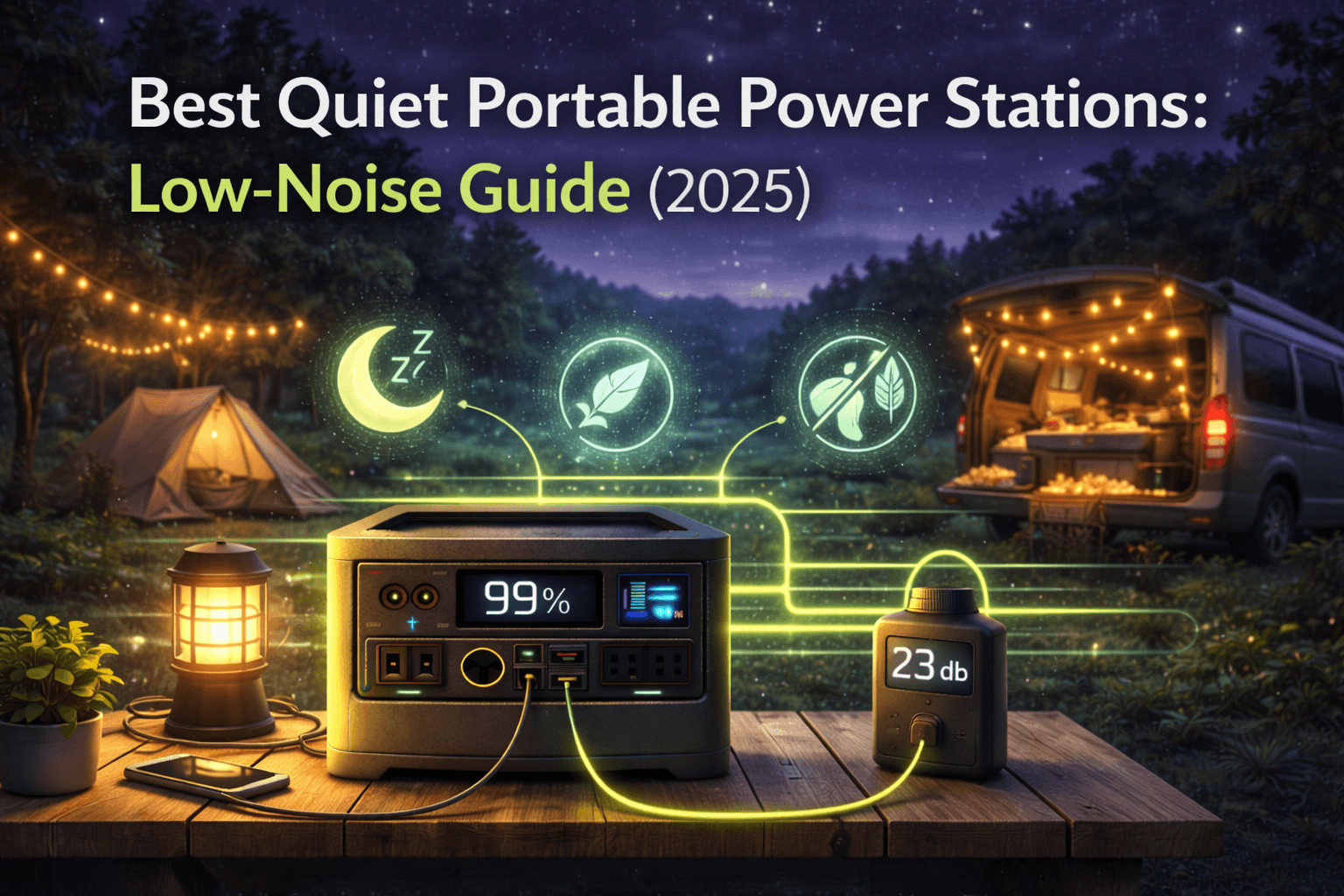
Noise is the spec nobody checks until they’re lying awake in a tent at 2 AM, listening to their power station’s fan whir like a tiny jet engine. Capacity and wattage dominate every comparison chart, but decibel output determines whether your portable power station actually fits your life — or ruins every quiet moment in it.
The gap between a quality unit and a budget unit isn’t subtle. A well-engineered power station running your CPAP at night registers somewhere around 25-30 dB — comparable to a whisper across the room. A cheap unit doing the same job hits 40-50 dB, roughly equivalent to someone having a conversation next to your pillow. That’s not a minor annoyance. That’s a dealbreaker for light sleepers, content creators, stealth campers, and anyone who bought a power station specifically to escape generator noise.
This guide breaks down how noise actually works in portable power stations, which models deliver genuinely quiet operation, and practical strategies to minimize noise regardless of which unit you own.
Note: This guide contains affiliate links. If you purchase through our links, we may earn a commission at no extra cost to you.
How Portable Power Station Noise Works
Three things create noise in a portable power station: cooling fans, electrical hum, and physical vibration.
Cooling fans account for the vast majority of audible noise. The inverter generates heat when converting DC battery power to AC output. More load means more heat, which means faster fan speeds. This is why every manufacturer’s “as low as X dB” spec is borderline misleading — that number represents the best-case scenario at minimal load, not what you’ll actually hear during normal use.
Electrical hum and coil whine come from the inverter’s switching frequencies. Premium units use higher-quality components that minimize or eliminate this. Budget units sometimes produce a noticeable 60/120 Hz hum that drives noise-sensitive users crazy, especially in quiet environments.
Physical vibration from internal components — the battery cells, transformers, and housing — creates subtle mechanical noise. Quality manufacturers use vibration-dampening mounts and acoustic insulation. Budget units bolt everything directly to bare metal housings, amplifying every rattle.
Understanding Decibel Ratings (And Why Manufacturer Specs Lie)
Sound is measured in decibels on a logarithmic scale. Every 10 dB increase sounds roughly twice as loud to your ears, and every 3 dB represents a doubling of actual sound energy. Here’s what the numbers feel like in practice:
0-20 dB — Silent to nearly imperceptible. Breathing, a quiet room at night. You won’t hear the power station unless you press your ear against it. This is where quality units operate at very low loads (under 100-150W).
20-30 dB — Whisper quiet. Rustling leaves, a library. Audible only if you’re actively listening in a very quiet room. Most quality units at typical light loads (100-300W) fall here.
30-40 dB — Quiet background noise. A refrigerator hum, a quiet office. Clearly present but not disruptive for most people. Quality units under moderate load (300-800W) and some budget units at minimal load operate in this range.
40-50 dB — Moderate, conversation-level. An air conditioner, normal speaking voice. Distracting in quiet environments. This is where budget units live even at low loads, and where quality units land under heavy loads near maximum output.
50+ dB — Loud and disruptive. Approaching vacuum cleaner territory. Some power stations during fast charging hit these levels. Avoid for any noise-sensitive application.
The marketing trick: When a manufacturer says “as low as 30 dB,” they mean 30 dB at near-zero load in a temperature-controlled lab. The second you plug in anything meaningful, fans kick in and that number climbs. Always look for noise measurements at relevant loads for your use case, not the headline minimum.
Distance matters enormously. Doubling your distance from the unit drops perceived noise by roughly 6 dB. A unit that measures 36 dB at 1 meter sounds like only 30 dB at 2 meters, and about 24 dB at 4 meters. Strategic placement is one of the most effective noise reduction tools you have.
Temperature makes a real difference too. The same unit running the same load will be noticeably louder on a 95°F summer day than a 65°F fall evening. Heat forces the cooling system to work harder, spinning fans faster. If noise matters to you, keep the unit shaded and well-ventilated.
What Makes Some Units Quieter Than Others
The engineering differences between a quiet power station and a loud one come down to four design choices.
Fan size and speed. A larger fan spinning slowly moves the same amount of air as a small fan spinning fast — but at significantly lower noise levels. Premium units invest in larger diameter fans (100-120mm) running at lower RPMs. Budget units cram in small 60mm fans that scream at high speeds to compensate for inadequate thermal design.
Intelligent fan control. Advanced battery management systems monitor internal temperatures in real time and adjust fan speed dynamically. At low loads, the fans stay off completely. As load increases, they ramp up gradually rather than kicking on at full blast. Cheaper units often run fans at a fixed speed whenever the inverter is active, regardless of actual thermal need.
Passive cooling design. Some smaller units (typically under 300Wh) use aluminum housings as heat sinks, eliminating fans entirely. The trade-off is limited capacity and output — you can’t passively cool a 1000Wh+ unit under heavy load. But for specific use cases like overnight CPAP or audio recording, fanless designs offer true zero-noise operation.
Component quality and acoustic insulation. Premium transformers and capacitors generate less electrical hum. Vibration-dampening mounts isolate moving parts from the housing. Some manufacturers line interior panels with acoustic foam. These details rarely appear on spec sheets, but they’re the difference between a unit that whispers and one that buzzes.
Best Quiet Portable Power Stations
1. EcoFlow Delta 2 — Best Overall for Noise-Sensitive Users
Price: ~$799-999 (frequently discounted)
The EcoFlow Delta 2 is one of the most capable power stations in the 1000Wh class, and it runs remarkably quiet at typical loads — though it’s not perfect. EcoFlow doesn’t publish an official dB rating for the Delta 2 (only the Delta 2 Max gets the “30 dB” marketing claim), but real-world testing by multiple reviewers confirms near-silent operation under light loads.
The fans stay completely off below roughly 100-120W of output. That means overnight CPAP use (typically 40-70W), device charging, LED lighting, and similar low-draw applications run in effective silence. Once you push past 120W, the fans engage — and this is actually the Delta 2’s most-criticized feature. PCWorld’s review noted fan noise as the unit’s biggest weakness, describing the fans as “shrill” under heavy loads and measuring approximately 54 dB at high output and 58 dB during maximum-speed charging.
The good news: most noise-critical applications don’t require heavy loads. Running a CPAP, charging phones, or powering a small fan totals well under the fan engagement threshold. And EcoFlow’s app lets you throttle charging speed, dramatically reducing noise during recharge. Dropping from the maximum 1200W charging rate to 400-600W cuts fan noise substantially.
| Spec | Value |
|---|---|
| Capacity | 1,024Wh (expandable to 3,040Wh) |
| AC Output | 1,800W (2,700W surge) |
| Battery | LiFePO4, 3,000+ cycles |
| Weight | 27 lbs |
| Charge Time | 0-80% in 50 min (AC) |
| App Control | Yes (WiFi + Bluetooth) |
Where it excels for noise: CPAP overnight (completely silent at 40-70W draw), device charging in a tent, bedroom backup powering a router and phone chargers, any application under ~120W. The app gives you real power management flexibility, including the ability to reduce charging noise.
The honest trade-off: Push it hard (800W+) and you’ll hear it clearly. The fast charging feature — which is otherwise a massive advantage — generates significant fan noise. If you’re running high-wattage appliances, the Delta 2 is no quieter than most competitors.
For a deeper look at EcoFlow’s lineup, see our Best EcoFlow Portable Power Stations guide.
2. Jackery Explorer 1000 Plus — Best Quiet + Capacity Balance
Price: ~$799-899 (MSRP, frequently on sale)
The Jackery Explorer 1000 Plus features a dedicated “Silent Charging Mode” accessible through the Jackery app, which caps noise at ≤30 dB. That’s a manufacturer-verified spec, not a vague “as low as” claim. Outside of this mode, normal operation stays quiet enough for most applications, though exact dB measurements at various loads aren’t published.
What makes the 1000 Plus compelling for noise-conscious buyers is the combination of low noise with a larger 1,264Wh capacity and 2,000W output — 23% more capacity and higher output than the Delta 2. Jackery’s reputation for reliability also matters here: consistent thermal management means consistent acoustic performance over years of use, rather than fans degrading into rattling nuisances.
| Spec | Value |
|---|---|
| Capacity | 1,264Wh (expandable to 5,056Wh) |
| AC Output | 2,000W (4,000W surge) |
| Battery | LiFePO4, 4,000 cycles |
| Weight | ~31.5 lbs |
| Charge Time | ~100 min (wall outlet) |
| App Control | Yes (WiFi + Bluetooth) |
| Silent Mode | ≤30 dB (app-controlled) |
Where it excels for noise: The Silent Charging Mode is a genuine differentiator — you can recharge overnight without waking anyone. The expandable capacity (up to 5kWh with battery packs) means you can scale up power without scaling up noise, since extra capacity comes from passive battery packs, not a louder base unit.
The honest trade-off: It’s heavier at ~31.5 lbs versus the Delta 2’s 27 lbs. And while the Silent Charging Mode is great, it extends charge times. If you need both quiet and fast recharging simultaneously, you’ll have to compromise on one.
Check Price on Jackery
Also on Amazon
Check out our full Jackery lineup comparison for more options.
3. Goal Zero Yeti 500 — Best Compact Quiet Option
Price: ~$400-500
Goal Zero redesigned their Yeti 500 line with a LiFePO4 battery, IPX4 water resistance, and a dual-speed charging system — including a “Low Speed Mode” specifically designed for quieter, cooler operation. The newer Yeti 500 (replacing the Yeti 500X) ships in Low Speed Mode by default, which tells you Goal Zero prioritizes quiet out of the box.
At 505Wh and 500W output, this is a different class of unit than the Delta 2 or 1000 Plus. It won’t run heavy appliances. But for dedicated quiet applications — overnight CPAP backup, tent camping with lights and device charging, content creation setups, stealth van life — the compact form factor and low-noise design make it an excellent focused tool.
| Spec | Value |
|---|---|
| Capacity | 499Wh |
| AC Output | 500W (1,000W surge) |
| Battery | LiFePO4, 4,000+ cycles |
| Weight | ~12.8 lbs |
| Charge Time | ~90 min (High Speed) |
| Water Resistance | IPX4 |
Where it excels for noise: The small form factor generates less heat, requiring less aggressive cooling. Low Speed Mode keeps things whisper-quiet. At 12.8 lbs, you can easily position it 10-15 feet away from your sleeping area — at that distance, even moderate fan noise becomes imperceptible. Goal Zero’s outdoor heritage (REI partnership, adventure-focused design) means this unit was designed specifically for environments where noise matters.
The honest trade-off: Limited capacity and output. This won’t power a portable fridge and your camping setup simultaneously for an entire weekend. It’s a minimalist’s quiet power solution, not an all-in-one camp station. The premium per-watt-hour pricing reflects the Goal Zero brand tax.
For more compact options, browse our Best Mini Portable Power Stations Under 300Wh guide.
Noise-Critical Applications: What You Actually Need
Overnight CPAP Use
This is the most common noise-sensitive application, and the stakes are high — you need uninterrupted, quiet power for 6-8 hours of sleep. Most CPAP machines draw 30-70W depending on pressure settings and humidifier use.
At those wattages, any quality power station (EcoFlow Delta 2, Jackery 1000 Plus, or Goal Zero Yeti 500) will operate with fans off or at minimal speed. The key is avoiding units with aggressive fan thresholds — some budget models kick fans on the moment the inverter activates regardless of load.
Practical tip: use your CPAP’s DC adapter if available. Drawing DC power directly from the station bypasses the inverter entirely, eliminating both inverter noise and efficiency losses. Many CPAP manufacturers sell 12V/24V DC cables specifically for portable power use. We cover this in detail in our CPAP power station guide.
Audio and Video Recording
Microphones pick up everything. A fan running at 30 dB across the room will show up as a persistent hum in your audio track, requiring post-production noise reduction that degrades overall quality.
For recording, you need either a fanless unit (if your power needs are under 200-300W) or enough distance between the power station and your microphone to drop perceived noise below the noise floor. A quality unit at 15+ feet running light loads is usually sufficient. For our full breakdown, see the photographer’s guide.
Stealth Camping and Van Life
Urban stealth camping demands genuine silence. A whirring fan at 2 AM in a Walmart parking lot draws exactly the kind of attention you’re trying to avoid. Here, the goal is keeping total power draw under the fan engagement threshold — typically 100-150W for quality units. LED lighting, phone charging, and a small fan easily fit within that envelope.
For van life considerations, our van life guide covers the full picture.
Home Backup During Outages
Overnight home backup typically runs a WiFi router (10-25W), phone chargers (10-15W each), a small fan (30-50W), and maybe a nightlight — totaling 60-120W. At those loads, quality units stay silent or near-silent. The primary noise concern is charging: if you’re cycling power during rolling blackouts, fast charging generates significant fan noise. Use the app (EcoFlow or Jackery) to throttle charge speed during nighttime hours.
For emergency scenarios, see our home backup guide and emergency preparedness guide or seniors.
7 Strategies to Reduce Power Station Noise
1. Reduce Your Load
The single most effective noise reduction strategy. Noise scales directly with load — cutting your draw from 600W to 300W can drop noise by 8-12 dB, which your ears perceive as roughly half as loud. Turn off devices you don’t actively need. Stagger high-draw appliances instead of running everything simultaneously.
2. Maximize Distance
Every doubling of distance reduces perceived noise by ~6 dB. Moving the unit from your nightstand (3 feet from your head) to the hallway (12 feet away) transforms a noticeable hum into something barely perceptible. Use extension cords to position the unit as far as practical from sleeping or quiet areas.
3. Throttle Charging Speed
Both EcoFlow and Jackery apps let you reduce charging wattage. The Delta 2 at 400W charging input is dramatically quieter than at its full 1,200W rate. The Jackery 1000 Plus Silent Charging Mode specifically addresses this. If you’re charging overnight, speed doesn’t matter — take the quieter, slower option. For more tips on optimizing charging, check our maintenance guide.
4. Keep It Cool
Shade the unit from direct sun. Ensure ventilation openings have clearance. Operate during cooler hours when possible. Lower ambient temperature means less thermal stress, which means slower fan speeds. The difference between a unit in direct sun at 95°F and one in shade at 80°F can be 5-8 dB. For seasonal tips, our winter guide covers cold-weather performance.
5. Use a Partial Sound Barrier
Draping a towel or blanket over the unit — with ventilation openings fully exposed — absorbs some noise directionally. This is not about enclosing the unit (which causes overheating and is dangerous). It’s about placing soft, absorbent material between the unit and your quiet zone. A sleeping bag draped over the top and sides (vents clear) can reduce perceived noise by 3-5 dB.
6. Maintain Your Unit
Dust accumulation in vents forces fans to work harder. Over months of camping use, grit and debris build up inside cooling pathways. Periodically blow out vents with compressed air and wipe down exterior surfaces. A well-maintained unit runs quieter than a neglected one. Our full maintenance guide covers the complete care routine.
7. Elevate the Unit
Placing the power station on a soft, elevated surface (foam pad, folded blanket on a camp table) reduces vibration transfer. Hard surfaces — especially metal or thin tables — amplify mechanical vibrations. Even a folded towel underneath makes a noticeable difference for units prone to low-frequency resonance.
How Quiet for Sleep? A Practical Reference
Everyone’s noise sensitivity differs, but here’s a practical framework:
Heavy sleepers generally tolerate 30-40 dB without issues. Most quality units at typical overnight loads (CPAP + device charging, under 100-150W) fall well below this threshold. Virtually any name-brand power station works fine.
Average sleepers do best under 30 dB. Quality units at low loads achieve this easily. Position the unit 6-10 feet from the bed, or use DC output to avoid inverter activation entirely.
Light sleepers need 20-25 dB or less. This requires either a quality unit at very low loads with fans off, or sufficient distance to drop perceived noise. A unit in the hallway or adjacent room drops even moderate noise to imperceptible levels.
Extremely sensitive individuals should prioritize fanless designs (small capacity units) or ensure their use case stays below the fan engagement threshold. If that’s not possible, placing the unit in another room with an extension cord is the most reliable solution.
The habituation factor is real — most people adjust to consistent low-level noise within 2-3 nights. A steady 25 dB hum becomes background quickly. It’s irregular noise (fans cycling on and off, changing speeds) that disrupts sleep more than constant low-level sound.
Frequently Asked Questions
Are portable power stations quieter than generators?
Dramatically. Even a “quiet” inverter generator like the Honda EU2200i runs at 48-57 dB — clearly audible from 50+ feet away. A quality portable power station at typical loads runs at 20-30 dB, and at low loads produces zero audible noise. It’s not a close comparison. For the full breakdown, see our power stations vs generators guide.
Do portable power stations make noise when not in use?
No. When powered off or in standby, portable power stations are completely silent — no fans, no hum, nothing. Noise only occurs during active use (especially under load) or during charging.
Can I use a portable power station for audio recording?
Yes, with the right setup. At low loads (under 100-150W), quality units either have fans off completely or running at barely perceptible levels. Position the unit 10-15 feet from your microphone for professional-quality clean audio. For higher power needs, a long extension cord from another room eliminates any acoustic concern.
Does battery chemistry affect noise?
Indirectly. LiFePO4 batteries generate slightly less heat during discharge than NMC lithium-ion, potentially reducing cooling requirements. But the real noise determinant is cooling system design, not battery chemistry. A well-engineered NMC unit can be quieter than a poorly designed LiFePO4 unit. That said, LiFePO4 is the superior choice overall for longevity and safety.
How do I calculate runtime for quiet operation?
Use our runtime calculator. The key for quiet use: keep total draw under the fan engagement threshold (typically 100-150W for quality units). For example, the EcoFlow Delta 2 at 100W gives you roughly 8-9 hours of completely silent operation on a full charge. Enough for a full night of CPAP plus device charging. For help sizing your capacity needs, our capacity guide breaks down the math.
Final Verdict: Which Quiet Power Station Should You Buy?
For most noise-sensitive users: The EcoFlow Delta 2 (~$799-999) delivers the best combination of silent low-load operation, solid 1,024Wh capacity, fast charging flexibility, and comprehensive app control. It’s genuinely silent for CPAP, camping, and backup use under 120W — which covers the majority of noise-critical scenarios.
For maximum quiet capacity: The Jackery Explorer 1000 Plus (~$799-899) pairs a dedicated Silent Charging Mode with 1,264Wh of LiFePO4 capacity and expandability to 5kWh. If you need both quiet operation and the flexibility to scale up for home backup or extended off-grid living, this is the pick.
For ultraportable quiet power: The Goal Zero Yeti 500 (~$400-500) is the noise-conscious minimalist’s choice. At under 13 lbs with built-in Low Speed Mode and IPX4 water resistance, it’s purpose-built for quiet camping and basic backup needs.
No matter which unit you choose, remember: the quietest power station is the one running below its fan threshold. Match your actual power needs to your capacity, keep loads reasonable, and use the distance and placement strategies above. Silent operation isn’t just about buying the right unit — it’s about using it intelligently.
For a broader comparison of top models across all categories, check our complete buyer’s guide.